UX Audit
UX Audit Cost in 2026: Freelancer vs AI Tool vs Agency vs Specialist — Which Actually Delivers ROI?
By

Abhinav Sharma


TL;DR — Which UX Audit Option Should You Pick?
SaaS UX audits cost between $999 and $25,000+ in 2026, depending on whether you hire a freelancer, use an AI tool, go with a full-service agency, or work with a specialist studio.
AI audit tools like Baymard's UX-Ray now scan 209 UX parameters at 95% accuracy. They handle ecommerce well, with partial SaaS support rolling out later in 2026. Strong for detection, but they cannot replace human judgment on business context or revenue prioritization.
The biggest hidden cost is not the audit itself. It is the "shelfware problem." Most audit reports never get fully implemented. Look for providers who deliver prioritized, dev-ready action plans.
Mad Brains Technologies' UX audit for Barbeque Nation identified 3 critical friction points and delivered results: bounce rate dropped from 45% to 31.4%, retention nearly doubled (19% to 34%), and mobile experience scores jumped from 2.9 to 4.8.
Match your audit to your SaaS stage: pre-seed teams should start with AI tools ($9–30/mo), while Series A+ companies get the highest ROI from specialist studios ($999–$3,999).
A $2,500 UX audit paid for itself in under two weeks for an apparel store last year. They fixed four checkout friction points and watched conversions climb.
Meanwhile, a SaaS founder I spoke with last month spent $18,000 on an agency audit and got back a 94-page PDF that is still sitting in a shared drive. Unopened.
That is the UX audit cost problem in 2026. It is not about finding the cheapest option. It is about finding the one that actually moves your numbers.
The UX services market is projected to hit $8.8 billion this year, growing at 31.2% annually (per Fortune Business Insights). And Deloitte's 2026 "State of AI in the Enterprise" report found that 85% of companies now expect to customize AI agents for their business workflows, with technology budgets nearly doubling from 8% to 14% of revenue in a single year. Demand is not the issue. Knowing where to put your money is.
I have led 50+ UX audits at Mad Brains Technologies. For brands like Barbeque Nation, Tanishq (Tata Group), and JustWravel. Here is the honest breakdown. No fluff. Just the numbers and the trade-offs a SaaS CMO actually needs.
How Much Does a UX Audit Actually Cost in 2026?
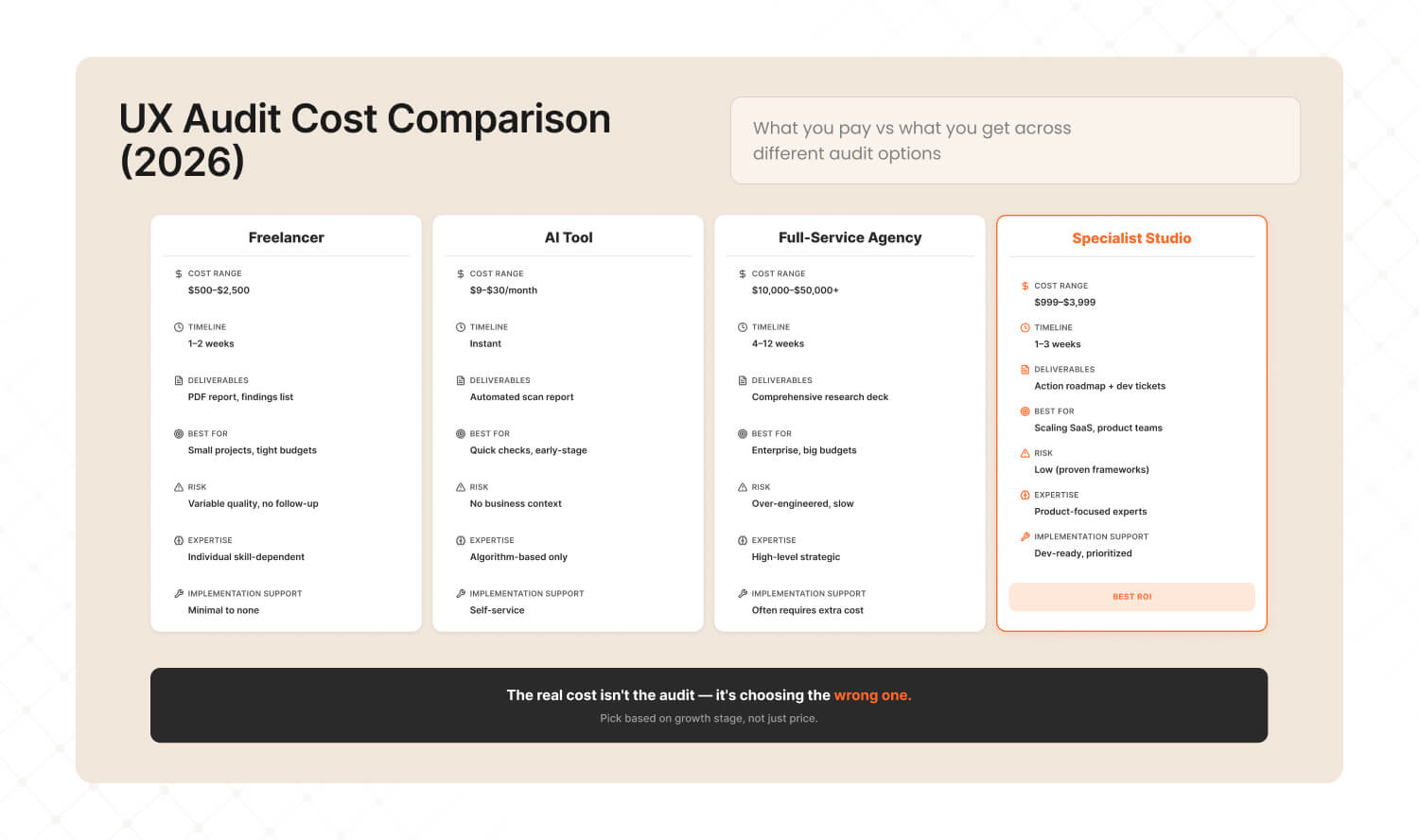
A UX audit costs between $999 and $25,000+ in 2026, depending on provider type. Freelancers charge $1,000–$8,000. AI tools run $9–$30 per month. Full-service agencies range from $8,000–$25,000+. Specialist studios like Mad Brains Technologies offer fixed-tier pricing from $999 to $3,999 with timelines of 3–21 days.
Here is the comparison most CMOs actually need. Not just pricing, but what you are trading off at each level:
Freelancer | AI Tool | Full-Service Agency | Specialist Studio | |
Cost Range | $1,000–$8,000 | $9–$30/mo | $8,000–$25,000+ | $999–$3,999 |
Timeline | 1–4 weeks | Minutes | 4–6 weeks | 3–21 days |
Deliverable | PDF report (varies wildly) | Automated issue list | 60–100 page report + presentation | Prioritized action plan + roadmap |
Best For | Tightly scoped, early-stage | Continuous monitoring, pre-launch | Enterprise ($10M+ ARR), compliance | Growth-stage SaaS ($500K–$10M ARR) |
Biggest Risk | Variable quality, no methodology | Cannot understand business context | Slow, expensive, shelfware | Smaller team, not for 50+ screen apps |
SaaS Expertise | Depends on individual | Generic (partial SaaS support) | Varies by agency | Deep (if right studio) |
Implementation | Rarely included | Never | Sometimes (extra cost) | Often included |
That table is your starting point. But the real decision comes down to understanding what each option actually gives you, and what it does not.
What Do You Get From a Freelance UX Auditor?
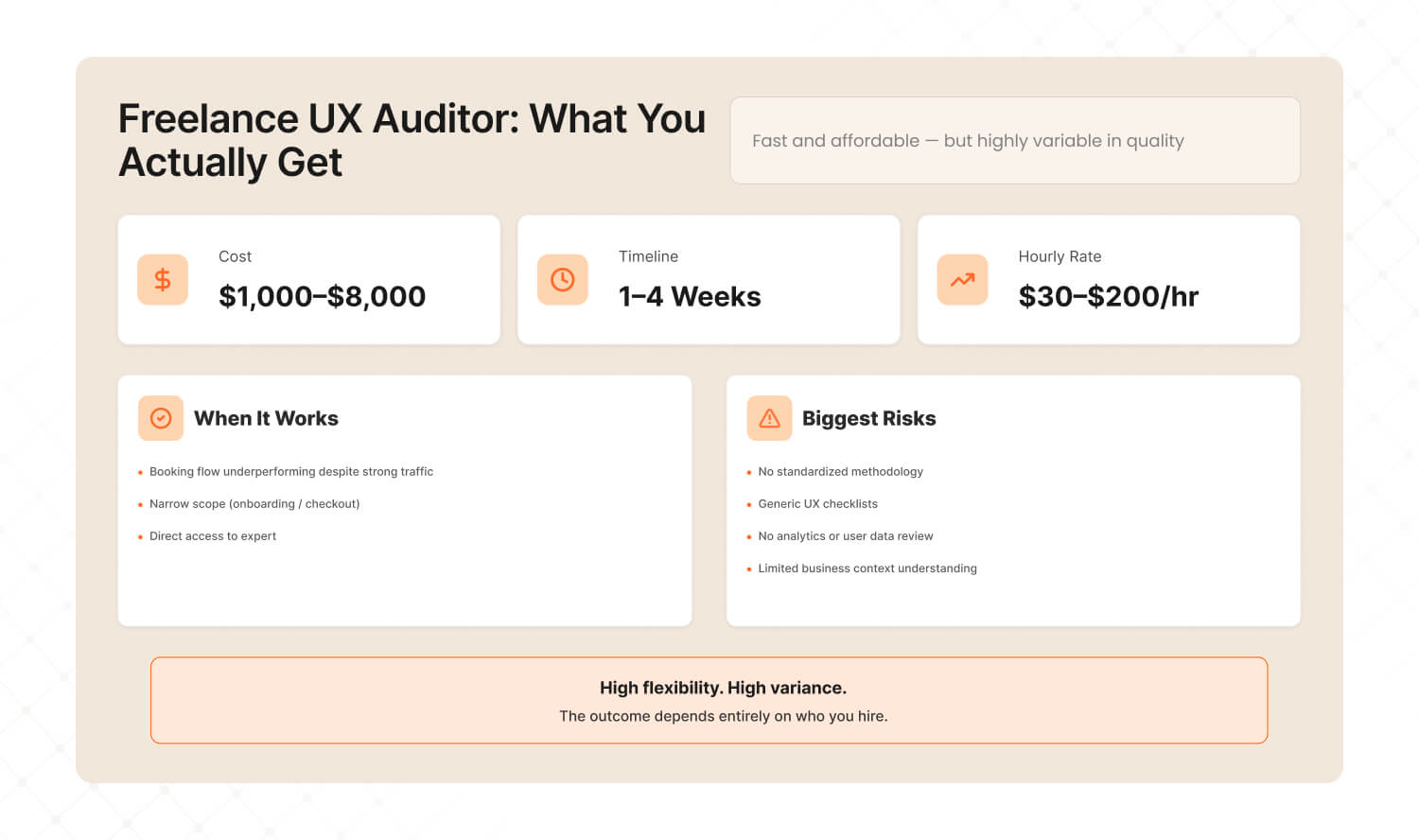
A freelance UX auditor typically charges $30–$200 per hour, with total project costs between $1,000 and $8,000 for a SaaS product audit. Turnaround is 1–4 weeks. Quality depends entirely on the individual. There is no standardized methodology, making this the highest-variance option available.
The upside? Direct access. No account managers, no layers. You are talking to the person doing the work. For a tightly scoped task (say, "audit our onboarding flow" or "review the checkout UX"), a good freelancer can be fast and affordable.
The downside is real, though.
I have seen SaaS teams hire freelancers who deliver a generic heuristic checklist that could apply to literally any product. No analytics review. No session recording analysis. Zero understanding of the business model or user personas.
When a freelancer is the RIGHT call:
You are pre-seed or early-stage. Your product has 5–10 screens. You have a narrow, well-defined scope. And you have vetted the freelancer's portfolio specifically for SaaS work, not just "UX design" generalists.
When to skip it:
Your SaaS has multiple user roles, complex permissions, or interconnected feature flows. You need someone who understands how pricing pages, onboarding sequences, and dashboard UX work together as a system, not isolated screens. A freelancer reviewing your settings page will not catch that your onboarding is causing churn three months later.
Can AI UX Audit Tools Replace a Human-Led Audit in 2026?
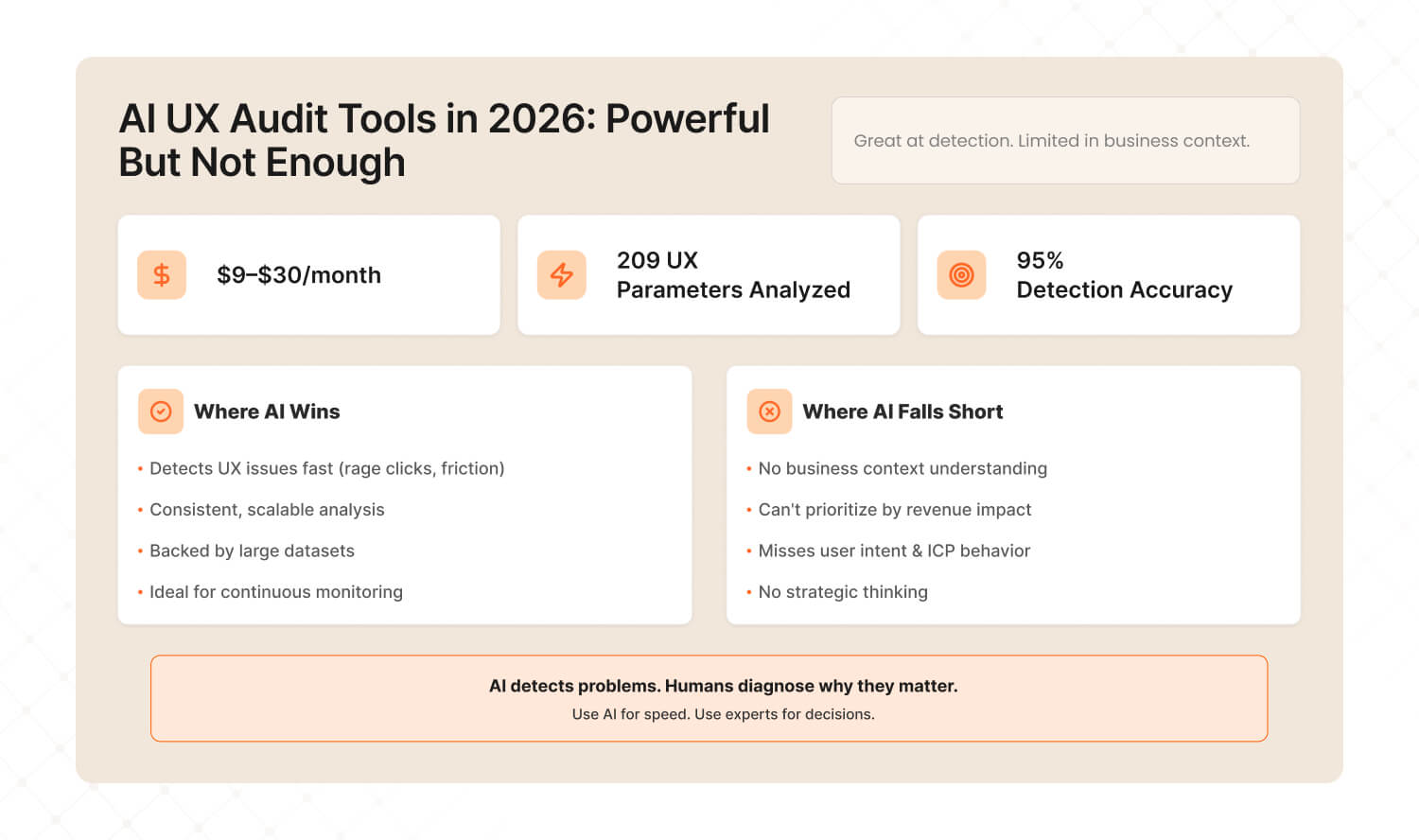
AI-powered UX audit tools cost between $9 and $30 per month in 2026 and have improved dramatically. Baymard Institute's UX-Ray now analyzes 209 distinct UX parameters with a documented 95% accuracy rate compared to human experts, up from just 39 parameters in October 2025. Tools like Krux ($13/month) and Flawless ($9 first month, then $29/month) offer subscription-based automated scanning.
I will be straight with you: these tools are genuinely good now. Not toys.
Baymard's UX-Ray cross-references your site against 15 years of checkout research from 4,500+ stores. That is a dataset no individual auditor can match. For detection (finding rage clicks, form friction, missing trust signals), AI tools are faster and more consistent than most humans.
Important caveat for SaaS teams: UX-Ray currently has full support for B2C and B2B ecommerce designs, with only partial support for SaaS. Full SaaS coverage is expected later in 2026. This means AI tools are not yet a complete solution for SaaS product audits.
But here is where they break down. Every single time.
AI tools can tell you your pricing page has poor visual hierarchy. They cannot tell you that your pricing page is losing enterprise deals because the "Contact Sales" CTA is buried below three self-serve tiers that confuse your ICP. That is a business context problem, not a UX parameter.
When AI tools are the RIGHT call:
Between human audits, for continuous monitoring. Quick pre-launch checks on new features. Running a design subscription and need fast iteration feedback.
When to skip them:
When conversion is your KPI and you need diagnosis, not detection. When your SaaS has nuanced user segments with different journeys. When you need someone to rank fixes by revenue impact, not severity score.
[CTA BANNER 1: "Sound familiar? Your product might have the same blind spots." Link: /ux-audit-services]
Also see: UX Audit Checklist to Improve Conversions in 2026 for a DIY starting point alongside these tools.
What Does a Full-Service Agency UX Audit Look Like?
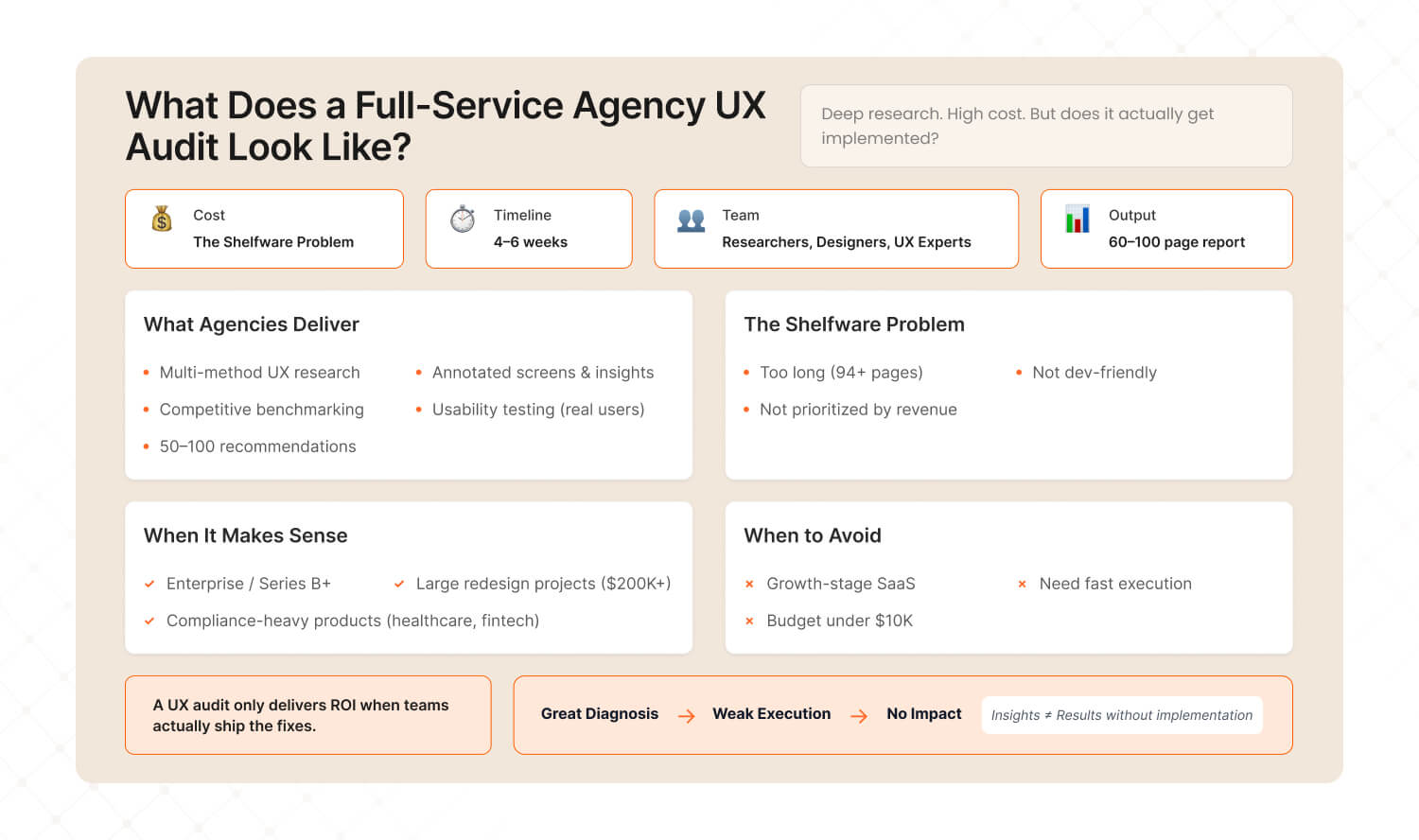
A full-service agency UX audit ranges from $8,000 to $25,000+ and typically takes 4–6 weeks. Enterprise or compliance-heavy products can push past $30,000–$75,000. You are paying for a team: researchers, designers, sometimes usability testing with recruited participants, and a thorough multi-method approach.
The output is usually impressive on paper. A 60–100 page report. Annotated screenshots. Competitive benchmarks. Maybe a 2-hour video walkthrough. Nielsen Norman Group's audits, for instance, stress-test every element against their proprietary 10 usability principles and deliver 50–100 prioritized recommendations.
Sounds great. And for the right company, it is.
But let me tell you what I have seen happen next. This is where the UX audit cost conversation gets uncomfortable.
The shelfware problem.
That beautiful 94-page report lands in the product team's inbox. The PM reads the executive summary. Skims half the recommendations. Then it sits. Because the findings were not written for developers. They were not ranked by revenue impact. They were not broken into sprint-ready tasks.
The agency diagnosed brilliantly. But they did not build the bridge between "here is what is wrong" and "here is what your dev team ships on Monday."
If you are weighing whether a CRO audit or a full UX audit is the right move for your team, we broke down the key differences in our CRO vs UX audit guide.
Forrester's research has consistently shown that companies investing in structured UX programs see significant revenue gains: up to 400% improvement in conversion rates and meaningful lifts in customer retention over multi-year periods. But that ROI only materializes when recommendations get implemented. Fast.
When a full-service agency is the RIGHT call:
You are Series B+ or enterprise ($10M+ ARR). You need usability testing with recruited participants: real users, recorded sessions, proper conditions. Your product is regulated (healthcare, fintech) where compliance audits are mandatory. Or you are doing a major platform overhaul and the audit feeds a $200K+ redesign.
When to skip it:
You are growth-stage SaaS where speed beats exhaustive documentation. You need fixes shipped this quarter, not a research report that takes a quarter to produce. Or your budget is under $10K and you would rather invest in focused, conversion-first analysis.
How Does a Specialist UX Studio Compare? (And What Does Mad Brains Charge?)
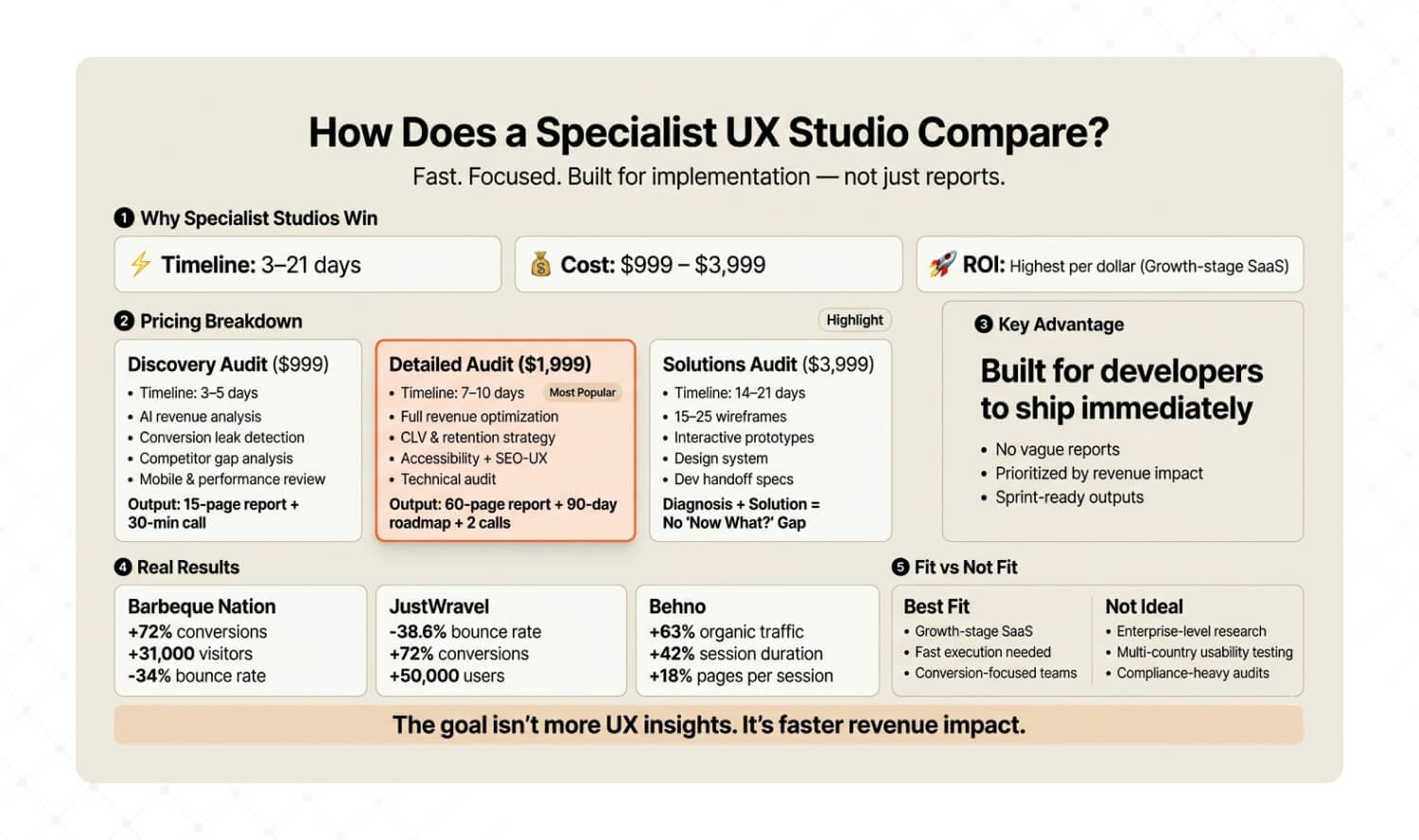
Based on Mad Brains Technologies' analysis of 50+ UX audits across SaaS, ecommerce, and enterprise clients, specialist studios deliver the highest ROI per dollar for growth-stage SaaS companies. Fixed-tier pricing ranges from $999 to $3,999 with timelines of 3–21 days and deliverables designed for immediate developer handoff.
Here is what we charge. Transparent. No discovery-call-required gatekeeping:
Discovery Audit — $999 (3–5 days)
AI-powered revenue analysis, conversion leak detection, competitor gaps, quick-win implementation plan, speed and performance check, mobile optimization review. You get a 15-page report + a 30-minute strategy call. Best if you need executive buy-in first or want to test the methodology before going deeper.
Detailed Audit — $1,999 (7–10 days)
Everything in Discovery, plus: complete revenue optimization analysis, advanced CLV enhancement, business growth UX strategy, market differentiation analysis, customer retention optimization, full technical audit, accessibility compliance, and SEO-UX integration. You get a 60-page report + a 90-day implementation roadmap + 2 strategy calls. This is the sweet spot for most growth-stage SaaS.
Solutions Audit — $3,999 (14–21 days)
Everything in Detailed, plus: 15–25 revenue-optimized wireframes, interactive business prototypes, a complete design system, mobile-responsive framework, developer handoff specs, A/B testing framework, and performance-optimized designs. Diagnosis AND the design solutions. Skip the "now what?" phase entirely.
I will not pretend we are the right fit for everyone. We are a focused studio, not a 200-person agency. If you need recruited usability testing with 15 participants across three countries, that is not us. If you need Baymard-level institutional research, go to Baymard.
But here is what the numbers say.
When we audited Barbeque Nation's booking flow, we found three critical friction points invisible to their internal team. Too many choices at the wrong decision moments. A reservation flow that was technically functional but psychologically overwhelming. After restructuring the journey and adding trust signals at key moments:
Bounce rate dropped from 45% to 31.4%. User retention nearly doubled (19% to 34%). Satisfaction scores jumped from 3.2 to 4.7. Mobile experience ratings went from 2.9 to 4.8. Page load time cut from 5 seconds to 1.8 seconds.
That is not a one-off. We see this pattern repeat constantly.
JustWravel, India's fastest-growing adventure travel platform, was getting traffic but losing visitors in under 8 seconds. Our audit found the homepage was drowning users in options. We restructured the information architecture and simplified the booking funnel. Result: 38.6% bounce rate reduction, 485% increase in clicks, 338% traffic increase, and 34% more leads.
With Behno New York, a luxury fashion brand on Shopify, our audit identified 20+ UX issues, leading to a 45% improvement in repeat purchases and a 38% reduction in size-related returns.
[CTA BANNER 2: "This is what we diagnosed for Barbeque Nation." Link: /contact-us]
What Is the Biggest Risk When Budgeting a UX Audit?
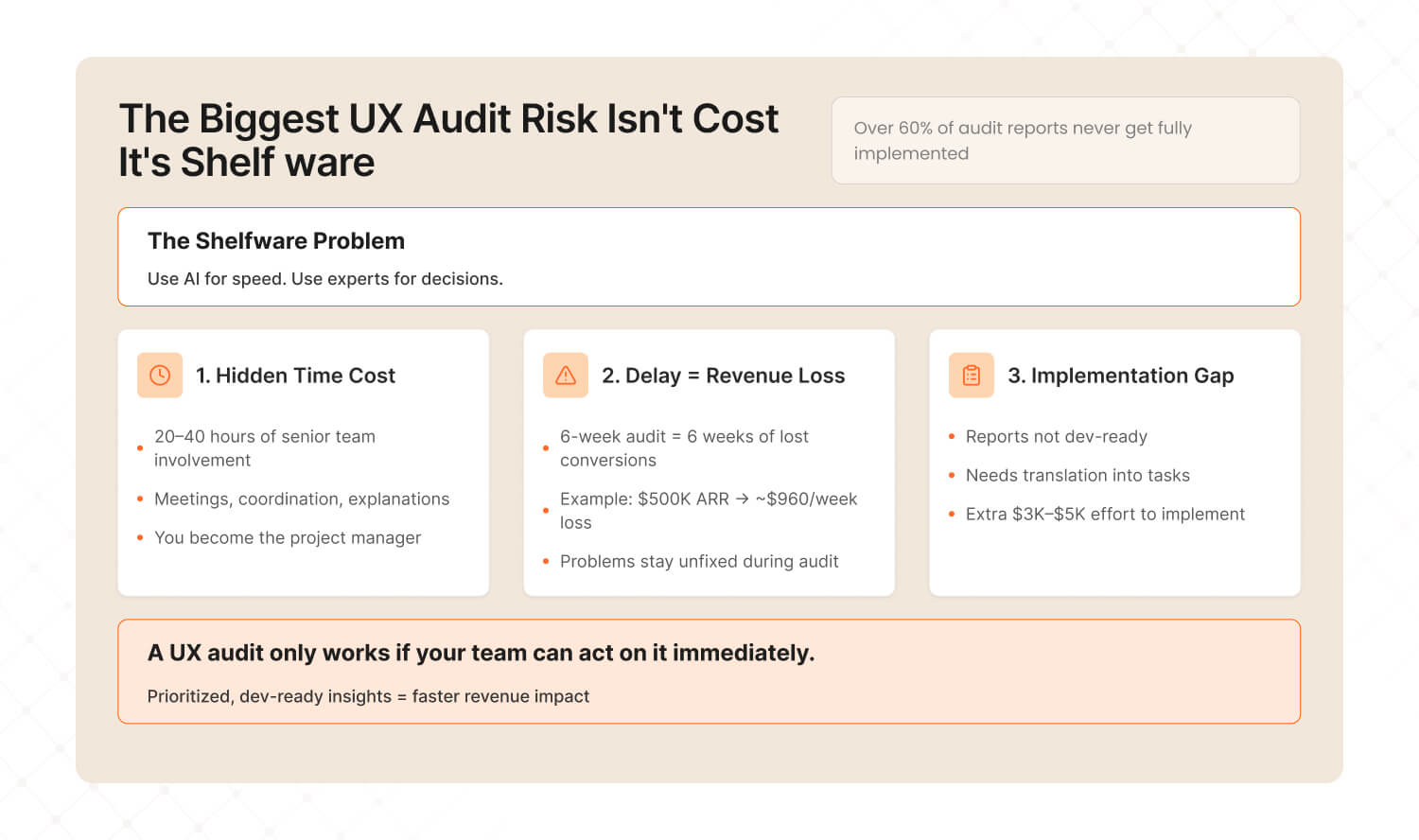
The biggest risk is not overpaying. It is paying for a report that never gets implemented. Industry practitioners call this the "shelfware problem," and based on conversations with SaaS teams who came to us after previous audit engagements stalled, Mad Brains Technologies estimates it affects over 60% of agency-led audits.
Three hidden costs most SaaS CMOs miss:
1. Internal management time. Briefing consultants, scheduling calls, answering questions, coordinating with dev to interpret recommendations. Budget 20–40 hours of senior staff time on top of the invoice. With freelancers, this overhead is worse: you are the project manager.
2. Opportunity cost of delay. A 6-week agency audit means 6 weeks of shipping with undiagnosed conversion problems. If your SaaS does $500K ARR and bad UX is costing you even 10% in lost conversions, that is roughly $960 per week bleeding out while you wait.
3. The implementation gap. Most reports are formatted for stakeholder presentations, not developers. Translating "improve visual hierarchy on the pricing page" into a Jira ticket with acceptance criteria takes additional time and often additional budget. We have watched teams spend another $3,000–$5,000 just translating an agency report into actionable dev tickets.
This is why specialist studios exist at this price point. When the deliverable is a prioritized action plan with severity ratings, estimated effort, and specific design recommendations, your team starts shipping fixes the day the report lands. No translation layer.
Which UX Audit Option Fits YOUR SaaS Stage?
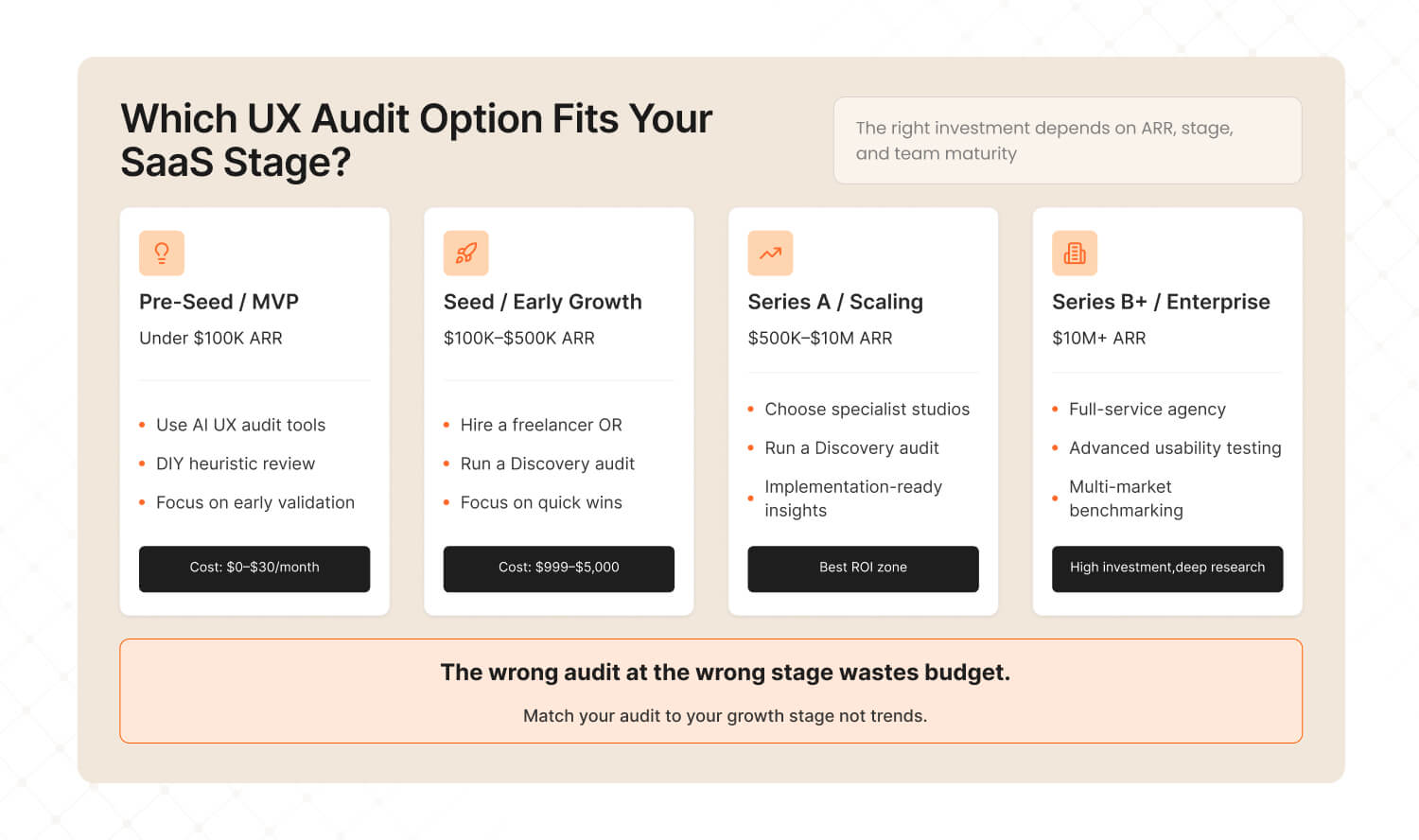
The right UX audit investment depends on company stage, ARR, and team maturity. Pre-seed startups should start with AI tools. Series A+ companies see the strongest ROI from specialist studios with conversion-focused methodology and proven case study metrics.
Here is the honest recommendation by stage. And yes, for some of these I am pointing you away from us. That is fine. Right fit matters more.
Pre-seed / MVP (under $100K ARR)
→ AI tools. Baymard UX-Ray for ecommerce, Krux or Flawless for general SaaS. Pair with a DIY heuristic review using NNGroup's 10 usability heuristics. Total: $0–$30/month. Save your audit budget for when you have enough traffic to measure results. For a self-guided starting point, try our UX audit checklist.
Seed / Early Growth ($100K–$500K ARR)
→ Freelancer OR specialist Discovery tier. A good freelancer at $2,000–$5,000 can deliver solid findings for a focused scope. Or start with a $999 Discovery audit to get quick wins and validate the approach.
Series A / Scaling ($500K–$10M ARR)
→ This is where specialist studios hit the ROI sweet spot. A $1,999–$3,999 audit that is conversion-focused and implementation-ready will outperform a $15,000 agency engagement that takes 3x longer. You need speed and specificity, not exhaustive documentation.
Series B+ / Enterprise ($10M+ ARR)
→ Full-service agency or Baymard Institute. At this scale you can afford recruited usability testing, multi-market analysis, and institutional benchmarking. Consider combining: a Baymard benchmark for research rigor + a specialist studio for rapid implementation.
Stop Guessing Where Your Conversions Are Leaking
Here is what it comes down to. The UX audit cost in 2026 ranges from $9/month to $25,000+. But the most expensive audit is the one you never act on.
We have watched SaaS products hemorrhage conversions for months while waiting for a "perfect" audit. Meanwhile, a focused 7-day engagement that identifies 5 high-impact fixes and gives your dev team a clear action plan pays for itself before the invoice is due.
Same methodology we used for Barbeque Nation's bounce rate and retention transformation. Same process behind JustWravel's 38.6% bounce rate reduction. Same team. Your product.
For a deeper self-diagnostic before booking a call, download The Conversion Leak Finder, our 30-minute self-audit playbook for SaaS and ecommerce teams.

Frequently Asked Questions
How much does a SaaS UX audit cost in 2026?
A SaaS UX audit costs between $999 and $25,000+ in 2026 depending on provider type and scope. Freelancers charge $1,000–$8,000. AI tools like Baymard UX-Ray and Krux run $9–$30/month. Full-service agencies charge $8,000–$25,000+. Specialist studios like Mad Brains Technologies offer fixed tiers from $999 to $3,999 with 3–21 day timelines.
What is the difference between a $999 and a $25,000 UX audit?
A $999 audit (like Mad Brains' Discovery tier) covers revenue analysis, conversion leak detection, and a quick-win implementation plan, delivered in 3–5 days. A $25,000 agency audit includes recruited usability testing, multi-device analysis, competitive benchmarking, and a 60–100 page report over 4–6 weeks. The higher price buys depth and research methodology, but does not guarantee better ROI. Mad Brains' $1,999 Detailed audit has delivered 30%+ bounce rate reductions and near-doubled retention metrics for clients like Barbeque Nation.
Can AI tools like Baymard UX-Ray or Krux replace a human UX audit?
Not fully, but they are closer than ever. Baymard's UX-Ray scans 209 UX parameters with 95% documented accuracy as of early 2026. These tools excel at detection (rage clicks, form friction, missing trust signals) but cannot interpret business context, user psychology, or prioritize fixes by revenue impact. Note: UX-Ray has full ecommerce support but only partial SaaS support as of early 2026. Best used as a complement between human-led audits, not a replacement.
How long does a UX audit take for a SaaS product?
Timeline varies by provider: AI tools deliver instant results, specialist studios take 3–21 days, freelancers need 1–4 weeks, and full-service agencies typically require 4–6 weeks. For growth-stage SaaS products, Mad Brains Technologies recommends the 7–10 day Detailed audit, the sweet spot between thoroughness and speed-to-implementation.
What ROI should a CMO expect from a UX audit?
Forrester's research shows that structured UX investments can yield conversion improvements of up to 400% and significant long-term revenue retention gains. Mad Brains Technologies' audit for Barbeque Nation cut bounce rate by 30%, nearly doubled user retention, and lifted mobile experience scores from 2.9 to 4.8. A separate audit for JustWravel reduced bounce rate by 38.6% while increasing clicks by 485%. ROI depends on implementation speed: the faster fixes ship, the faster revenue recovers.
Last updated:
Abhinav Sharma
Founder & CEO | Enterprise UX & Growth Strategy
Abhinav Sharma is the Co-Founder & CEO of Mad Brains, specializing in enterprise UX audits, conversion-focused product design, and high-impact experience systems. He helps SaaS, healthcare, and fintech companies reduce usability risk, increase conversions, and build scalable, user-centered platforms.