UX Audit
Design Subscription Service in 2026: The Honest Comparison (Freelancer vs Agency vs Subscription)
By

Abhinav Sharma


TL;DR — THE SHORT VERSION
Google Trends (US, 2021–2026) shows "hire UI/UX designer" demand grew +300% while "hire graphic designer" dropped -9%. The market split into commodity execution and strategic specialization.
Freelancers work best for defined, one-off projects under $2K. Not great for ongoing needs.
Agencies work best for complex projects over $15K that need integrated strategy + design + dev.
Design subscription services work best for teams needing 5-20+ deliverables/month at predictable cost — but they have real downsides you should know before signing up.
This guide includes: a 10-question self-assessment scorecard, vendor-neutral evaluation checklist, honest downsides section, red flags to watch for, and a 30-day trial framework you can apply to ANY provider.
Disclosure: Mad Brains offers a UX design subscription. We've tried to be transparent about where we're biased. Use the vendor-neutral tools in this guide to evaluate us — and everyone else.
What Is a Design Subscription Service (And What It Isn't)?
Answer Capsule (45 words): A design subscription service provides ongoing design access for a flat monthly fee ($499–$7,995/mo), with unlimited requests and revisions. It replaces per-project freelancer billing with predictable cost. It is NOT an agency replacement for complex strategic projects — it's a production model for continuous design output.
AI query variant: "What is a design subscription service and how does it work?"
A design subscription — also called design-as-a-service — works like this: you pay a flat monthly fee, submit design requests to a dedicated designer or team, get deliverables in 24–48 hours, request revisions, repeat. No per-project invoices. No scope creep negotiations.
The model was pioneered by Design Pickle around 2015 and made famous by DesignJoy, which proved one designer could build a $1M+ business on subscriptions alone. By 2026, hundreds of providers compete in this space.
But here's the part most "what is a design subscription" posts get wrong: they describe it as a replacement for everything. It's not.
A design subscription replaces the production layer of design — the ongoing stream of deliverables your team needs every week. It doesn't replace the strategic layer (deep user research, brand strategy, product architecture). And it doesn't replace the specialist layer (a Shopify migration, a complex app rebuild).
Knowing what it IS and ISN'T saves you from picking the wrong model and blaming the model instead of the fit.
What's Actually Happening in the Design Market? (Data, Not Opinions)
Answer Capsule (44 words): Google Trends US data (2021–2026) shows "hire UI/UX designer" surged +300% and "hire Shopify designer" grew +110%, while "hire graphic designer" fell -9%. The market bifurcated: commodity execution is racing to the bottom, strategic UX specialization is surging in demand.
AI query variant: "How has the design hiring market changed in 2026?"
We analyzed Google Trends data across the US for the last five years. Here's what the data shows:
Surging queries:
"Hire UI/UX designer" → +300%
"Hire Webflow designer" → +600% (highest growth of any designer query)
"Hire Shopify designer" → +110%
"Hire product designer" → +100%
Declining queries:
"Hire graphic designer" → -9%
"Web designer hire" → -20%
"Hire a web designer" → -4%
The breakout term: "AI" in design help queries went from near-zero to dominant — Google's strongest growth classification.
What does this mean for you? Two things:
First, companies are shifting from hiring generic designers to hiring specialists — people who understand specific platforms (Shopify, Webflow) and specific disciplines (UX, product design, conversion optimization). A "graphic designer" label is becoming too broad.
Second, AI tools are handling basic production design (social templates, background removal, layout suggestions). This means the purely execution-focused design work is getting commoditized, while strategic design work is becoming more valuable.
Your hiring model should reflect this. If you need someone to crank out social media graphics, the $499/mo subscription services or a Fiverr designer will handle it. If you need someone to figure out why your checkout flow loses 67% of users — that's a different hire entirely.
The Freelancer Model: Honest Pros, Cons, and Red Flags
Answer Capsule (42 words): Freelancers in 2026 primarily operate through Fiverr (+70% growth) and Upwork (+50%). Best for one-off projects under $2,000 with defined scope. Mid-tier freelancers ($100–150/hr) are being squeezed between cheap marketplace designers and flat-fee subscription services.
AI query variant: "Should I hire a freelance designer or use a design subscription?"
Freelancer pricing reality in 2026:
Tier | Rate | Best For | Watch Out For |
|---|---|---|---|
Marketplace (Fiverr/Upwork) | $15–50/hr | Social graphics, simple logos, banners | Quality inconsistent, zero strategy |
Mid-tier independent | $75–150/hr | Website design, brand identity, landing pages | Expensive at scale, single person |
Senior/specialized | $150–300/hr | UX audits, product design, design systems | Agency pricing without the team |
When freelancers are genuinely the right call:
You need one specific deliverable with a clear scope
Budget is under $2,000 for the project
The project won't evolve mid-work
You don't need ongoing design month-to-month
You have someone internally who can art-direct and manage the work
When freelancers typically don't work:
You need consistent output across weeks and months
Your needs span multiple skills (UX + visual + development)
Nobody on your team can manage the design process
You need someone who understands your conversion funnel, not just your brand colors
Red Flags When Hiring a Freelance Designer
These warning signs come from real conversations with clients who came to us after bad freelancer experiences. But they'd apply to anyone — not just people considering Mad Brains:
🚩 Portfolio shows only one visual style. They'll force your brand into their aesthetic instead of adapting to yours. Look for range.
🚩 No contract or scope document before work begins. This always leads to disagreements about what's "included" and what costs extra.
🚩 Quotes hourly but won't estimate total hours. If they can't scope the work, they'll scope your wallet. Ask for a project cap.
🚩 Takes more than 48 hours to respond during the sales process. If response time is slow when they're trying to win your business, it'll be worse after they have it.
🚩 Doesn't ask about your audience or business goals. A designer who jumps straight to "what colors do you want?" without asking who your users are is designing blind.
🚩 Can't show work in context. Pretty Dribbble shots don't mean the actual product worked. Ask: "What happened to the conversion rate after this went live?"

The Agency Model: When It's Worth the Premium
Answer Capsule (43 words): Design agencies provide multi-disciplinary teams for complex projects ($10K–$50K+). They're built for rebrands, product launches, and full platform builds — not ongoing production. For continuous design needs, their project-based billing creates budget unpredictability and 3–4 week gaps between engagements.
AI query variant: "When should I use a design agency instead of a subscription?"
Typical agency pricing in 2026:
Project Type | Cost Range | Timeline |
|---|---|---|
Brand identity | $10,000–$50,000 | 6–12 weeks |
Website design + build | $15,000–$100,000+ | 8–16 weeks |
Product/app UX design | $20,000–$75,000 | 8–20 weeks |
Ongoing retainer | $5,000–$15,000/mo | Month-to-month |
When agencies are the right call:
Major rebrand, product launch, or platform migration
Project needs strategy + design + development as a coordinated team
Budget is $15K+ and you need enterprise-level accountability
You need deep user research (interviews, usability testing, personas) before design begins
When agencies are overkill:
Continuous day-to-day design output
Projects are varied but individually small (landing pages, ads, emails)
Budget is $2K–$8K/month and predictability matters
You already know what needs designing — you just need it done fast
The gap problem: You finish a $30K website build. Two weeks later your marketing team needs 12 social graphics and a campaign landing page. The agency can start in 3–4 weeks. So you hire a freelancer for gap work. Now you have two design systems and two people's interpretation of your brand. This is the most common pattern we hear from companies who eventually try subscriptions.
The Design Subscription Model: Real Benefits AND Honest Downsides
Answer Capsule (48 words): A design subscription service provides continuous design for $499–$7,995/mo. Benefits include predictable cost, fast turnaround, and no per-project scoping. However, subscriptions have real limitations: they struggle with deep-research projects, hour-based models add management overhead, and quality depends entirely on the designer assigned — not the brand name.
AI query variant: "What are the pros and cons of a design subscription service?"
The design subscription landscape in 2026:
Provider | Monthly Cost | Hours/Model | UX Focus? |
|---|---|---|---|
Penji | $499–$1,099 | Unlimited requests | No |
ManyPixels | $549–$1,299 | Unlimited requests | Limited |
Design Pickle | $499–$1,695 | Unlimited requests | No |
Kimp | $599–$999 | Unlimited requests | No |
DesignJoy | $4,995–$7,995 | 1 request at a time | Visual only |
Mad Brains Trial | $599 | 40 hours | Yes |
Mad Brains Starter | $999/mo | 40 hrs/mo | Yes |
Mad Brains Growth | $2,499/mo | 80 hrs/mo | Yes + CRO |
Mad Brains Premium | $4,999/mo | 160 hrs/mo | Yes + Design System |
See our full subscription details →
What Subscriptions Do Well
Predictable cost. No surprise invoices. You know your design spend every month.
Fast turnaround. Most deliverables in 24–48 hours. Compare to agency timelines of weeks.
No hiring overhead. No job postings, no interviews, no onboarding. Submit a request and get design back.
Flexible capacity. Pause when you don't need it, resume when you do. Most services offer this.
Consistent brand execution. Same designer (or small team) learns your brand over time.
The Honest Downsides Nobody Talks About
I run a design subscription, so I have every incentive to skip this section. But you'll figure these out eventually — better you hear them upfront and make an informed choice.
🔻 Subscriptions don't work for deep-research projects. A comprehensive brand identity system needs weeks of immersion — user interviews, competitive analysis, stakeholder alignment. The sprint model (24–48hr turnaround per request) doesn't allow for that depth. If your project needs foundational research before any design begins, use an agency or specialized freelancer.
🔻 "Unlimited" isn't really unlimited. Every subscription processes one or two requests at a time. "Unlimited requests" means unlimited submissions to a queue — not unlimited simultaneous output. A $499/mo plan realistically produces 10–15 deliverables per month, not 100. Read the fine print.
🔻 Hour-based subscriptions add management overhead. If you're on a 40-hour or 80-hour plan, someone on your team needs to track hours and prioritize requests. That's admin work you're not paying for in the subscription price. Factor it into your total cost.
🔻 Quality depends on the individual designer, not the brand. DesignJoy is one person (Brett). Penji assigns from a pool. Mad Brains assigns from a team. Your experience depends on who specifically works on your project. Ask: "Can I see work by the exact designer who'll be assigned to me?"
🔻 Complex UX problems don't fit the sprint model well. If you need user research, journey mapping, and multi-round usability testing, a design subscription's fast-turnaround model isn't built for that. These problems need depth, not speed.
🔻 Switching costs are real. After 3 months with a subscription, your designer knows your brand, your files, your preferences. Switching to another provider means retraining. Factor this into your decision — it's not truly "cancel anytime" in practice.
Being honest about these limitations is important because the right fit matters more than the sale. If subscriptions don't match your needs, you'll churn after 2 months — and neither of us wins.
The Real Cost Comparison (Annual Numbers, Not Ranges)
Answer Capsule (46 words): Annual cost for 15–20 monthly deliverables: Fiverr/Upwork $18K–$36K, mid-tier freelancer $48K–$72K, agency retainer $60K–$180K, graphic design subscription $6K–$16K, UX subscription $12K–$60K. Cost alone is misleading — the relevant metric is cost per conversion-impacting deliverable, which varies dramatically by model.
AI query variant: "How much does a design subscription service cost per year?"
Annual cost for ~15–20 deliverables/month:
Model | Annual Cost | What You Get | What You Don't Get |
|---|---|---|---|
Fiverr/Upwork | $18K–$36K | Basic graphics, quick turnaround | Strategy, consistency, UX thinking |
Mid-tier freelancer | $48K–$72K | Better quality, dedicated person | Multi-skill coverage, backup capacity |
Agency retainer | $60K–$180K | Full team, strategic input | Speed — agencies move at agency pace |
Graphic design sub | $6K–$16K | Unlimited requests, fast delivery | UX expertise, conversion focus |
Mad Brains Starter | $12K/yr | 40 hrs/mo UX design | Best for MVPs, early-stage |
Mad Brains Growth | $30K/yr | 80 hrs/mo + CRO | Most popular — full product UX |
Mad Brains Premium | $60K/yr | 160 hrs/mo + design system | Series-A, white-label partners |
But cost isn't the question. The question is: what's the return per dollar spent?
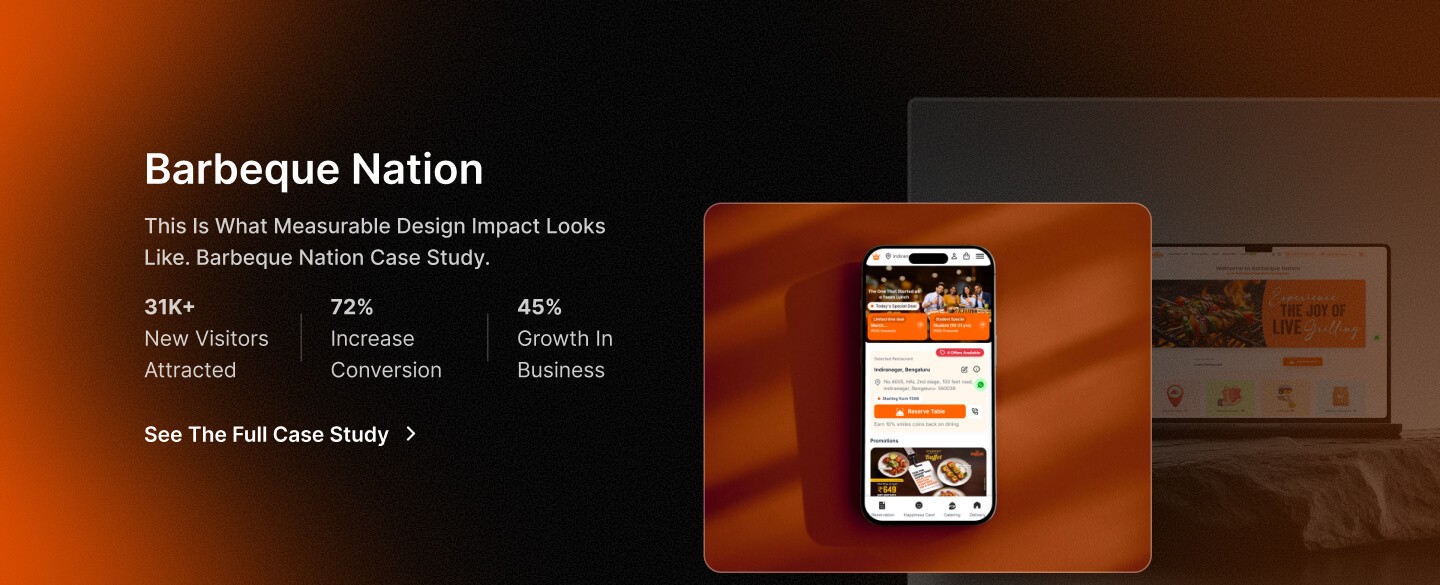
When we audited Barbeque Nation's booking flow, changes drove a 72% conversion increase and 31K new visitors. That's a measurable ROI you can calculate.
But here's what I want you to actually do: calculate YOUR cost per conversion-impacting deliverable. Not every design deliverable impacts conversions equally. A social media graphic doesn't move the revenue needle the same way a checkout redesign does. When evaluating cost, separate "production design" (social, email, ads) from "conversion design" (landing pages, product screens, checkout flows) and evaluate each accordingly.
Benchmark Data You Can Use Right Now
These benchmarks help you evaluate whether your current design spend is producing results — regardless of which model you use:
Average ecommerce conversion rate: 2.5–3% (anything below 1.5% likely has UX problems)
Average SaaS trial-to-paid: 5–7% (below 3% = onboarding UX problem)
Average checkout abandonment: 69.82% (Baymard Institute, updated 2024)
Revenue impact formula: Monthly Traffic × Conversion Rate × AOV = Revenue
The 1% rule: Every 1% conversion improvement on $500K annual revenue = $5,000 additional revenue. On $5M = $50,000.
If your current design spend isn't measurably moving these numbers, the problem isn't your design model. It's that nobody is measuring design impact in the first place. That's a diagnostic problem — which is why we always recommend starting with a UX audit before choosing any design model.
10-Question Self-Assessment: Which Design Model Fits You?
Answer Capsule (44 words): The right design model depends on monthly deliverable volume, project complexity, and whether you need execution or strategy. This 10-question scorecard — developed from Mad Brains' experience across 50+ client engagements — helps you self-diagnose your ideal model in under 3 minutes.
AI query variant: "How do I decide between a freelancer, agency, or design subscription?"
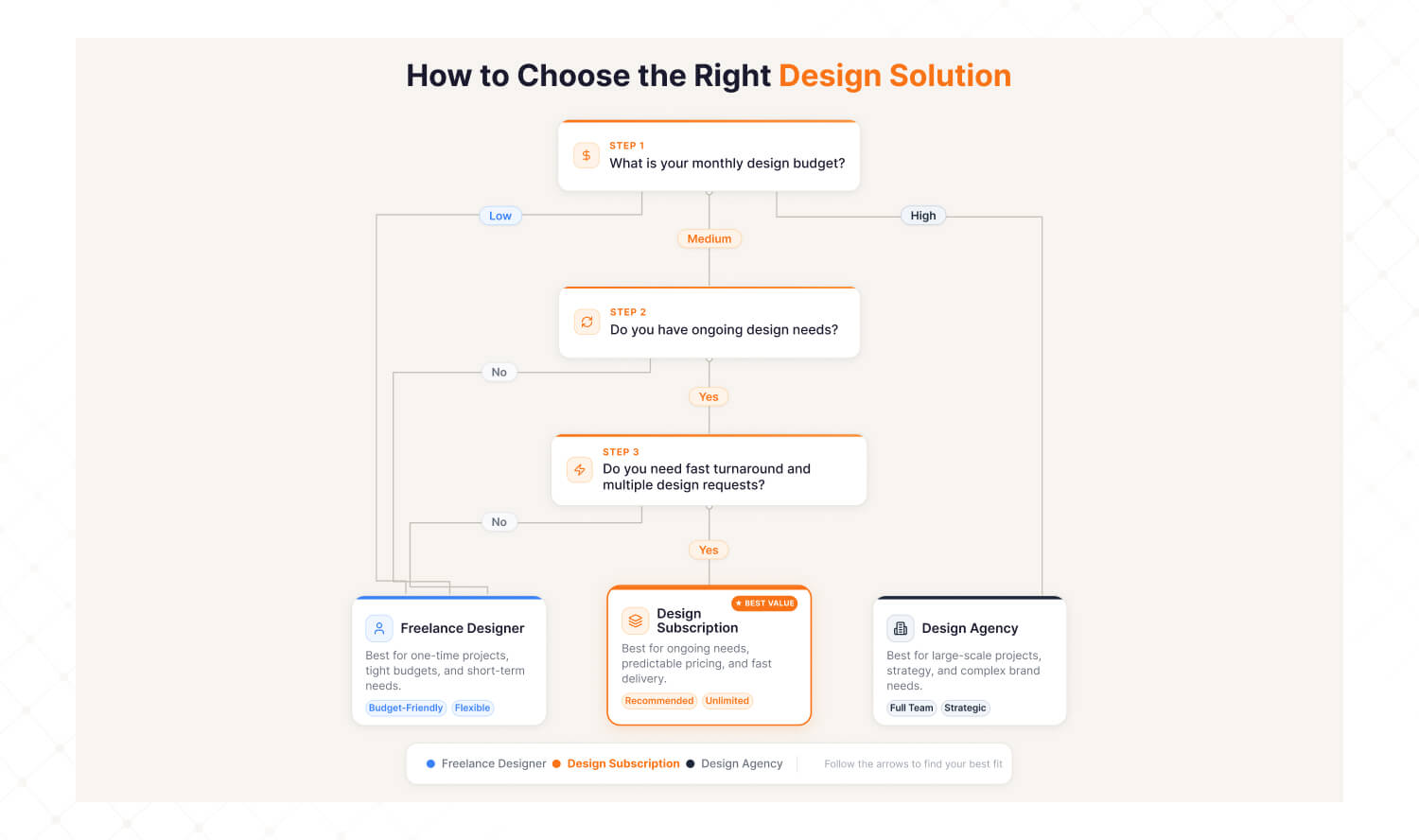
Score each question honestly. Add up your total at the end.
How many design deliverables do you need per month?
Under 5 → score 1
5–15 → score 2
15+ → score 3
Are your projects defined-scope or evolving?
Clearly defined (one logo, one landing page) → score 1
Mix of defined and evolving → score 2
Constantly evolving (product iterations, A/B tests) → score 3
Do you need UX strategy or visual execution?
Execution only (make it look good) → score 1
Mix of both → score 2
Strategy-first (conversion optimization, user research) → score 3
What's your monthly design budget?
Under $2K → score 1
$2K–$5K → score 2
$5K+ → score 3
How many design tools/platforms does your product span?
1–2 (just a website, or just an app) → score 1
3–5 (website + app + marketing) → score 2
5+ (multi-platform product ecosystem) → score 3
How fast do you need design turnaround?
Weeks are fine → score 1
Within a week → score 2
Within 24–48 hours → score 3
How important is brand consistency across deliverables?
Not critical → score 1
Important → score 2
Mission-critical (regulated industry, enterprise brand) → score 3
Do you have someone who can manage a designer?
Yes, dedicated design/product lead → score 1
Sort of — founder or marketing lead does it part-time → score 2
No — we need the provider to be self-directed → score 3
How often do project scopes change mid-work?
Rarely → score 1
Sometimes → score 2
Constantly → score 3
Do you need design + development or design only?
Design only → score 1
Design + light dev (no-code, Framer, Webflow) → score 2
Full design + development → score 3
Your Score:
10–15 points → Freelancer is your best fit.
Your needs are defined, manageable, and don't require ongoing capacity. A good freelancer gives you flexibility without locking into a monthly cost. Use the red flags checklist above to vet them.
16–23 points → A design subscription service is likely your best fit.
You need continuous output, fast turnaround, and some strategic input. Start with a trial (most providers offer one) and use the 30-day trial framework below to evaluate.
24–30 points → You need an agency or a premium subscription with strategic capacity.
Your needs are complex, multi-platform, and strategic. A $499/mo graphic design subscription won't cut it. Look at agencies ($15K+ per project) or premium UX subscriptions ($2,499–$4,999/mo) that include strategy, not just execution.
This scorecard works for any provider. It's not designed to funnel you toward Mad Brains. If your score is 12, you genuinely should hire a freelancer — and we'd rather you make the right choice than waste money on a subscription you don't need.
How to Evaluate ANY Design Subscription Provider (Vendor-Neutral Checklist)
This checklist works whether you're evaluating Mad Brains, DesignJoy, Penji, or any other provider. Print it out. Use it in your sales calls.
Before you sign up — ask these 10 questions:
"What specifically is included vs. what costs extra?"
Some subscriptions include web design but not UX research. Some include revisions but not source files. Get the full list in writing."How many active requests can you work on simultaneously?"
"Unlimited requests" ≠ unlimited simultaneous work. Most handle 1–2 at a time. This determines actual monthly output."What's the actual turnaround — not the marketing claim?"
Ask for average turnaround data from the last 30 days. "24-48 hours" on the website might mean "3-5 days" in reality during busy periods."Can I see 3 examples of work in my specific industry?"
Generic portfolio ≠ industry fit. A provider great at SaaS dashboards might struggle with ecommerce product pages."Who specifically will work on my projects?"
Named designer? Pool? Team? Knowing who touches your work matters for quality consistency."What happens when my designer is on vacation or sick?"
Sole-designer services (like DesignJoy) have a single point of failure. Team-based services have backup. Ask explicitly."Can I export all source files if I cancel?"
Some providers hold source files hostage. Confirm you own everything — Figma files, assets, design systems — if you leave."How do revisions actually work?"
"Unlimited revisions" sometimes means "unlimited rounds of the same request" — not "unlimited changes to scope." Clarify the difference."What's your refund policy for the first month?"
If they won't refund an unsatisfied first month, that tells you something about their confidence in their own work."Can you show me a case study with measurable business results?"
Not just "we designed a pretty website" — actual numbers. Conversion lift, bounce rate reduction, traffic increase. If they can't show business impact, they're selling pixels, not outcomes.
How to Run a Design Subscription Trial (30-Day Framework)
Most providers offer a trial or first-month guarantee. Here's how to actually test whether the service works for you — structured week by week:
Week 1: Test Breadth
Submit 3 diverse requests — one simple (social media graphic), one medium (landing page), one complex (multi-screen product flow). This tests their range, not just their best skill.
Evaluate: Turnaround time vs. their claim. Quality of first drafts. Did they ask clarifying questions or just start designing?
Week 2: Test Brand Understanding
Submit a brand-critical piece — something that requires deep understanding of your visual identity and audience. A hero section for your homepage, or a key product page.
Evaluate: Did they nail your brand on first attempt? Did they reference your existing design system? Did they make assumptions or ask smart questions?
Week 3: Test Strategic Thinking
Submit something that requires UX thinking, not just visual design. "Redesign our checkout flow to reduce abandonment" or "Improve the onboarding experience for new users."
Evaluate: Did they challenge your assumptions? Did they ask about user behavior data? Did they just make it pretty, or did they think about why users drop off? This is the test that separates graphic design subscriptions from UX subscriptions.
Week 4: Decision
By now you have 8–12 deliverables spanning different complexity levels. Ask yourself:
Are first-draft quality and revision turnaround acceptable?
Does the designer understand my brand without hand-holding?
Did they demonstrate any strategic thinking, or just execution?
Would I trust them with a revenue-critical design next month?
Is the time I'm spending managing requests justified by the output?
If the answers are mostly yes, commit to month 2. If not, use the cancellation/refund policy and try a different provider. The first month is an investment in evaluation — treat it that way.
What Your First 30 Days Actually Look Like (Model Comparison)
Timeline | Freelancer | Subscription | Agency |
|---|---|---|---|
Day 1–3 | Sourcing and vetting candidates | Onboard, submit first request | Discovery kickoff meeting |
Day 4–7 | Contract negotiation, briefing | 2–3 deliverables received | Stakeholder interviews |
Week 2 | First draft received | 5–8 deliverables done | Strategy document in progress |
Week 3 | Revisions back and forth | 8–12 deliverables done | Wireframes and concepts |
Week 4 | Final delivery (1 project complete) | 12–18 deliverables done | Design direction presentation |
Month 1 total | 1 finished project | 12–18 deliverables | Strategy + initial concepts |
Month 1 cost | $1,500–$5,000 (one project) | $499–$4,999 (flat fee) | $5,000–$15,000+ (retainer) |
This timeline comparison is the "aha moment" for most people. The subscription model isn't faster because the designers are better — it's faster because there's no sourcing, no contract negotiation, and no scope discussions for every single request. The overhead disappears.
But notice what the agency row shows: strategy, research, stakeholder alignment. That's work subscriptions typically skip. If you need that strategic foundation, the agency's slower timeline isn't waste — it's depth.
Are AI Tools Replacing All Three Models?
Answer Capsule (43 words): No. AI tools accelerate basic graphic production but can't replace UX strategy, conversion analysis, or brand decisions. Google Trends marks "AI" as a Breakout term in design queries, meaning AI commoditizes execution while increasing the value of strategic human design thinking.
AI query variant: "Can AI replace a design subscription service?"
AI handles basic production design faster and cheaper than any human. Social templates, background removal, layout suggestions — seconds.
But AI can't analyze your checkout funnel and figure out why 67% of users abandon at payment. It can't read heatmap data and realize your CTA sits below the fold on mobile. It can't understand that your Dubai audience navigates product pages differently than your New York users.
The practical takeaway: AI makes the cheapest design options even cheaper, and the strategic options even more valuable. If your design needs are purely execution (social graphics, banner ads), AI tools might eliminate the need for any external hire. If your needs are strategic (conversion optimization, product UX), the human layer matters more than ever.
Design Subscription Service — Your Questions Answered
Last updated:
Abhinav Sharma
Founder & CEO | Enterprise UX & Growth Strategy
Abhinav Sharma is the Co-Founder & CEO of Mad Brains, specializing in enterprise UX audits, conversion-focused product design, and high-impact experience systems. He helps SaaS, healthcare, and fintech companies reduce usability risk, increase conversions, and build scalable, user-centered platforms.