
UX Audit
By

Mad Brains Technologies

Sports fandom isn’t just about a single seat at a stadium or a few hours of broadcast viewing. Today’s fandom is about a phone screen on the way to work, the second screen application while watching the game, highlight reels one hour after, and the loyalty system that discreetly keeps track of what makes fans care all through the year. The evolution has made digital experience design essential not only for sports brands to succeed but also the most important driver of retention and loyalty.
As digital product landscapes shift, partnering with specialized design experts like Madbrains allows teams and founders to build hyper-personalized, high-converting platforms. If you're building or leveraging professional UI/UX audit services to analyze a sports brand's digital presence in 2026, here are the UX trends that matter most and what they mean for how you design.
Why Digital Fan Experience Matters More Than Ever
The modern fan journey starts well before the actual game day. Supporters learn about teams on social networks and scour the web for schedules, buy tickets online, install mobile apps, get involved in fan communities, and shop at ecommerce platforms.
Every interaction made in the digital dimension contributes to the overall fan journey.
Any step that is confusing and demanding on the users' side will definitely discourage them. Research studies have consistently shown that users expect speedy website loading, easy navigation, and a simple buying process. When these expectations are not met, they just leave.
UX issues may result in:
Decreased ticket sales
Decrease in merchandise purchases
Decline in application usage
Decreased membership renewal
Sponsorship devaluation
Fan de-activation
Brand disassociation
Developing a great digital experience is not just about appearance. It is about ensuring every single aspect of user interaction is easy and pleasurable.
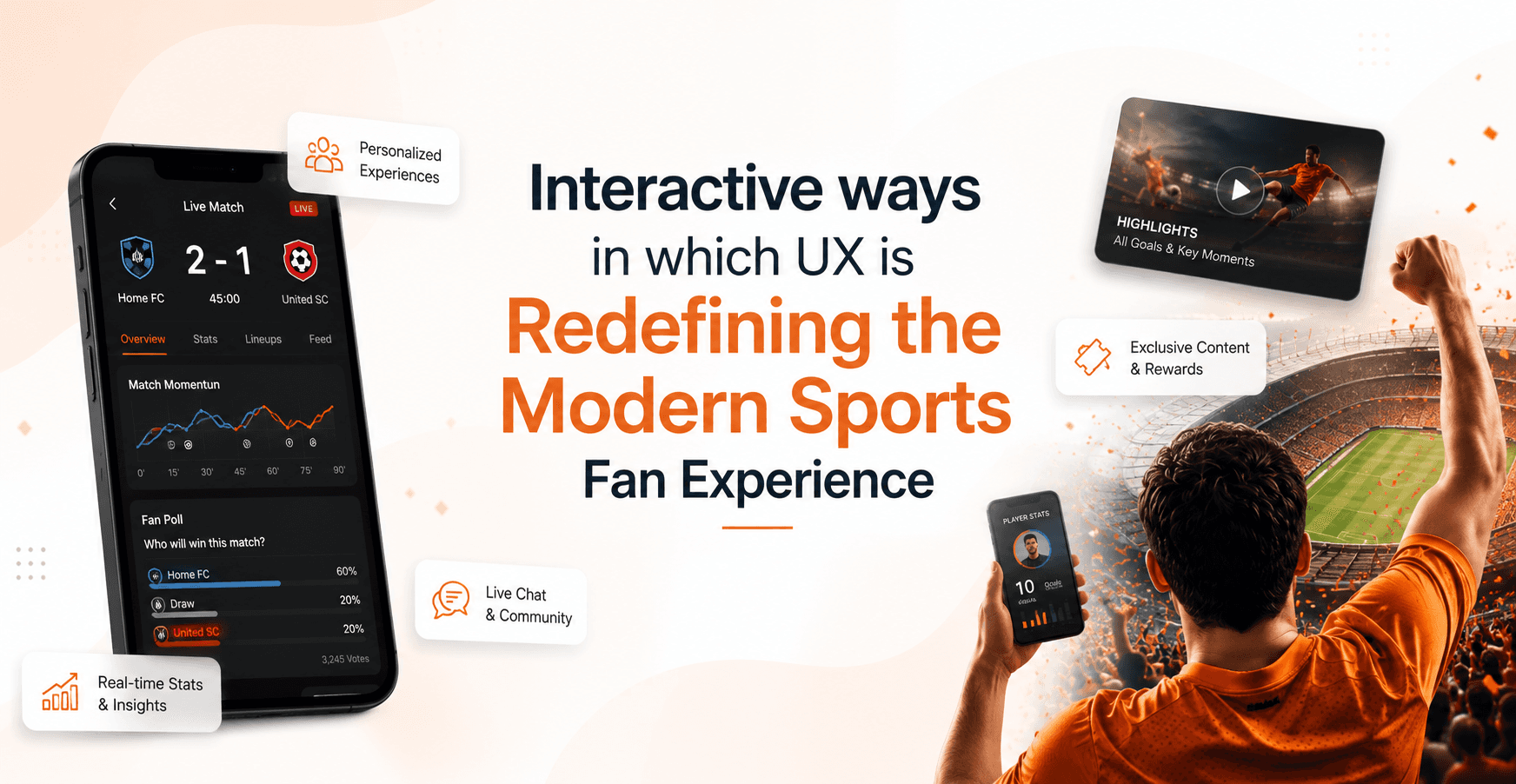
Interactive ways in which UX is Redefining the Modern Sports Fan Experience
The modern UX makes it possible to transform passive spectators into active participants by offering them customized and engaging digital experiences that can help to build their loyalty.
Here are a few key ways modern UX is transforming digital fan experience:
1. Intent-First & "Task-Morphic" Interfaces : Gone are the days when a fan has to search through a hamburger menu at least three levels deep just to access a match stream or bar codes for tickets. It is now time for modern sports platforms to become intent-oriented and flexible to switch the UI mode as necessary.
Modern applications now change their designs according to the context:
Pre-Game Mode: The home screen displays only relevant items such as parking passes, stadium maps, and merchandise suitable for specific weather conditions.
Live Match Arena Mode: The interface will switch from consuming a lot of bandwidth through video streaming to low-latency mode to give priority to making cashless payments for snacks and issuing digital tickets through the "stadium mode".
Live Match at Home Mode: The UI will now transition to providing up-to-date overlays, presenting multiple cameras to choose from and giving real-time in-app betting options.
Business Benefits: The number of steps necessary to perform transactions decreases during periods of emotional peaks.
2. Contextual "Shoppable Moments" (Integrated Commerce) : The biggest drawback of most traditional sports apps is throwing the fan into a completely new website environment from a third party simply to get their jerseys and tickets for match days. Such fragmentation destroys consumer trust and conversion rates.
The new standard is integrated commerce. Whenever a player scores a hat-trick, fans immediately see something about getting his jersey on-screen. The shop, ticketing agent, and media need to work together to provide a smooth experience for their consumers. To see how these seamless transactional principles apply to driving immediate retail revenue on your platform, read our detailed UX/UI playbook for e-commerce websites that convert browsers into buyers.
3. Ambient AI & Predictive Live Feeds : The use of AI technology in sports apps has transitioned from the basic chatbot system into a more sophisticated level. Ambient AI is responsible for the patterns of behavior among the users and helps in its predictive capabilities by knowing what type of information a sports fan wants even before the information is requested.
Traditionally, sports apps used to provide their users with a cumbersome display of numerical data and tables, but now the trend is the usage of a narrative type of presentation of the information. AI-driven mini-version of companions on the basis of the interactive messaging, provides personal stories to its users based on the complicated information regarding the games.
4. Micro-Interactions Built for Crowded Venues : The sports applications should be built to endure the pressures of the congested physical surroundings. The UX designers are placing more emphasis on the use of one-handed design along with large and highly contrasting targets to handle the shaky hands, lighting conditions, and poor cell phone signal in the huge stadiums.
Functional micro-motions are being employed to offer instant feedback. When a fan tries to place an order or make a payment through tapping at the hectic concession counter, the use of micro-animations and haptic feedback assures him about their payment instantly.
5 Athletes and Creators Are Becoming Part of the Interface : The modern sports UX is no longer focusing only on logos and teams’ brands; it is becoming increasingly based on the personalities that the fans are interested in. It is now obvious that athletes, coaches, influencers, and creators are part of a digital experience, making it feel authentic and engaging with the help of personal greetings, special content, and various opportunities for interaction such as live Q&A sessions, an overview of product recommendations, and more.
Engagement with familiar people is definitely much more stimulating than generic advertising, therefore making the experience of interacting with the sport brand driven by athletes.
Partner with The Madbrains to Build a User-Centric Sports Experience
Modern fandom occurs on the screen. If you want to engage your modern fans, sports brands should go beyond static designs and use dynamic, task-morphic design, shoppable experiences, AI predictions, and content creator navigation. Poor digital workflow directly hits your bottom line and kills retention rate. Want to make your product future-ready and increase fan lifetime value? Take advantage of our expert UI/UX audit services to uncover performance leaks, or work together with The Madbrains to create a user-focused sports experience where there is no transaction pain point, transforming casual spectators into permanent superfans.

FAQs
How do we balance heavy features like live stats and video without crashing the app in a crowded stadium?
Activate a dynamic stadium mode that drops heavy video content, serving light cached assets and fast interactions over congested networks.Will transitioning to an athlete or creator-driven interface alienate our core, traditional team fans?
Not at all. Build customizable dashboard preferences so traditional fans retain classic layouts while younger demographics choose individual athlete feeds.What is the fastest way to implement integrated commerce without completely rebuilding our backend?
Use middleware APIs to create a unified frontend checkout layer over your existing legacy ticketing and merchandise backend systems.
Last updated:
Mad Brains Technologies
Enterprise UX & Product Strategy Team
Mad Brains is an enterprise UX and product consultancy focused on reducing product risk and accelerating growth. Through UX audits, conversion-led design, and full-stack development, the team helps organizations build scalable digital platforms that drive measurable business outcomes.