UI/UX Design
By

Mad Brains Technologies


In 2026, the difference between an appealing website and an effective website is greater than ever before.
High-performing websites do not succeed in terms of having the most visually stunning features or the most on-trend color schemes. Instead, they succeed through deliberate design choices which eliminate friction, create trust, and help move users towards conversion. The average website now converts just 2.35% of visitors, meaning roughly 97 out of every 100 people who land on a page leave without taking action, while top performers convert at up to 5x that rate.
With businesses competing for the user's attention, cooperation with an experienced UI UX design agency is an absolute must to create amazing digital experiences that will bring you tangible business success. With more and more AI-based web designs becoming available, users' expectations have been raised accordingly. Generic layouts are abundant, making it that much more critical for businesses to offer unique and user-centered design. New research coming out of the industry further confirms that future trends will be moving away from merely appealing visuals and more towards AI-friendly layouts, accessibility, performance optimization, intentional interactions, and personalization.
If your website still appears to be designed as if it were several years ago, then you may very well be missing out on conversions.
Here are five ways in which the highest-converting websites will be different in 2026 and how you can incorporate those trends into your business
Minimalism with Purpose (Intentional Friction Reduction)
Minimalism in 2026 is going to be determined by usability and not aesthetics. Websites that have high converting rates will be removing any extra elements that may either divert the user’s attention or hamper the process of decision making. They concentrate on having one primary call to action, simple navigation features, clean layouts, and succinct content that leads the user effortlessly towards conversion. This will result in lower cognitive load, simpler forms, and a reduction in extra steps. Instead of hiding things, minimalistic websites are meant to highlight the most important things for the user.
Purposeful Motion Instead of Decorative Animation
Useful movements replace flashy and distracting animated elements with meaningful and UX-led actions to increase conversions. Rather than distracting visitors with moving texts or effects, high-performing websites employ subtle movements to help attract attention to core call-to-actions, to let users know about system states (e.g., changing a button into a progress bar to decrease user anxiety), and to make it easier for visitors to understand complicated products via the "scrollytelling" technique.
Making all transitions last no more than 300 milliseconds and making sure that all movements serve some purpose, brands can achieve great performance and instant credibility of the website. First impressions of a site's credibility form in as little as 50 milliseconds, which is why every animation and micro-interaction above the fold carries so much weight.
AI-Personalized Experiences Instead of Static Websites
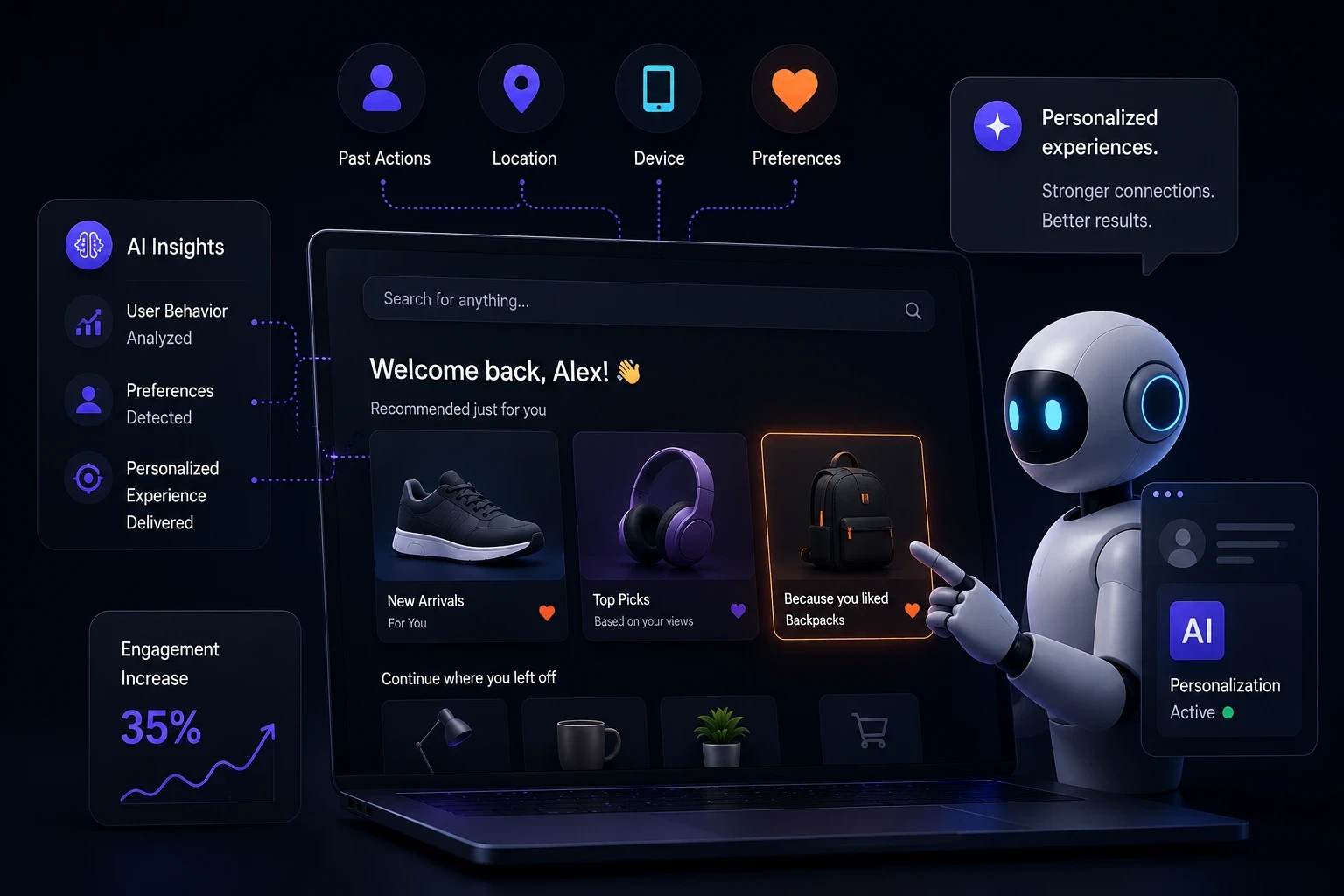
By the year 2026, the emphasis on personalization will have led to high-quality websites abandoning static and cookie-cutter experiences. Instead of showing the same material to all users, AI will be able to personalize messages and products based on a user’s past actions, geographic location, gadget used, how they arrive at the site, and their past Internet habits. For example, new users will receive educational messages, while returning customers are flooded with offers based on their previous choices.
Furthermore, artificial intelligence will play a great role in transforming search engines and navigation, which will help customers obtain the appropriate materials that they want. By providing such personalized experiences, the industry will be able to eliminate the friction point and improve customer experience.
Speed Is a Design Decision, Not a Dev Afterthought
Website loading speed is often considered a technical issue that can be addressed after going live. However, the best converting sites view this issue as a design challenge from the very beginning. Each animation, each image, each font choice, each third-party code, and each user interaction influences the time needed for interaction with your content. An attractive website that takes too much time to load will immediately become frustrating.
Current UX design favors simplicity of interface and media, carefully chosen animations, and quick user flow on all devices. The inclusion of speed into the design process brings about increased user satisfaction, decreased bounce rate, better search engine optimization, and a more efficient conversion rate.
Performance-First Architecture
The design of contemporary websites revolves around performance right from the very beginning, meaning that all elements and assets of a web page must be assessed for their effect on the speed of loading and responsiveness. This can be achieved through the use of tools like lazy loading, code splitting, image optimization, effective caching, and the use of lightweight frameworks to deliver content rapidly to all devices.
Performance-based approach to design also involves the implementation of Core Web Vitals, thus providing the users with smooth user interactions and fast visual stability. Overall, it results in a website that feels really fast from the very first moment of use.
Trust-First UX
The decision on whether to trust the site is made within seconds. Websites that convert highly have the trust built into their messaging, transparent pricing, genuine customer reviews, security signals, and branding. Rather than bombard people with all sorts of claims, they give social proof, simple navigation, easy access to contact, and seamless user flow.
Everything from font type to copywriting is done in order to eliminate uncertainty and foster credibility. Building trust-focused UX does not just improve conversion rates but also fosters a stronger relationship with customers by giving them an informed, secure, and confident experience.
Accessibility as the Creative Default
Accessibilities are not any more seen as a mere compliance checklist, but as an essential ingredient for good design. Websites that perform well are designed to be accessible to people with different capabilities via good typography, high contrast in colors, good navigability through the keyboard, descriptive labels, and flexible layouts.
These design decisions enhance readability, usability, and navigability for all users irrespective of whether they are using assistive devices or not. Through building accessibility into the creative default of the design process, companies achieve a much more inclusive approach and make websites easy to use.
Why Businesses Choose The MadBrains to Build High-Converting Websites
Design trends become productive only when they are applied through the proper understanding of user behavior, business goals, and conversion strategy. The MadBrains is a leading UX/UI design Agency offering design and development of functional websites that are not just aesthetically pleasing but also aimed at providing an excellent user experience, high-performing, accessible, and business-oriented. Be it user experience research, UI design for conversions, artificial intelligence, or performance optimization, each project is designed to decrease friction and maximize engagement. No matter whether you are going to launch a brand new website or redesign an old one, our team creates a perfect digital experience which will convert your visitors into loyal customers.
Are you ready to start creating a website? Contact us now to create a faster and smarter digital experience.

Last updated:
Mad Brains Technologies
Enterprise UX & Product Strategy Team
Mad Brains is an enterprise UX and product consultancy focused on reducing product risk and accelerating growth. Through UX audits, conversion-led design, and full-stack development, the team helps organizations build scalable digital platforms that drive measurable business outcomes.