UX Audit
UX Audit Services: The $100 ROI Fix Most Growing Brands Are Still Ignoring
By

Mad Brains Technologies


TL;DR — Key Takeaways
✓ Every $1 invested in UX returns up to $100 — a verified 9,900% ROI (Forrester)
✓ A well-designed UX can boost conversion rates by up to 400% (Forrester Research)
✓ Checkout UX improvements alone can recover up to 35.26% of lost e-commerce sales (Baymard Institute)
✓ Mad Brains' UX audit helped Barbeque Nation achieve +72% conversions and 31,000 new visitors
✓ Most brands skip audits and go straight to redesigns — a costly mistake our data proves repeatedly
We audited a restaurant booking platform last year that was losing reservations every single day.
Strong brand. National presence. Decent traffic.
But their online booking flow had 12 friction points buried inside 4 steps — and the internal team had stopped seeing them. You know how it goes. You've been staring at the same product for months. You stop seeing it the way a first-time user does.
Three targeted fixes later, conversions jumped 72%. New visitors climbed by 31,000. Booking volume grew 45%.
That was Barbeque Nation. And the fix didn't require a redesign.
That's what a professional UX audit service does. It doesn't guess. It finds the exact leak. It tells you where to patch — and why.
If your product is growing but not as fast as it should, there's a high probability a fixable UX problem is the ceiling. This guide will show you exactly what a UX audit covers, when you need one, what it costs, and — critically — what most brands get wrong when they skip one.
What Is a UX Audit Service?
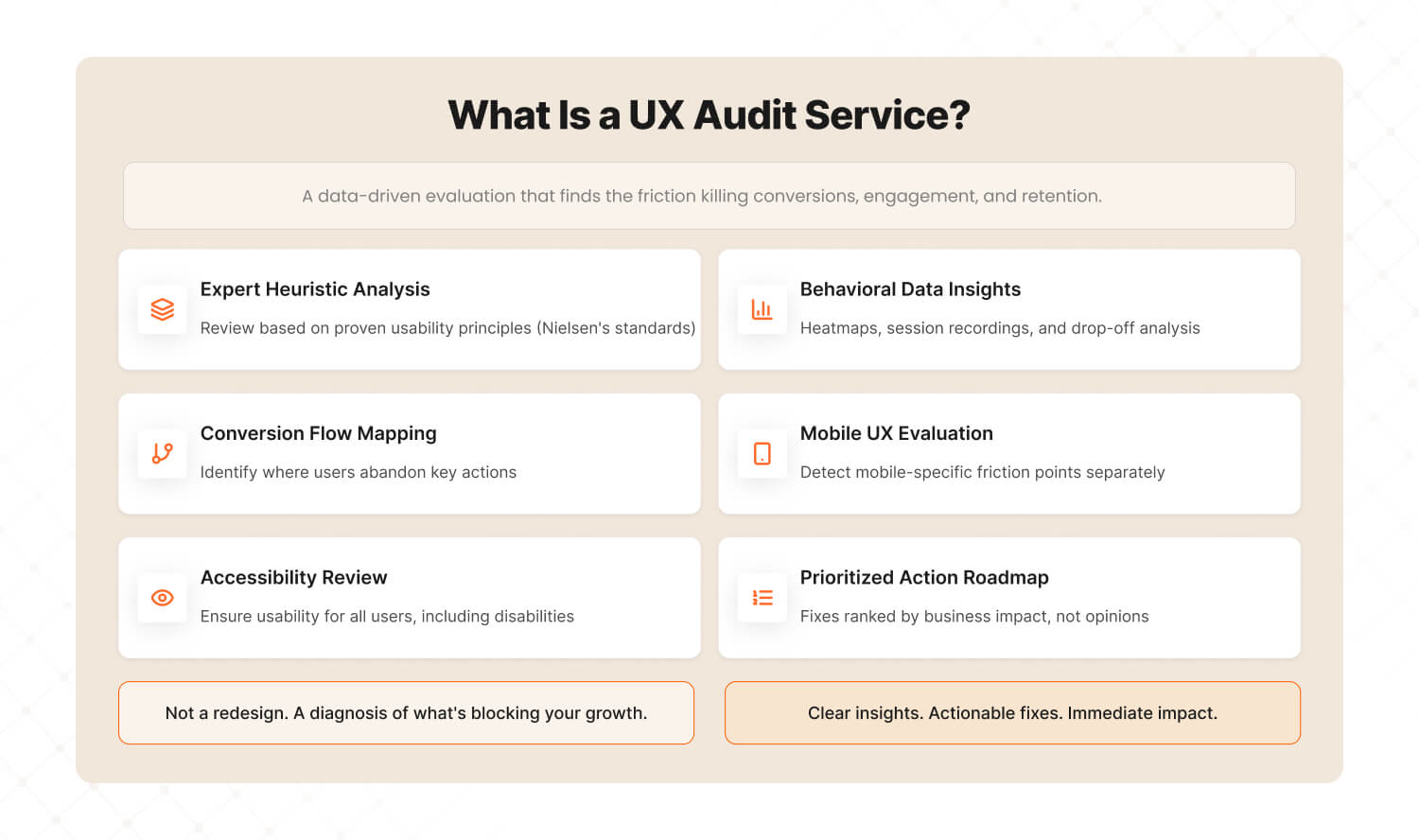
A UX audit service is a systematic, expert-led evaluation of your digital product — website, SaaS platform, or mobile app — that identifies the friction points silently killing your conversions, engagement, and retention.
Unlike a redesign that changes how things look, a UX audit answers why users behave the way they do — and what's stopping them from completing the actions your business depends on.
A professional UX audit combines:
Heuristic analysis — Expert review against Nielsen's 10 usability principles
Behavioral data review — Heatmaps, session recordings, funnel drop-off analysis
Conversion flow mapping — Every step from entry to action, traced and diagnosed
Mobile UX evaluation — Assessed separately (mobile friction ≠ desktop friction)
Accessibility review — Over 1.3 billion people globally have disabilities; 90% of websites still fail them (UXtweak, 2025)
Prioritized action roadmap — Ranked by business impact, not design preference
The output isn't a 60-page opinion document. It's a ranked list of conversion-impacting issues with specific, implementable solutions your team can act on immediately.
The Real Cost of Skipping a UX Audit
Here's what competitors won't say: the most expensive UX decision you'll make is the one you don't make.
Most brands treat UX audits as optional. They're not. Consider the verified data:
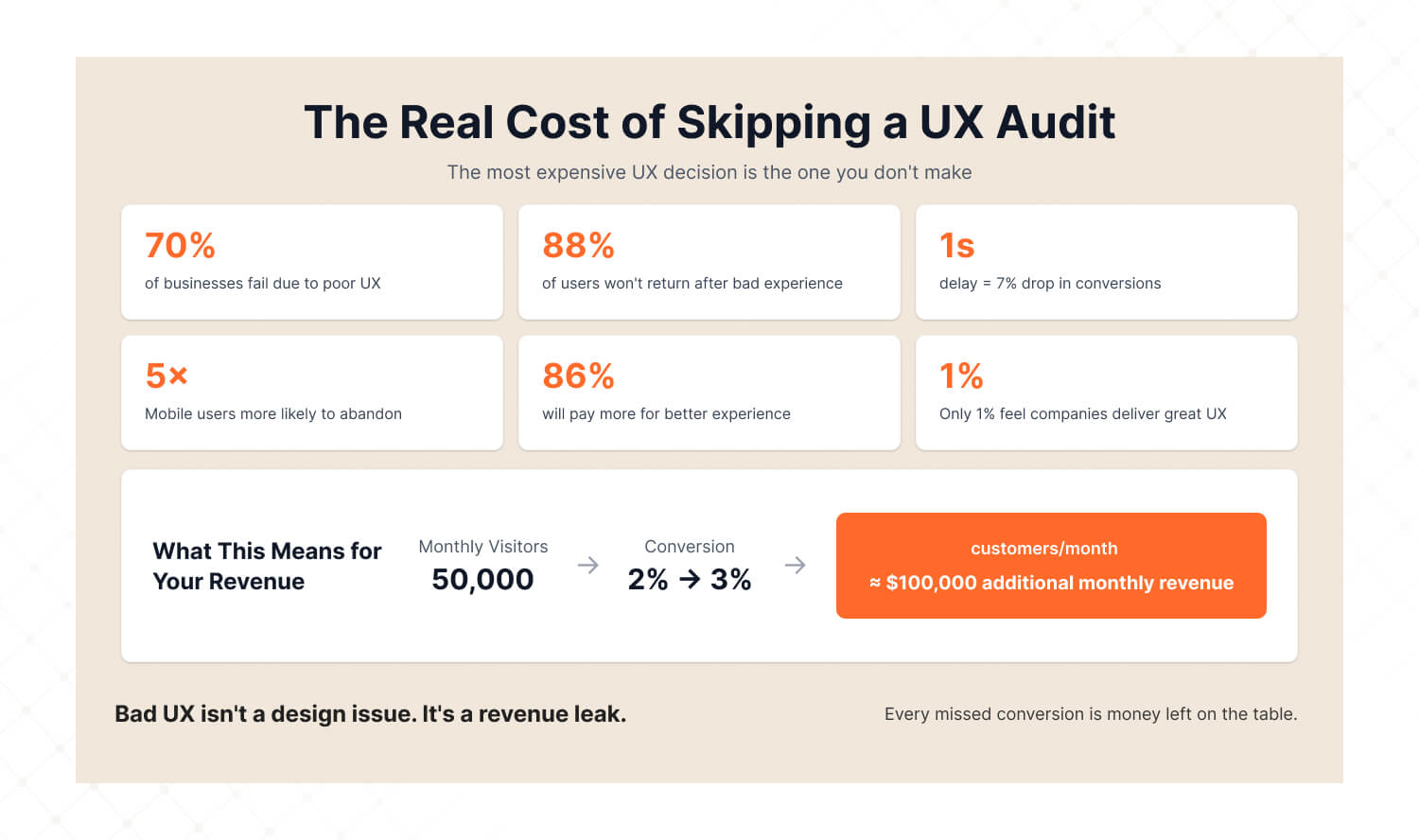
70% of online businesses fail because of bad UX — not bad products, not bad marketing (Uxeria)
88% of users won't return to a site after a poor experience (Toptal)
1-second page delay causes a 7% drop in conversions (Kissmetrics)
Mobile users are 5x more likely to abandon a task on a non-optimized site (Toptal)
86% of buyers will pay more for a better customer experience — yet only 1% say vendors consistently deliver it (CEI Survey via UXtweak)
The math is straightforward: if your product gets 50,000 monthly visitors and converts at 2%, fixing a UX issue that improves conversion to 3% adds 500 new customers per month. At an average customer value of $200, that's $100,000 in additional monthly revenue — from one audit.
The real question isn't can you afford a UX audit. It's how much is poor UX already costing you.
5 Signs Your Product Needs a UX Audit Right Now
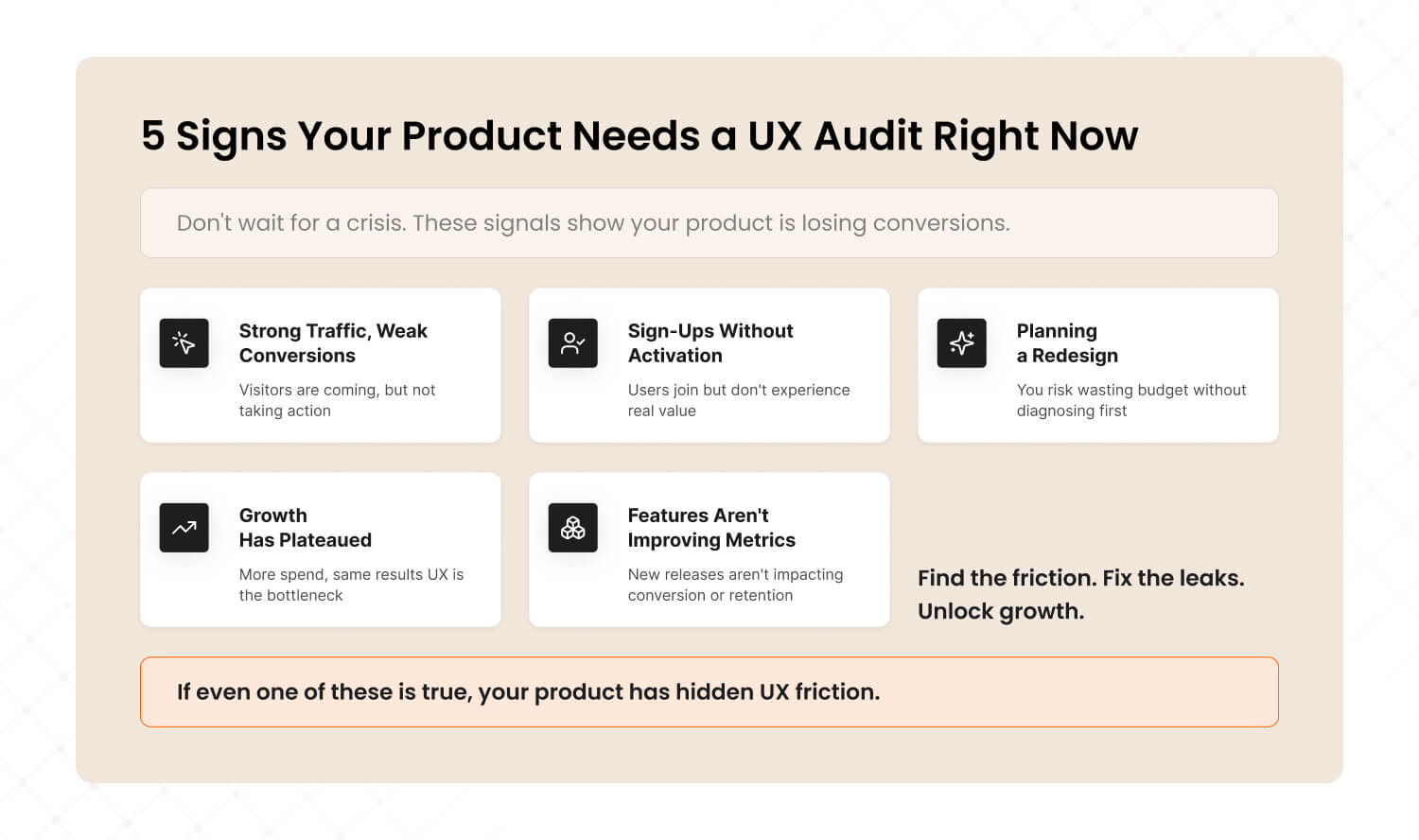
Don't wait for a crisis. These patterns — from our experience auditing 50+ SaaS and e-commerce products — signal that a UX audit should be your next move:
1. Traffic is strong, but conversions are weak
You're getting visitors. They're not converting. Something in the journey is breaking their intent — and you need to know exactly where.
2. Users are signing up but not activating
High sign-up rates + low activation = broken onboarding. The product isn't communicating value fast enough. This is where most SaaS products leak their worst conversions.
3. You're about to invest in a redesign
Stop. Redesigns without a prior audit are the most common waste of product budget we see. You'll spend six figures changing aesthetics when the problem is structural. Audit first — then decide what actually needs to change.
4. Growth has plateaued despite increasing spend
You've tried more ads, more content, better offers. Nothing moves the needle. This is almost always a product or experience problem — not a marketing problem.
5. Your last release didn't improve the metrics it was supposed to
New features regularly introduce unexpected friction. If your update didn't move retention or conversion, the UX audit will show you why.
If this sounds familiar, you're not alone. Our UX Audit service is specifically designed to find these patterns and give you a precise fix map — not a vague list of suggestions.
What Does a Professional UX Audit Actually Cover?
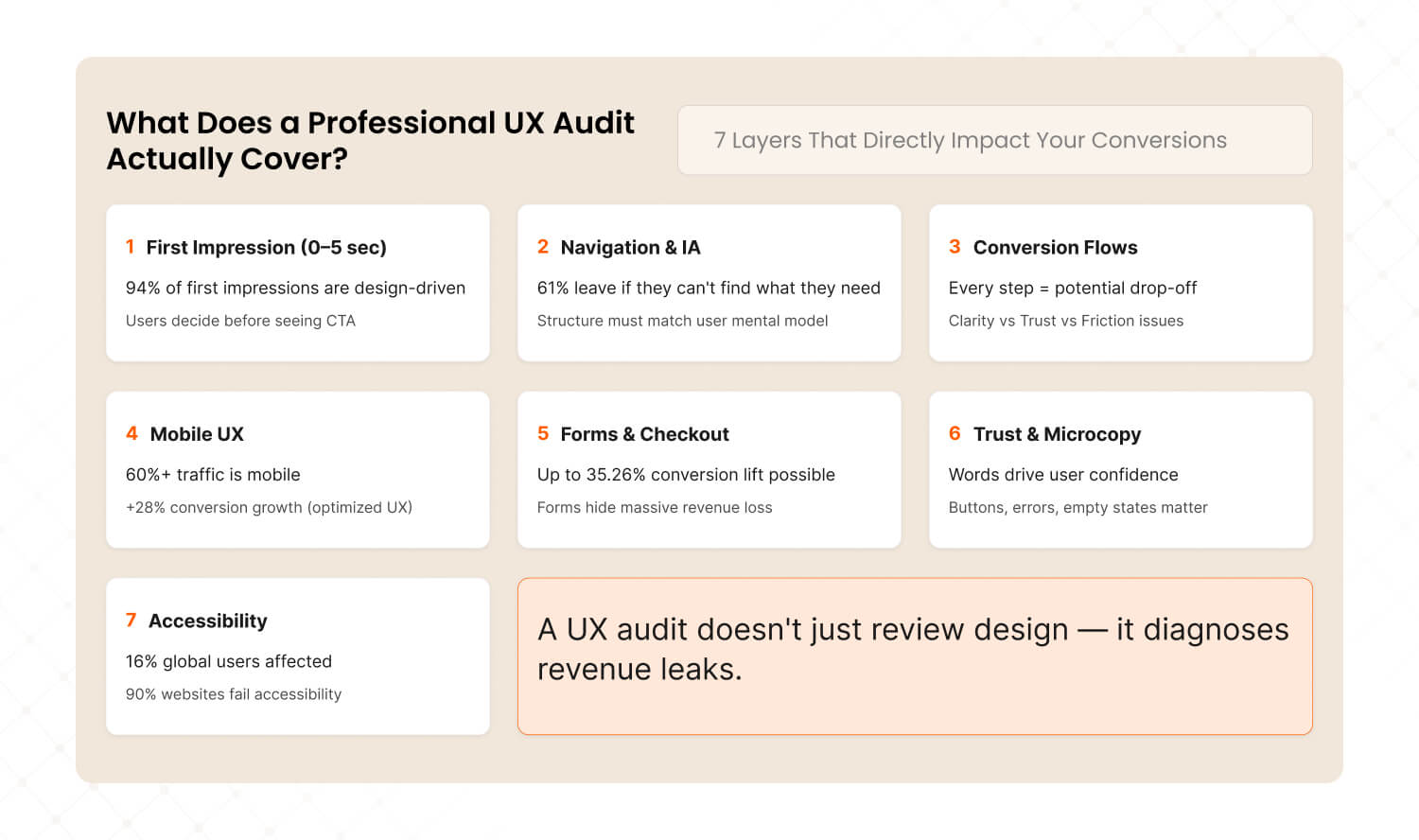
Not all UX audits are created equal. Here's exactly what a high-quality audit investigates — and why each layer matters to your bottom line:
First Impression & Cognitive Load (0–5 Seconds)
Does a new user immediately understand what your product does and why it's relevant to them? Research shows 94% of first judgments about a digital product are based on visual design and layout (UXtweak). Most bounce decisions are made here — before a single CTA is seen.
Navigation & Information Architecture
Confusing navigation is invisible to product teams and painfully obvious to every new user. When users can't find what they need, 61% leave immediately (Wearetenet). We map every navigation path against your user's mental model.
Conversion Flows & Funnel Breakpoints
Every step between awareness and action is a potential drop-off. We trace each flow, identify where users hesitate or abandon, and establish whether it's a clarity issue, a trust issue, or a friction issue. These are three completely different problems requiring three different fixes.
Mobile UX (Evaluated Independently)
Over 60% of web traffic is mobile — but most products are still designed desktop-first. Mobile friction points are completely different from desktop ones. We audit both environments separately. Organizations that improved mobile UX saw +28% conversion growth and +15% higher retention in 2024 (Arounda, based on Google data).
Form & Checkout Optimization
Long forms, forced account creation, unclear error states — these are silent conversion killers. According to Baymard Institute's research across 200,000+ hours of UX testing, optimizing checkout design can boost e-commerce conversion rates by 35.26%. That's not a rounding error. That's recoverable revenue hiding in a form.
Trust Signals & Micro-copy
The words on your buttons, error messages, and empty states determine whether users feel confident or anxious. We audit every touchpoint of your copy for clarity, confidence signals, and action-driving language.
Accessibility
16% of the global population has some form of disability. 90% of websites fail basic accessibility standards. This isn't just ethics — it's an untapped audience and an SEO signal that Google increasingly weights.
UX Audit vs. Redesign: Which One Do You Actually Need?
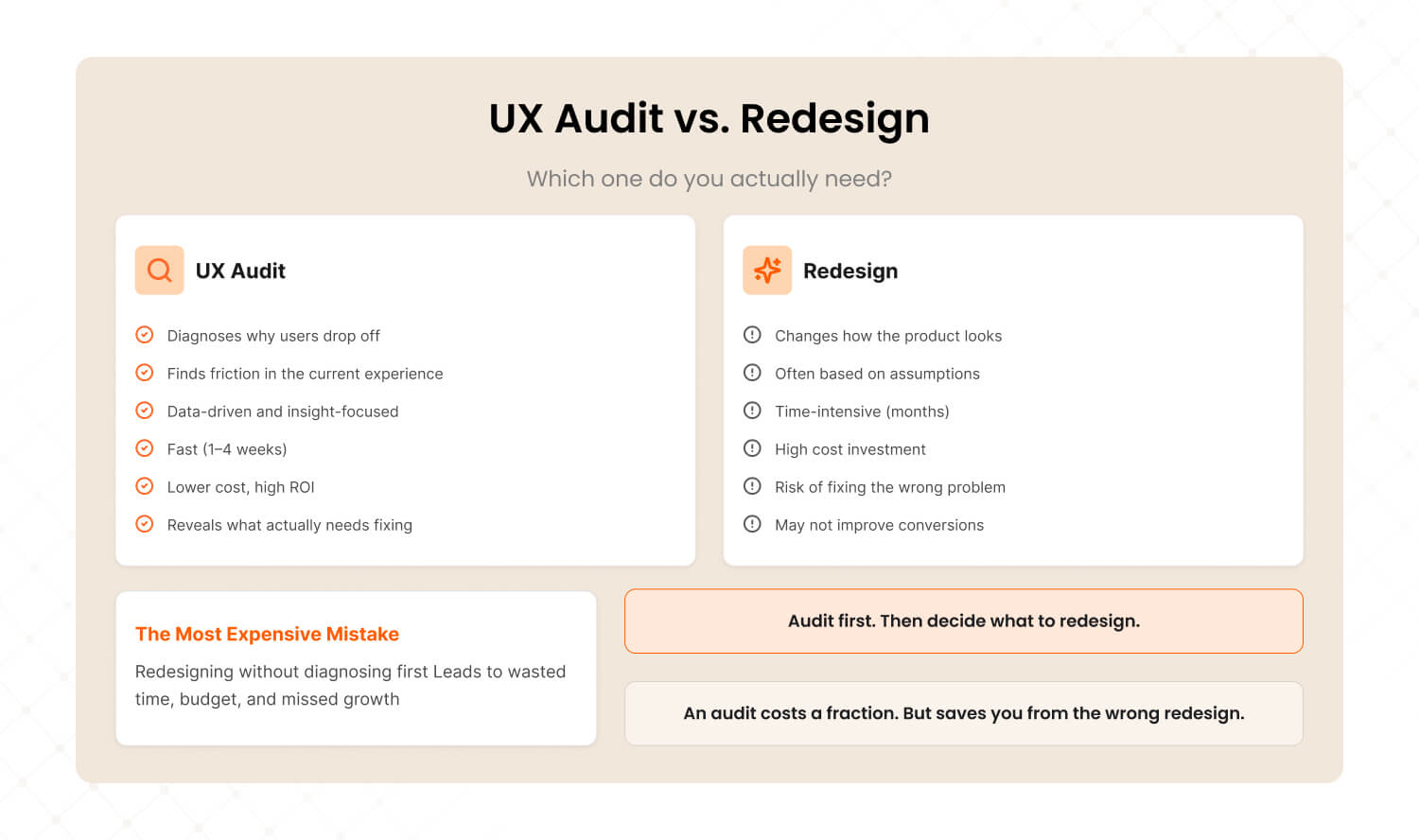
This is the question most agencies won't help you answer honestly — because redesigns are more expensive engagements.
Here's how Mad Brains approaches it:
Situation | What You Need |
|---|---|
Conversion rate is low, but design looks modern | UX Audit |
Users report confusion navigating the product | UX Audit |
Brand looks outdated, conversion is also low | Audit → then redesign informed by findings |
You've just launched and want to optimize | UX Audit |
Competitor redesigned and you want to follow | Stop. Audit your own data first. |
Audit findings reveal systemic architecture issues | Redesign — but only now do you know exactly what to redesign |
The most expensive product mistake we see: brands that redesign without auditing first. They spend months and six figures on a new look — and discover the conversion problem was a 3-field form and an unclear CTA.
An audit costs a fraction of a redesign. It tells you whether you need one.
Real Results: The Barbeque Nation UX Audit
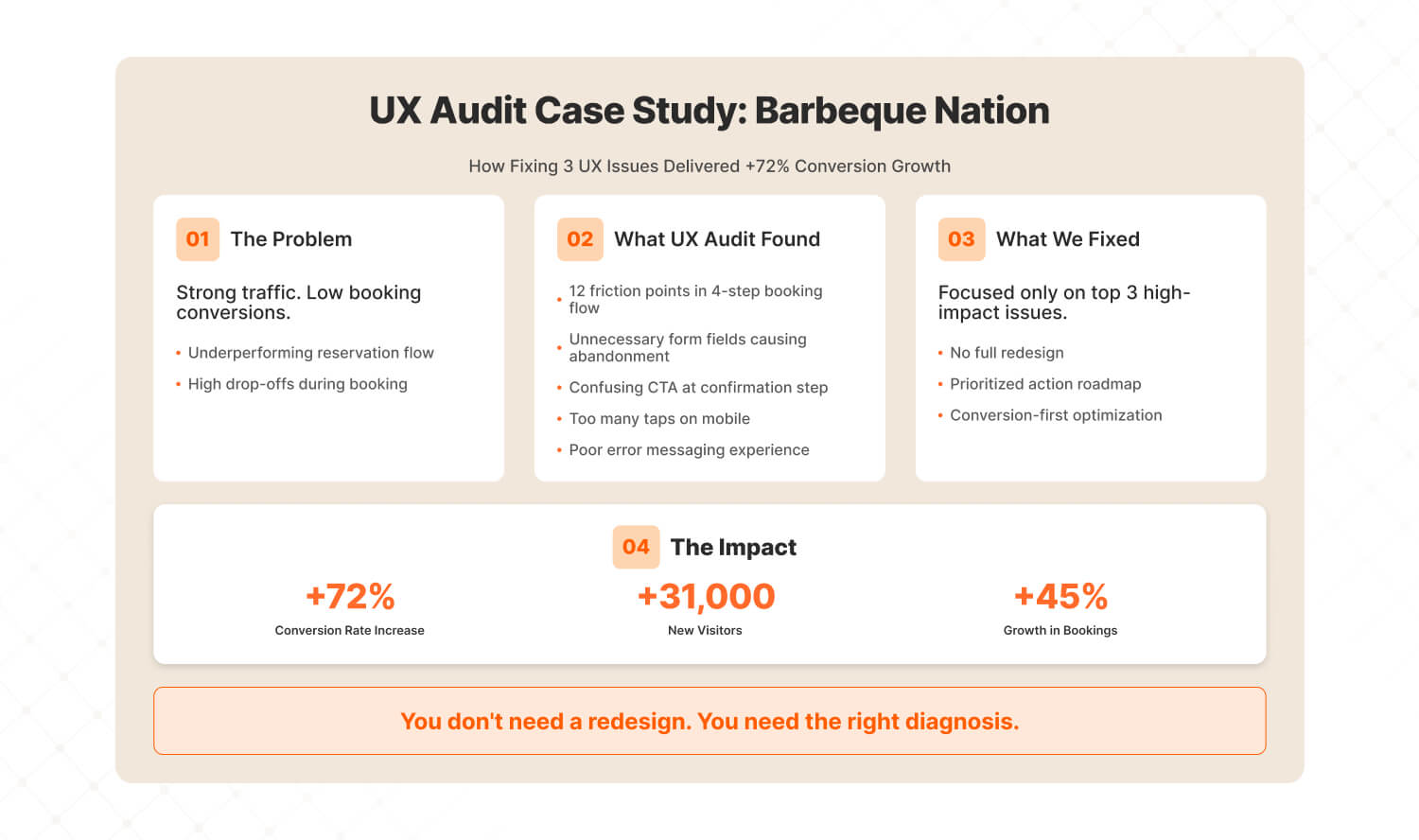
Let's make this concrete.
When Mad Brains Technologies audited Barbeque Nation — one of India's largest casual dining chains — their online table booking flow was underperforming despite strong brand recognition and solid traffic.
What our UX audit found:
12 distinct friction points across a 4-step reservation process
Unnecessary form fields creating abandonment before completion
CTA language that created ambiguity at the confirmation step
Mobile experience requiring too many taps — critical for a restaurant audience booking on-the-go
Error states that frustrated users instead of guiding them forward
What we didn't do: Recommend a full redesign.
What we did: Delivered a prioritized action roadmap targeting the 3 highest-impact friction points first.
The results:
+72% increase in conversion rate
+31,000 new visitors driven by improved engagement and reduced bounce signals
+45% overall growth in booking volume
The fix didn't require rebuilding the product. It required knowing exactly which three things to fix.
This is the pattern we see across every audit — in SaaS, e-commerce, fintech, and hospitality. The problem is never what it looks like from the outside.

How Mad Brains Conducts a UX Audit
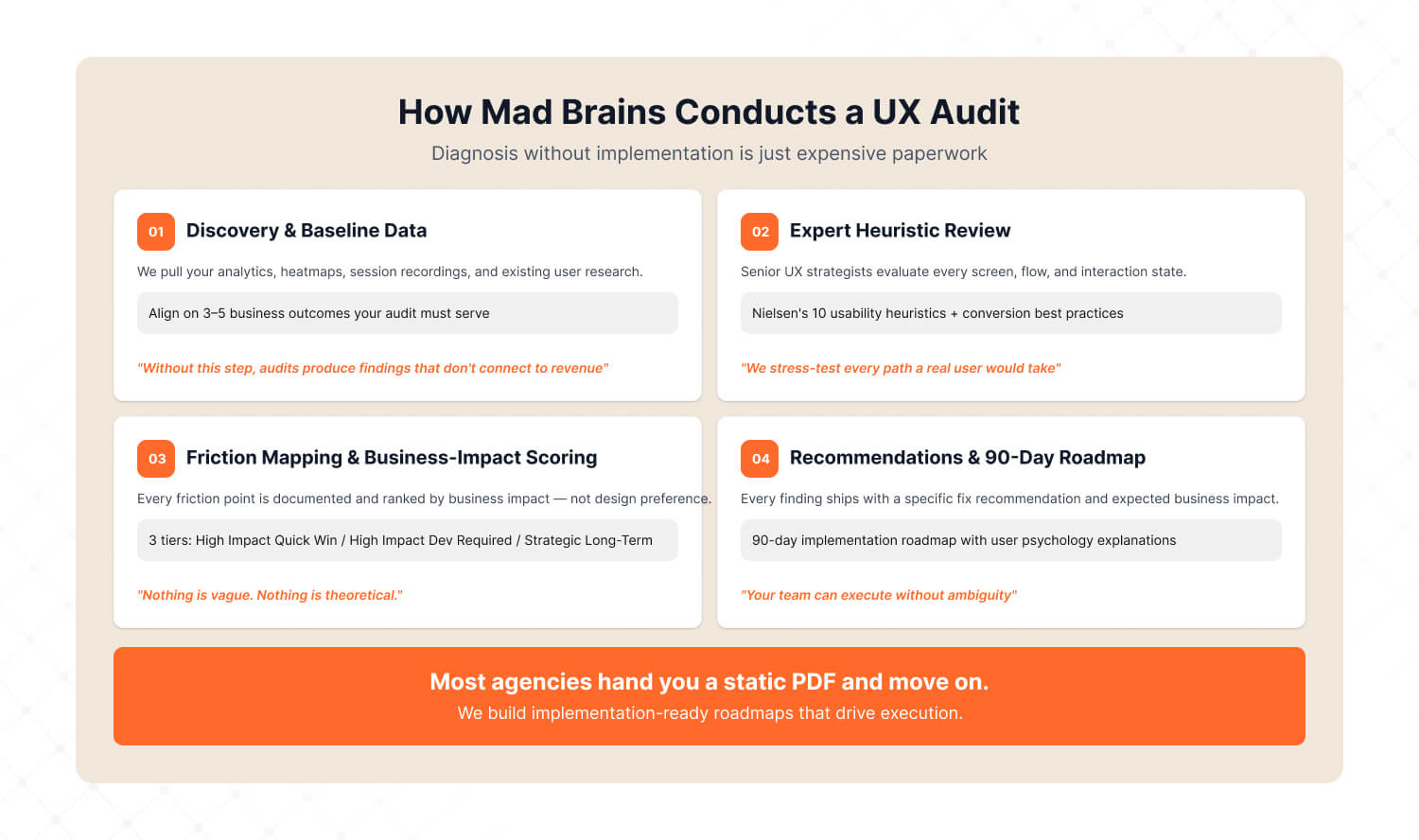
Most agencies hand you a static PDF and move on. That report sits in a folder. Nothing changes. We've built our audit process around one principle: diagnosis without implementation is just expensive paperwork.
Phase 1 — Discovery & Baseline Data
We pull your analytics, heatmaps, session recordings, and existing user research. We align on the 3–5 business outcomes your audit must serve. Without this step, audits produce findings that don't connect to revenue — and nobody acts on them.
Phase 2 — Expert Heuristic Review
Our senior UX strategists evaluate every screen, flow, and interaction state against Nielsen's 10 usability heuristics, mobile UX standards, and conversion best practices. We don't skim — we stress-test every path a real user would take.
Phase 3 — Friction Mapping & Business-Impact Scoring
Every friction point is documented and ranked by business impact — not design preference. You receive three tiers: High Impact / Quick Win, High Impact / Development Required, and Strategic Long-Term Changes. Nothing is vague. Nothing is theoretical.
Phase 4 — Recommendations & 90-Day Roadmap
Every finding ships with a specific fix recommendation, an explanation of the user psychology behind the issue, and an expected business impact. We build a 90-day implementation roadmap so your team can execute without ambiguity.
This is also how we work across our UI/UX Subscription service — for teams that need ongoing design support post-audit.
How Much Does a UX Audit Service Cost in 2025?
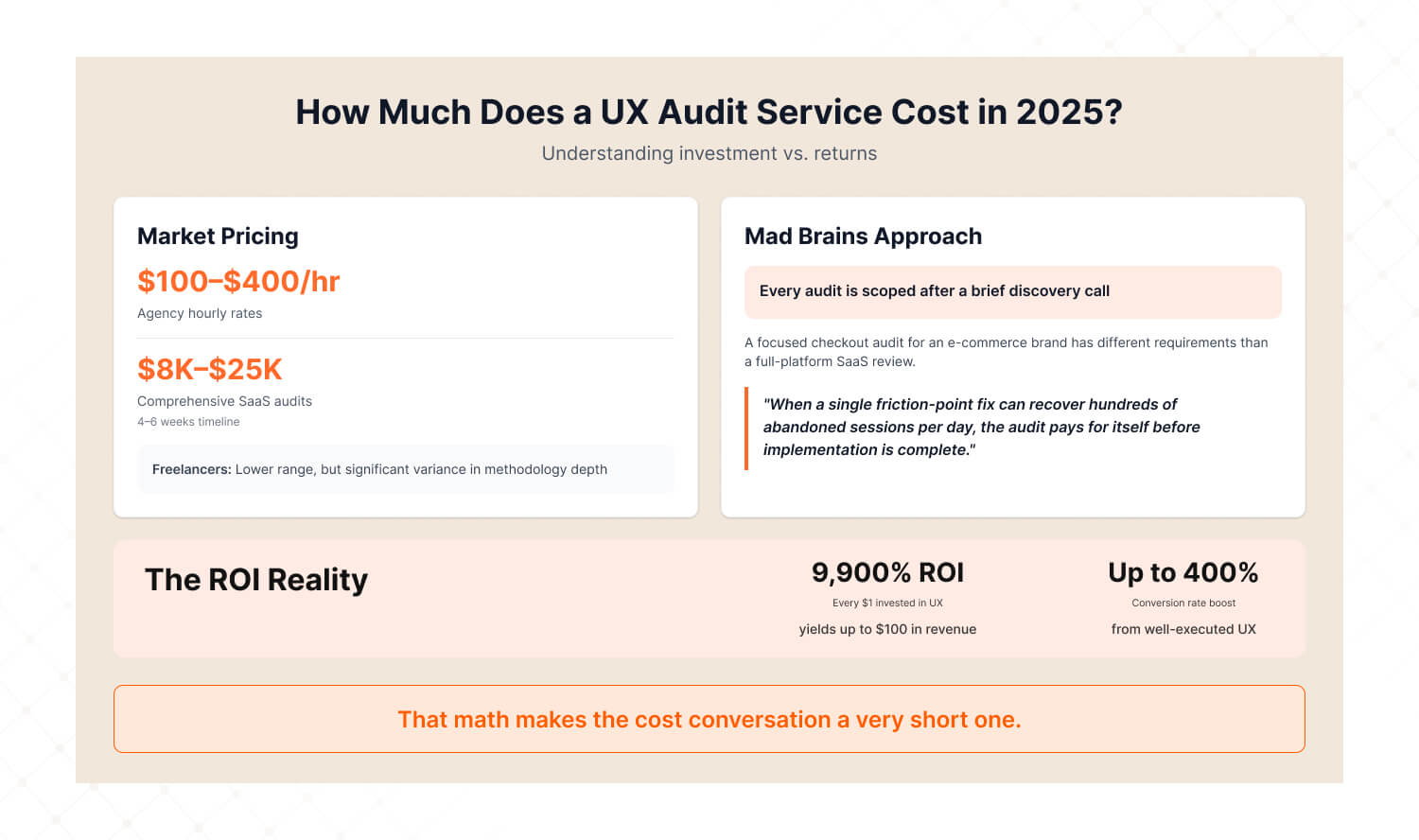
Agency-led UX audits range from $100–$400 per hour, with comprehensive SaaS audits typically running $8,000–$25,000 and taking 4–6 weeks. Freelancers typically range lower, but with significant variance in methodology depth.
At Mad Brains, every audit is scoped after a brief discovery call — because a focused checkout audit for an e-commerce brand has different requirements than a full-platform SaaS review.
What we can tell you with confidence: the ROI on a well-executed audit consistently outperforms almost every other investment in your product stack. When a single friction-point fix can recover hundreds of abandoned sessions per day, the audit pays for itself before implementation is complete.
Every $1 invested in UX yields up to $100 in revenue — a 9,900% ROI. A well-executed UX can boost conversion rates by up to 400%.
That math makes the cost conversation a very short one.
How to Choose the Right UX Audit Partner
This is the section no competitor writes — because the answer requires being honest about what separates good audits from expensive paperwork.
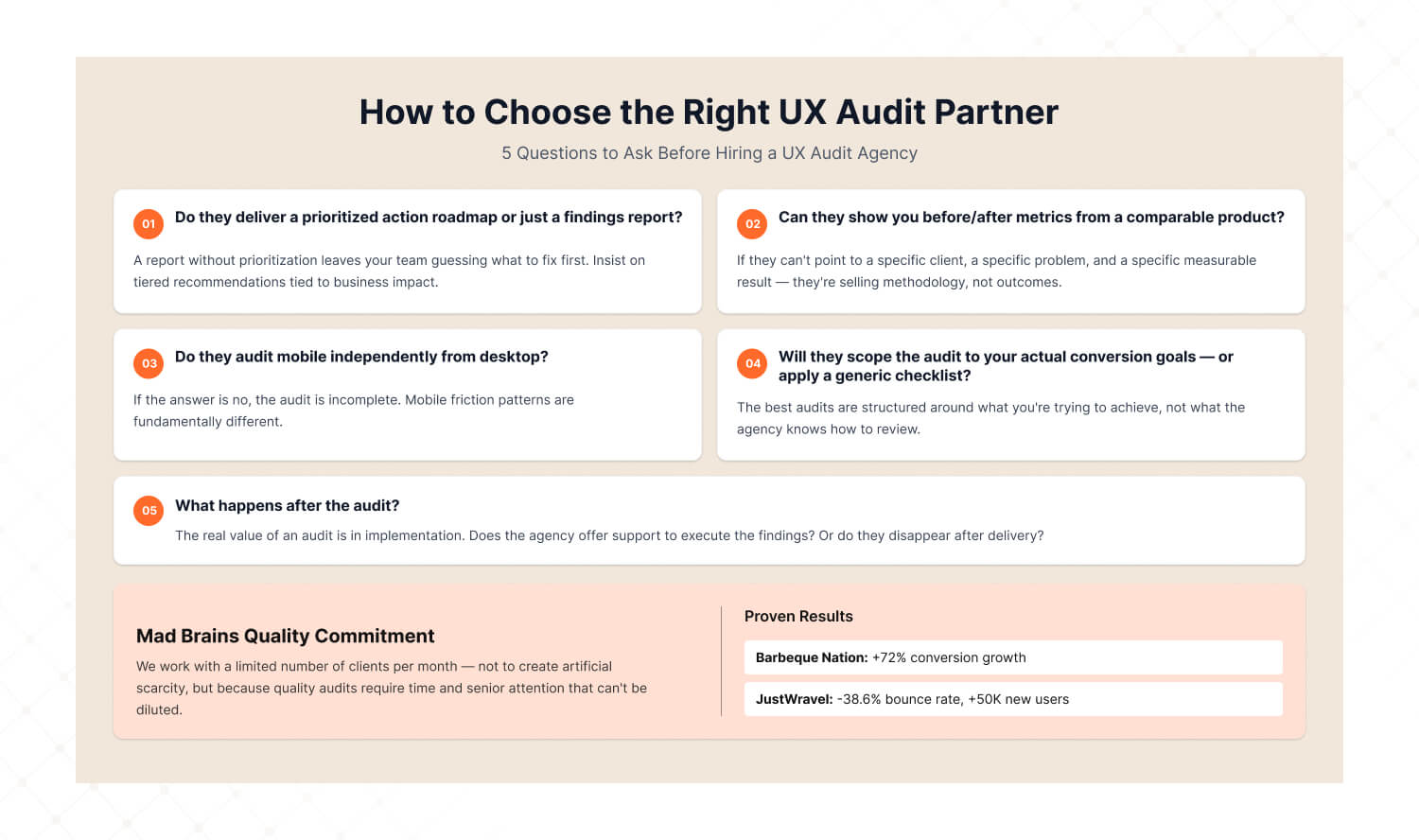
Ask these 5 questions before hiring a UX audit agency:
Do they deliver a prioritized action roadmap or just a findings report?
A report without prioritization leaves your team guessing what to fix first. Insist on tiered recommendations tied to business impact.
Can they show you before/after metrics from a comparable product?
If they can't point to a specific client, a specific problem, and a specific measurable result — they're selling methodology, not outcomes.
Do they audit mobile independently from desktop?
If the answer is no, the audit is incomplete. Mobile friction patterns are fundamentally different.
Will they scope the audit to your actual conversion goals — or apply a generic checklist?
The best audits are structured around what you're trying to achieve, not what the agency knows how to review.
What happens after the audit?
The real value of an audit is in implementation. Does the agency offer support to execute the findings? Or do they disappear after delivery?
Mad Brains works with a limited number of clients per month — not to create artificial scarcity, but because quality audits require time and senior attention that can't be diluted. The same team that audited Barbeque Nation and JustWravel (whose bounce rate dropped 38.6% while adding 50,000 new users) brings that same methodology to every engagement.
Frequently Asked Questions
Stop Losing Conversions You Can't See
Your bounce rate isn't a marketing problem. Your drop-off rate isn't a copy problem. Your low activation rate isn't a features problem.
In 9 out of 10 audits we conduct, the root cause is a UX problem that the internal team stopped seeing months ago — because familiarity creates blind spots that only an external, structured audit can remove.
Organizations that adopted continuous UX research and testing achieved revenue retention improvements of up to 10.8% over three years. That's before you account for the conversion lift from fixing what the audit finds.
The brands that grow aren't the ones with the best products. They're the ones who know exactly what's blocking their users — and fix it precisely.

Last updated:
Mad Brains Technologies
Enterprise UX & Product Strategy Team
Mad Brains is an enterprise UX and product consultancy focused on reducing product risk and accelerating growth. Through UX audits, conversion-led design, and full-stack development, the team helps organizations build scalable digital platforms that drive measurable business outcomes.