CRO
By

Mad Brains Technologies
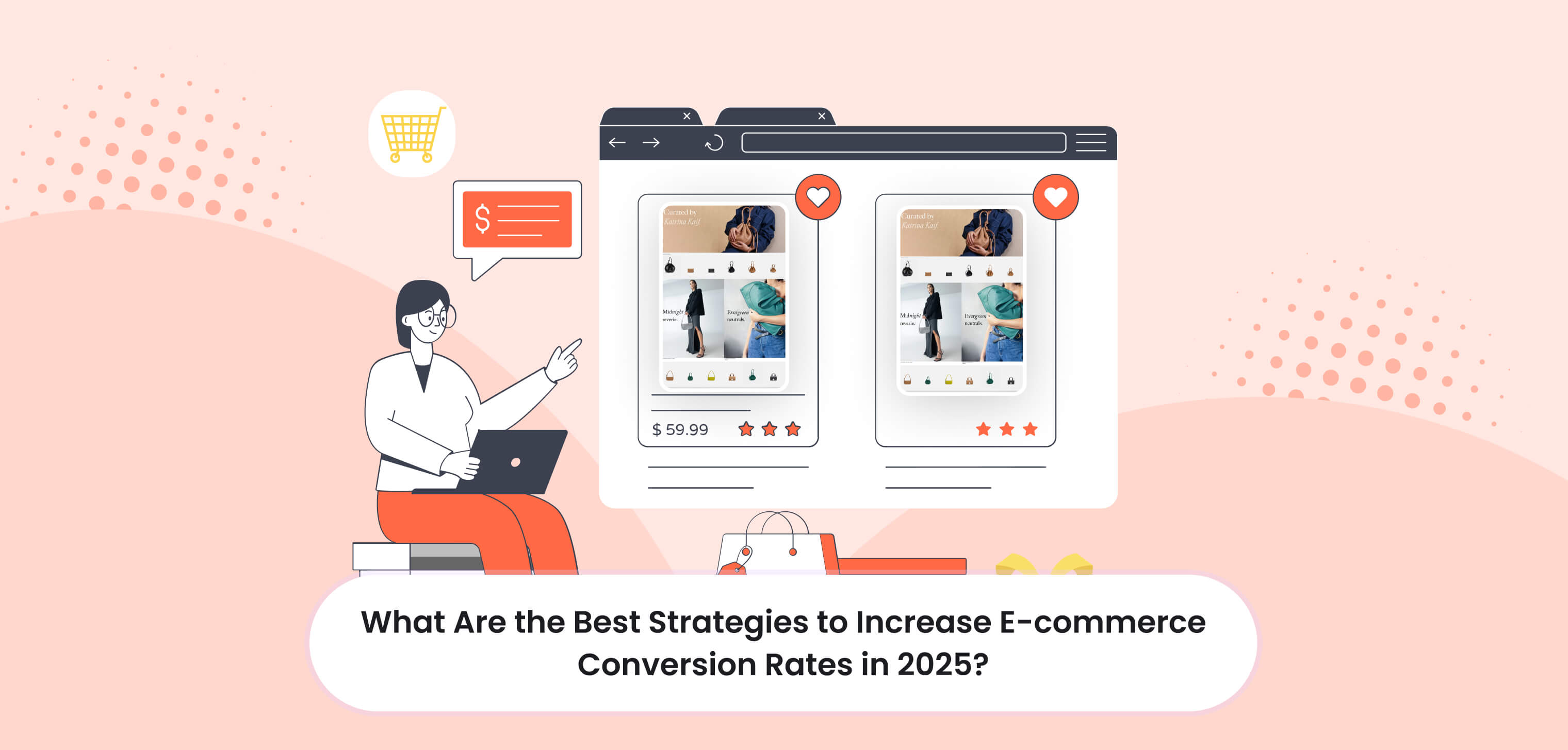


Getting visitors to your ecommerce store is only half the job. The bigger challenge is getting those visitors to complete a purchase.
Ecommerce conversion rate optimization (CRO) is the process of improving an online store so more visitors complete a desired action, such as making a purchase. A high-traffic store can still struggle with conversions if shoppers encounter confusing navigation, weak product information, slow pages, unexpected costs, or a complicated checkout process.
That’s why increasing an ecommerce conversion rate isn’t about adding random pop-ups or changing a button color. It starts with understanding where shoppers drop off and what is stopping them from moving forward.
The right ecommerce conversion rate optimization strategies focus on reducing friction, building trust, improving the shopping experience, and fixing the points where potential customers leave without buying.
What Is E-commerce Conversion Rate Optimization?
E-commerce conversion rate optimization (CRO) is the process of improving an online store so a higher percentage of visitors complete a desired action, such as making a purchase, adding a product to their cart, or starting checkout.
CRO focuses on finding and removing the reasons shoppers hesitate, abandon their carts, or leave before completing a purchase. This can involve improving product pages, navigation, checkout flows, page speed, mobile usability, trust signals, and other parts of the shopping experience.
Your ecommerce conversion rate is calculated as:
(Number of Conversions ÷ Total Visitors) × 100
For example, if 10,000 people visit your store and 200 make a purchase, your conversion rate is 2%.
A higher conversion rate means your store is generating more purchases from the traffic you're already attracting. That can increase revenue without requiring a proportional increase in traffic, although the actual financial impact also depends on factors such as average order value, margins, and acquisition costs.
The Top 10 Strategies to Increase E-commerce Conversion Rates
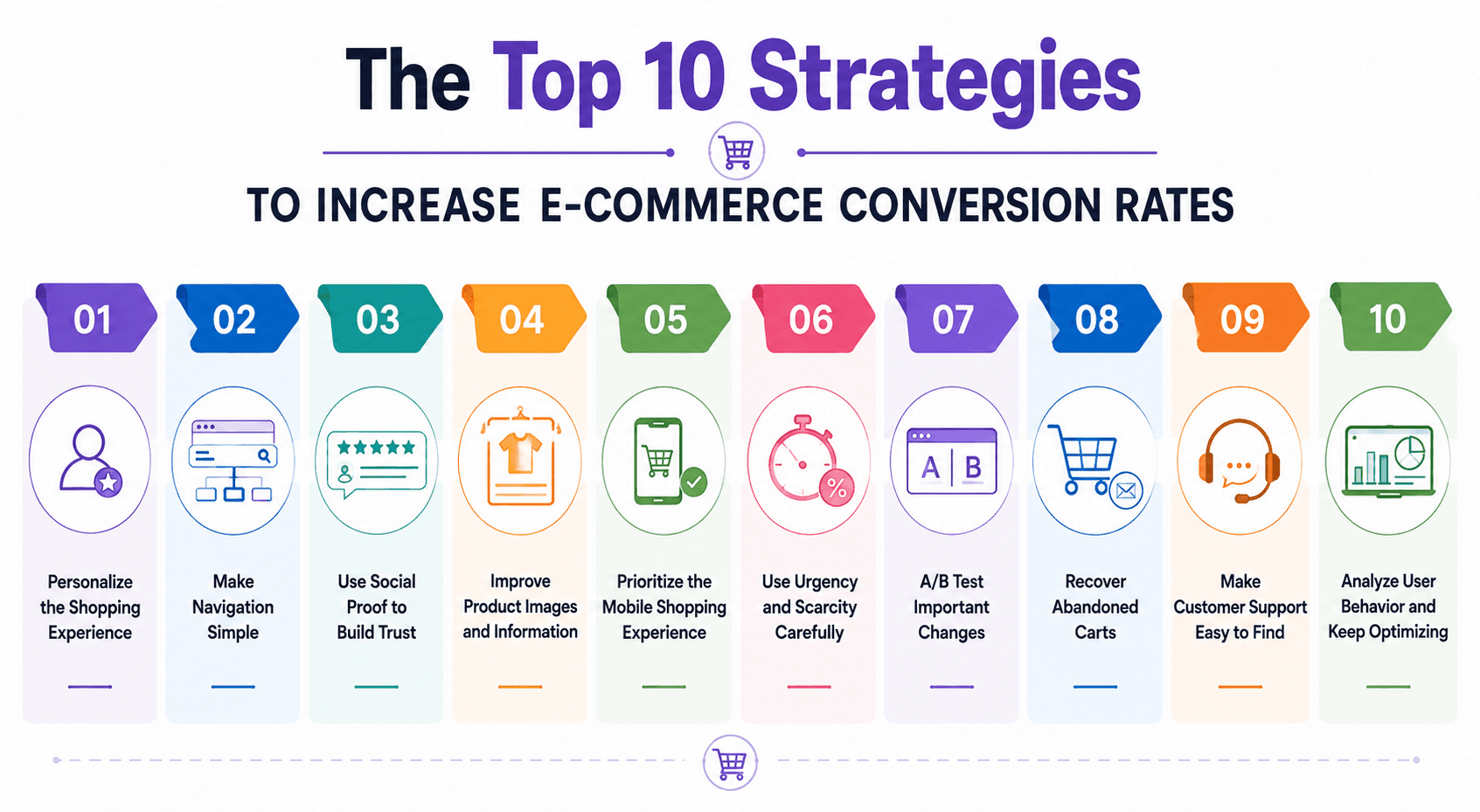
These strategies focus on the areas that most directly affect the ecommerce buying journey, from product discovery and trust to checkout and ongoing optimization.
1. Personalize the Shopping Experience
Use browsing behavior, previous purchases, and cart activity to make product recommendations and offers more relevant. Personalized product recommendations and targeted email flows can help shoppers discover products that match their interests.
2. Make Navigation Simple
Shoppers should be able to find products without having to figure out how your website works. Use clear categories, useful filters, effective site search, and mobile-friendly navigation to reduce friction.
3. Use Social Proof to Build Trust
Reviews, ratings, testimonials, and customer-generated content can reduce uncertainty before a purchase. Place relevant social proof near product information and other points where shoppers are making decisions.
4. Improve Product Images and Information
Give shoppers enough visual and product information to make a confident decision. Use multiple product angles, zoomable images, videos where useful, clear specifications, sizing details, and transparent shipping and return information.
5. Prioritize the Mobile Shopping Experience
Your mobile experience should make browsing, product discovery, cart actions, and checkout easy on smaller screens. Focus on tap-friendly controls, simple navigation, fast-loading pages, readable product information, and an easy-to-use checkout.
6. Use Urgency and Scarcity Carefully
Genuine limited-time offers, low-stock notifications, and clearly defined sale periods can encourage shoppers to act. Avoid fake countdowns or misleading scarcity, which can damage trust.
7. A/B Test Important Changes
Don't assume a design or copy change will improve conversions. Test elements such as CTAs, product page layouts, promotional messaging, navigation, and checkout experiences against a clear hypothesis and measurable goal.
8. Recover Abandoned Carts
Some shoppers leave without purchasing because they're distracted, comparing products, or still have unanswered questions. Abandoned-cart emails, SMS reminders, and retargeting can bring some of these shoppers back.
9. Make Customer Support Easy to Find
Questions about products, shipping, returns, or payments can prevent a purchase when shoppers can't find answers quickly. Offer accessible support through live chat, FAQs, clear policies, and easy-to-find contact options.
10. Analyze User Behavior and Keep Optimizing
CRO is an ongoing process. Track metrics such as conversion rate, add-to-cart rate, checkout completion, and average order value, then use analytics, user testing, and customer feedback to identify what needs improvement.
How The Mad Brains Approaches E-commerce CRO
At The Mad Brains, we approach e-commerce CRO by looking beyond individual design elements and examining the complete shopping journey. We identify where users encounter friction, from product discovery and product pages to cart and checkout, and use those insights to determine what needs to change.
Our process combines UX audits, user behavior analysis, usability evaluation, and conversion-focused design to uncover issues that may be preventing visitors from taking the next step. Instead of relying on assumptions or applying the same checklist to every store, we prioritize improvements based on the store’s goals, user behavior, and the impact each change can have on the shopping experience.
The goal is simple: make the buying journey clearer, easier, and more effective while creating an experience that works for both shoppers and the business.
Conclusion
Increasing your ecommerce conversion rate isn’t about making one isolated change and expecting immediate results. It requires a better understanding of how shoppers move through your store and where friction causes them to hesitate or leave.
Start by improving the areas that have the biggest impact on the buying journey, including product pages, navigation, mobile usability, trust, cart recovery, and checkout. Use analytics and testing to measure what works, then keep refining the experience based on real user behavior.
If you’re unsure where your store is losing potential customers, a UX and CRO audit can help identify the issues worth fixing first.

Frequently Asked Questions
1. What is e-commerce conversion rate optimization?
E-commerce conversion rate optimization (CRO) is the process of improving an online store to increase the percentage of visitors who complete a desired action, such as making a purchase. It involves identifying friction in areas such as navigation, product pages, mobile usability, cart, and checkout, then improving those experiences.
2. How can I increase my e-commerce conversion rate?
Start by identifying where shoppers drop off and what may be preventing them from completing a purchase. Improving product information, simplifying navigation and checkout, strengthening trust signals, optimizing the mobile experience, recovering abandoned carts, and testing changes can all help increase conversions.
3. What is a good e-commerce conversion rate?
There is no single conversion rate that applies to every e-commerce store. Results can vary based on factors such as product category, traffic source, pricing, audience, device, and purchase intent. Instead of relying only on an industry benchmark, track your own conversion rate over time and look for meaningful improvements.
4. How do you calculate e-commerce conversion rate?
E-commerce conversion rate is calculated by dividing the number of conversions by the total number of visitors and multiplying the result by 100.
Conversion Rate = (Conversions ÷ Total Visitors) × 100
For example, if 200 out of 10,000 visitors make a purchase, the conversion rate is 2%.
5. Why is my e-commerce conversion rate low?
A low conversion rate can result from several issues, including confusing navigation, poor product information, slow pages, weak trust signals, unexpected costs, limited payment options, or a complicated checkout process. Analytics and user behavior data can help identify where shoppers are leaving and which problems should be addressed first.
Last updated:
Mad Brains Technologies
Enterprise UX & Product Strategy Team
Mad Brains is an enterprise UX and product consultancy focused on reducing product risk and accelerating growth. Through UX audits, conversion-led design, and full-stack development, the team helps organizations build scalable digital platforms that drive measurable business outcomes.