Agentic AI
By

Mad Brains Technologies


Quick Summary:
The parent article explains what agentic AI is, how it works, how it differs from traditional and generative AI, and why businesses are adopting it in 2026. It covers key benefits, major business use cases, challenges, autonomy, human oversight, and how companies can get started. The supporting article should avoid repeating these fundamentals and instead focus specifically on how AI agents can be applied within business workflows, including suitable workflows, practical process examples, human-agent responsibilities, and how to identify the right opportunities for AI workflow automation.
That makes agentic AI different from traditional automation and many generative AI tools, which typically respond to a specific instruction or follow predefined rules. AI agents can work toward an outcome rather than simply completing one isolated task.
For businesses, this creates a new approach to business automation. Instead of relying only on fixed workflows, companies can use AI agents to handle more complex tasks that involve judgment, changing inputs, and multiple decisions.
This guide explains what agentic AI is, how AI agents work, how they differ from other AI systems, and why they are becoming increasingly important for business automation in 2026.
Businesses can apply this shift to specific operational processes by using AI agents to automate business workflows, while keeping employees involved where judgment or approval is required.
What is Agentic AI?
Agentic AI is an artificial intelligence system designed to work toward a goal by reasoning, making decisions, taking actions, and adapting to changing conditions with limited human input. Instead of waiting for a person to provide an instruction for every step, an agentic system can determine what needs to happen next based on the goal it has been given.
That difference is what makes agentic AI more than another way of describing generative AI. A generative AI tool might create an email when asked. An AI agent, depending on how it is designed, could determine which customer needs a response, gather the relevant information, draft the reply, take an approved action, and adjust its next step based on the result.
The technology is built around AI agents that combine reasoning capabilities with tools, data, memory, and access to business systems. Their level of autonomy can vary, so not every AI agent operates completely independently.
What Makes Agentic AI Different From Traditional AI?
Agentic AI stands apart from traditional AI mainly because of how it approaches a goal. Conventional AI systems are often built to produce a specific output from a given input. Agentic systems can go a step further by assessing the situation, deciding what needs to happen next, and taking action toward an objective.
That difference becomes clearer when you compare the two.
Traditional AI | Agentic AI |
Responds to a defined input | Works toward a defined goal |
Often performs a specific task | Can handle multiple related tasks |
Follows predefined logic or instructions | Can decide what action to take next |
Usually requires another prompt for the next step | Can continue acting based on the situation |
Limited adaptability | Can adapt its actions based on new information |
How Does Agentic AI Work?
Agentic AI works by combining reasoning, planning, decision-making, and action to pursue a defined goal. Instead of producing an answer and stopping, an AI agent can assess the situation, determine what needs to happen next, take an action, and use the result to decide its next move.
A typical agentic AI system follows a cycle like this:
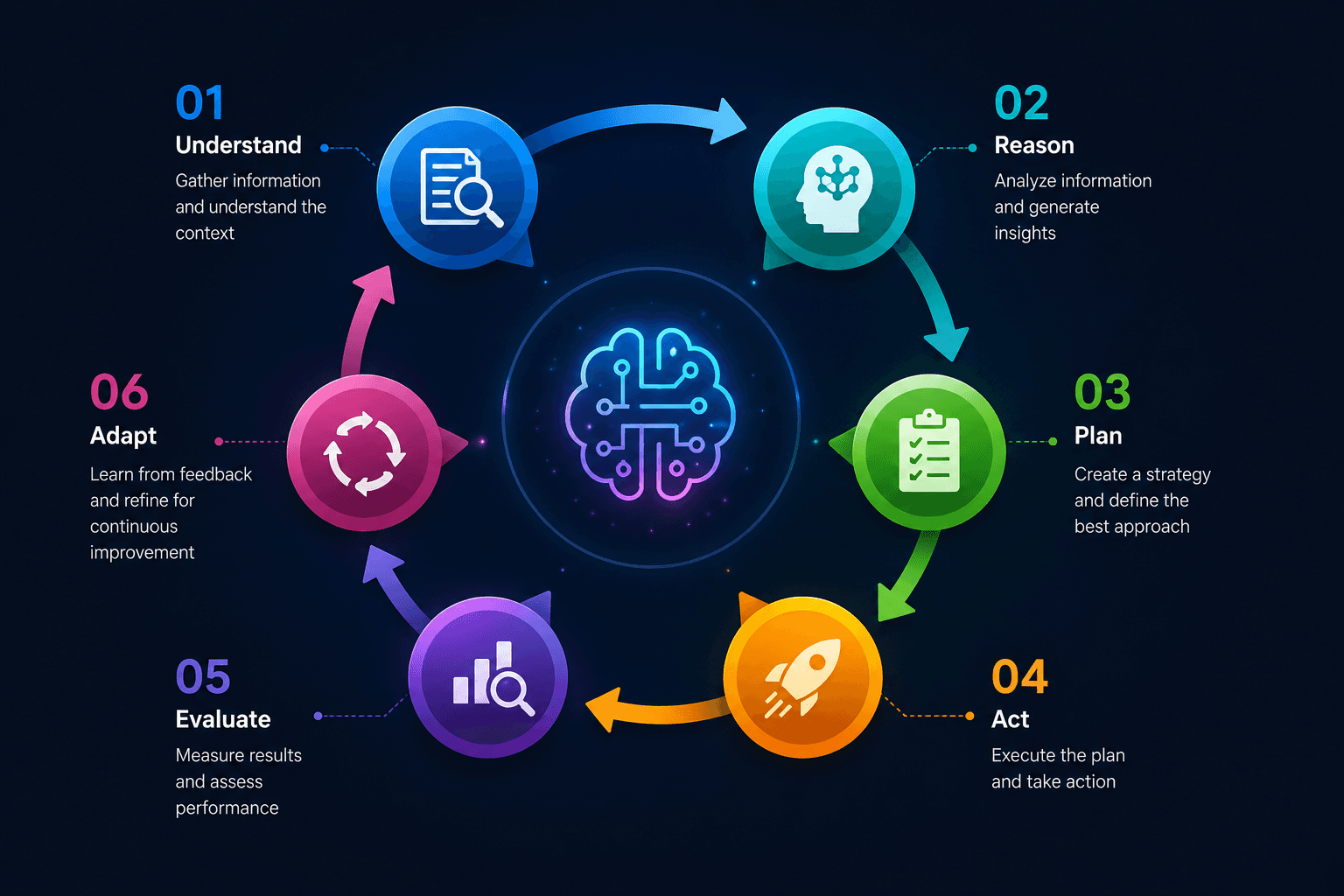
An agent typically brings together several capabilities to make this possible:
Reasoning: Helps the system assess information and determine an appropriate course of action.
Planning: Allows it to break a larger objective into manageable tasks when necessary.
Tool use: Lets the agent interact with software, databases, APIs, or other resources it has been permitted to access.
Memory and context: Gives the system information it can use when deciding what to do next.
Feedback: Allows it to assess the outcome of an action and adjust its approach.
AI strategy and consulting can help organisations make those decisions before deploying agents at scale.
Google Cloud's research also found that 43% of IT leaders identify difficulty integrating with legacy APIs and data sources as their biggest agentic AI infrastructure gap.
Why Is Agentic AI Important for Businesses in 2026?

Businesses are moving past the stage where AI is mainly used to generate content, answer questions, or assist employees with individual tasks. The bigger opportunity now is using AI to act on business objectives, make decisions within defined boundaries, and handle work that previously required several manual steps.
The adoption curve shows how quickly this shift is happening. Gartner’s 2026 CIO and Technology Executive Survey found that only 17% of organisations have deployed AI agents, but more than 60% expect to deploy them within the next two years. Gartner describes this as the most aggressive adoption curve among the emerging technologies measured in its survey.
1. Beyond Task-Level Automation
Traditional automation works best with predictable processes. Agentic AI can handle situations that involve changing information, decisions, and exceptions. This reduces the need for constant human intervention.
2. AI Is Entering Business Operations
AI is increasingly being used for areas such as customer service, research, internal operations, software development, and security. AI agents for business can take on defined responsibilities rather than simply assisting employees with individual requests.
3. More Context-Aware Decisions
Connecting AI with business data allows systems to consider information from multiple sources before recommending or taking an action. Human review can remain necessary for decisions with significant consequences.
4. The Competitive Question Is Changing
The question is no longer just whether a business should use AI. It’s becoming where AI can take meaningful responsibility within the organisation.
That shift could also change how businesses interact with enterprise software. Gartner estimates that up to $234 billion in enterprise application spending could be exposed to agentic AI between now and 2030, representing roughly 20% of enterprise SaaS spending by 2030.
That makes agentic AI an operational consideration for businesses planning their next stage of AI adoption.
How Is Agentic AI Changing Business Automation in 2026?
The key difference, though, is that automation is no longer being driven by pre-defined, rule-based orders. Rather than execute actions in a sequence and be utterly helpless when something unexpected occurs during the process, agentic AI can react.
This is changing AI automation in several practical ways:
More flexible processes: Systems can respond to changing inputs instead of relying entirely on fixed rules.
Less manual intervention: Routine decisions can be handled without requiring employees to approve every small step.
Better handling of exceptions: AI can assess unexpected situations and determine an appropriate next action.
Connected operations: Agents can work across different tools and systems when given the required access.
Continuous improvement: Systems can use feedback from previous actions to adjust how they approach similar tasks.
The result is a shift from automation that simply executes instructions to automation that can work toward an outcome within defined boundaries.
What Are the Benefits of Agentic AI for Businesses?
The value of agentic AI goes beyond reducing the time spent on individual tasks. Its bigger advantage is giving businesses systems that can handle more responsibility while employees focus on work that requires judgment, creativity, or direct customer interaction.
1. Reduced Manual Work
Repetitive work can take up significant employee time. Agentic systems can take responsibility for certain routine activities, reducing the number of tasks employees need to handle manually.
2. Faster Operations
An AI system that can assess information and act without waiting for constant instructions can shorten the time between identifying an issue and responding to it. This can be useful in areas where delays affect customers or internal teams.
3. Greater Scalability
As business volume grows, adding more people isn't always the most practical solution. Agentic systems can help handle increasing workloads without requiring every additional task to be managed manually.
4. Better Employee Productivity
Employees can spend less time on repetitive coordination and information gathering and more time on work that needs human expertise. The goal isn't to replace every human task, but to remove unnecessary effort around it.
5. More Consistent Execution
Once appropriate boundaries and processes are defined, AI systems can perform recurring work consistently without fatigue or variations in how an employee approaches the same task.
6. More Responsive Business Operations
Because these systems can respond to changing information, businesses can react more quickly when conditions change instead of waiting for someone to manually identify and handle every situation.
What Are the Challenges of Agentic AI?
Greater autonomy also means businesses need to think carefully about how these systems are deployed. The main challenge isn't whether agentic AI can perform useful work, but how much responsibility it should have and under what conditions.
The infrastructure behind these systems is another consideration. Google Cloud's 2026 research found that 83% of organisations require infrastructure upgrades to support production-grade autonomous systems. The same research found that 4 in 5 organisations consider security, governance, or MLOps among their most significant challenges when scaling agentic AI.
Setting the right level of autonomy: Businesses need clear boundaries around which decisions an agent can make independently and which require approval.
Managing access: Agents may interact with business data and software, so permissions need to match their responsibilities.
Maintaining oversight: Monitoring helps teams understand what agents are doing and step in when an action falls outside expectations.
Handling complex decisions: Tasks involving sensitive information or significant business consequences may still require human judgment.
These considerations don't reduce the value of agentic AI. They help businesses determine where greater autonomy makes sense and where human involvement should remain part of the process.
Conclusion
Agentic AI is changing business automation by moving AI beyond simple responses and predefined tasks. AI systems can work toward broader objectives, make decisions within defined boundaries, and take action across different stages of a process.
For businesses, the opportunity is less about adding AI everywhere and more about identifying where greater autonomy can reduce manual effort, improve responsiveness, and support employees. Agentic automation can help businesses move toward more adaptive operations, while AI workflow automation can connect AI-driven actions with recurring business processes.
As adoption grows in 2026, organisations that approach these technologies with clear goals, appropriate controls, and practical use cases can make AI a more meaningful part of their day-to-day operations.
Explore how The Mad Brains can help you build and implement AI solutions tailored to your business needs.
FAQs
Last updated:
Mad Brains Technologies
Enterprise UX & Product Strategy Team
Mad Brains is an enterprise UX and product consultancy focused on reducing product risk and accelerating growth. Through UX audits, conversion-led design, and full-stack development, the team helps organizations build scalable digital platforms that drive measurable business outcomes.