App Development
By

Mad Brains Technologies



Summary: A complete 2026 guide to mobile app development cost. This covers pricing by complexity, feature, platform, industry, region, and team structure. It also includes an honest look at what low-cost quotes usually exclude, how engagement models affect price, and how to evaluate a development partner.
Mobile app development cost in 2026 ranges from $15,000 for an MVP to $500,000 or more for a high-level, enterprise-grade application. Most funded startups and small-to-mid businesses land somewhere between $50,000 and $180,000 for a fully custom app with a real feature set. Five things move that number: app complexity, platform choice, design depth, who's building it, and where they are during the building process.
Stick around this guide by The Mad Brains for the full app development cost breakdown, what cheap quotes conveniently leave out, and how to spot a fair price versus a bad one before you have signed anything.
Why "It Depends" Is Actually the Honest Answer
Ask ten agencies how much does it cost to build an app, and you will get ten numbers, sometimes ten times apart. That’s not evasiveness. It’s closer to asking a tailor what a suit costs – off-the-rack and bespoke are both technically “a suit,” but one is ready by Friday, and the other involves three fittings and a very different bill.
Every quote, underneath the sales language, comes down to the same equation:
Total development hours × hourly rate = mobile app development cost
Hours depend on how many screens the app needs, how much custom design goes into it, and how many integrations it has to juggle. The rate depends on who’s typing the code and which city they’re doing it from. Stack a bloated hour count on top of a premium rate, and you land in six figures fast. Keep the scope tight and hire someone where the cost of living is lower, and the same category of app costs a fraction of that – not a worse app, necessarily, just a differently resourced one.
And the market backing all this isn’t small. Statista projects worldwide downloads from the Google Play Store will hit roughly 143 billion in 2026, up from 111 billion in 2021, with Apple’s App Store adding another 38 billion on top.
That’s the pool everyone’s fishing in, and it’s a decent reason to spend more than five minutes on the budget.
Mobile App Development Cost by App Complexity
Four buckets cover most of what’s actually quoted in 2026.
Complexity Tier | Cost Range | What’s Typically Included |
Simple/MVP | $15000 - $50000 | One core user flow, basic UI, minimal backend, no complex integrations |
Mid-complexity | $50,000 – $150,000 | User accounts, payments, third-party APIs, custom UI, moderate backend |
Complex | $150,000 - $300,000 | AI/ML features, real-time functionality, multiple integrations, custom animation |
Enterprise-grade | $300,000 – $500,000+ | Compliance requirements (HIPAA, SOC 2, GDPR), multi-role systems, custom infrastructure at scale |
Clutch, the B2B research firm that surveys hundreds of development shops, publishes an average full-cycle project cost of $90,780, with projects taking roughly 11 months on average. Smaller, well-scoped builds tend to fall in the $10,000 - $50,000 range; anything with real AI, compliance, or multi-platform demands routinely clears six figures.
Here’s the thing nobody selling you an app wants to lead with: the price was never really about code. A five-screen app with one login flow and one job to do is cheap because there’s simply less of everything, less to design, less to test, less that can break.
Bolt on a wallet, push notifications, three integrations, and an admin dashboard, and you have tripled the work before a single function gets written.
The $15,000 Quote: What It Usually Doesn't Include
You'll see rock-bottom quotes everywhere, and most aren't scams. You genuinely can get an app built for $10,000–$20,000. What that number usually skips is a proper UX process, both platforms instead of one, a real backend rather than a bare-bones Firebase setup, actual QA, and anything resembling support once the app ships.
The vendor isn't lying to you. They're quoting a specific, narrow scope, honestly. Trouble starts when the buyer assumes that number covers a polished, scalable, App Store-ready product.
If you're testing an idea or shipping a single-feature prototype, that budget can be exactly right. If you're building something you actually want to grow, budget for a proper app design process, a real backend, and a support contract, and watch the number climb accordingly.
App Development Cost by Platform
Platform choice moves the price tag on its own, before complexity even enters the conversation. Two separate native codebases, one for iOS and one for Android, roughly double the engineering effort versus one cross-platform build.
Platform | Simple App | Mid-Complexity App | Enterprise App |
iOS (native) | $25,000 – $60,000 | $60,000 – $150,000 | $150,000 – $350,000 |
Android (native) | $28,000 – $70,000 | $65,000 – $150,000 | $160,000 – $380,000 |
Cross-platform (Flutter/React Native) | $18,000 – $50,000 | $50,000 – $120,000 | $130,000 – $300,000 |
Flutter and React Native compile a single codebase to something close to native performance on both operating systems, which explains why they’ve become the default rather than the compromise.
Unless there’s a specific reason to go fully native, starting cross-platform and bolting on native-only features later, if you ever need them, is the harder position to argue against.
Worth a quick clarification here, since the terms get mixed up constantly: cross-platform (Flutter, React Native) isn't the same thing as a true hybrid app (built with something like Ionic or Cordova).
Hybrid apps run web code inside a native wrapper via WebView, which tends to show in animation smoothness and overall feel. Cross-platform frameworks compile closer to native and generally perform better, which is why they've largely replaced older hybrid tooling for anything beyond the simplest builds.
Mobile App Development Cost Breakdown by Industry
What your app is for changes its price more than people expect, and it’s rarely because the features themselves are harder. It’s compliance.
Industry | Cost Range | Main Cost Driver |
Retail/e-commerce | $20,000 – $150,000 | Product catalogs, payments, inventory sync |
Media & entertainment | $15,000 – $150,000 | Streaming infrastructure, content licensing logic |
Social / community | $30,000 – $250,000 | Real-time feeds, moderation, media handling at scale |
Education | $15,000 – $100,000 | Video delivery, content management, offline mode |
On-demand services | $50,000 – $200,000 | Multi-sided architecture (customer, provider, admin) |
Healthcare | $40,000 – $250,000+ | HIPAA/GDPR compliance, EHR integration, data security |
Fintech | $50,000 – $300,000+ | PCI-DSS compliance, KYC/AML, fraud detection, payment rails |
A login screen for a retail app might take two days. The identical-looking login screen for a HIPAA-compliant health app can eat a week, and not because anyone's typing slower.
Audit logging, session management, and encryption requirements pile on top of the same basic feature. So when a fintech quote comes in three times higher than a to-do list app, the developers aren't gouging you. They're paying a second-layer-of-review tax that healthcare and finance apps carry by law.
The same trust-and-compliance UX thinking shows up on the web side too; our piece on UX strategies for modern banking websites covers principles that carry straight over to a fintech app's design.
App Development Cost Breakdown by Feature
Below the complexity tier and the industry, individual features carry their own sticker prices. This is the level of detail most first-time founders never see coming, which is exactly why budgets balloon here.
Feature | Estimated Cost | Why It Costs What It Costs |
User login & profiles | $3,000 – $8,000 | Standard, well-documented, low custom-code needs |
Push notifications | $2,000 – $6,000 | Simple in concept, but needs backend triggers and segmentation logic |
Payment gateway integration | $5,000 – $15,000 | Security, compliance, and multiple payment methods add hours |
In-app chat/messaging | $8,000 – $20,000 | Real-time infrastructure and message history storage |
GPS/location tracking | $6,000 – $15,000 | Battery optimization and map SDK licensing costs |
AI-based recommendations | $15,000 – $40,000+ | Data pipeline, model training or API integration, and ongoing tuning |
Admin dashboard | $8,000 – $25,000 | A second interface with its own UI/UX and access controls |
Every feature drags a shadow cost behind it: testing time, documentation, and a maintenance line item that never goes away. That’s why real-time features specifically- live GPS, live chat, live order tracking- tend to run three or four times the cost of the same app without them.
A screen that just loads and displays data doesn’t need to worry about dropped connections or conflicting updates. A live one does, constantly.
What Actually Drives App Development Pricing
If you’d rather understand your quote than just nod along and sign it, here’s what actually moves app development pricing.
Feature Count and Complexity
Every screen, every integration, every weird edge case adds hours. GPS tracking, live chat, AI recommendations, and payment processing are the usual culprits that turn “reasonable” into “we should probably schedule another call.”
Third-party Integrations
Each one is basically its own tiny project, complete with documentation to read, a sandbox to test in, and production-ready edge cases nobody warned you about. Wiring up a payment gateway in a sandbox takes maybe two days.
Making it production-ready with webhooks, refunds, and failed-payment handling can eat a full week on its own. Stack a few of these and the bill moves fast.
Design Depth
This is where mobile app UI design quietly eats more budget than people plan for. A generic, off-the-shelf-looking interface takes about a week. A custom, brand-specific one with real motion and accessibility testing can take a month, and that’s before any development starts.
There’s a payoff for doing this properly, too: sloppy design forces developers to guess at flows they should never have had to guess at, which means rebuilding screens later at a rate that’s higher than getting it right the first time.
Team Location
A senior developer in San Francisco and one in Eastern Europe or South Asia might be equally sharp and still charge wildly different rates.
The U.S. Bureau of Labor Statistics puts the median hourly wage for American software developers at $63.59 in May 2023, with the top 10% clearing over $100 an hour. Plenty of agencies and freelancers elsewhere bill well under half that for comparable work.
AI-assisted Development
GitHub, Copilot, Cursor, etc have genuinely sped up the boring parts: boilerplate, standard UI components, basic CRUD, test scaffolding.
Teams using these tools will report shaving 15-20% off that slice of the build. What hasn’t budged is architecture decisions, gnarly integrations, and edge-case QA – the stuff that still needs a human who’s seen this particular kind of mess before. So take it with a grain of salt whenever a vendor claims AI has changed everything, and equal skepticism when one insists it’s changed everything.
Post-launch Maintenance
Almost nobody budgets for this until it's already biting them. Set aside 15–20% of the build cost every year for updates, OS compatibility, and the inevitable bug patches. Some teams handle this through an ongoing design and dev subscription rather than a one-off retainer, which keeps the work flowing instead of restarting a vendor search every time something breaks. Skipping this line is one of the most reliable ways to blow a budget you thought you'd nailed.
Mobile App Development Cost Breakdown by Project Phase
A useful app development cost breakdown doesn’t look like a single number. It looks like a stack of phases, each one taking its cut.
Phase | Share of Budget | What Happens Here |
Discovery & Planning | 5–10% | Research, wireframes, technical scoping |
UI/UX Design | 15–20% | Wireframes, prototypes, visual design system |
Frontend Development | 25–30% | Screens, interactions, client-side logic |
Backend Development | 25–30% | APIs, databases, server-side logic |
QA & Testing | 10–15% | Device testing, bug fixes, performance checks |
Deployment & Launch | 5% | App store submission, final QA |
Post-launch Maintenance | 15–20% of build cost, annually | Updates, OS compatibility, bug patches |
Interesting detail here: Frontend and backend split the bigger chunk of the budget, not design, even though design is the part users actually see first.
All the databases, APIs, and business logic live in the backend, and complexity there has a habit of compounding invisibly – a feature that looks like a checkbox on screen can hide a genuinely nasty amount of work underneath.
Cut corners on design or QA to save a few thousand dollars, and you’ll usually pay it back with interest, either in a rebuild or in users who bounce off something that just feels off.
Cost of Developing an App: Freelancer vs. Agency vs. In-House
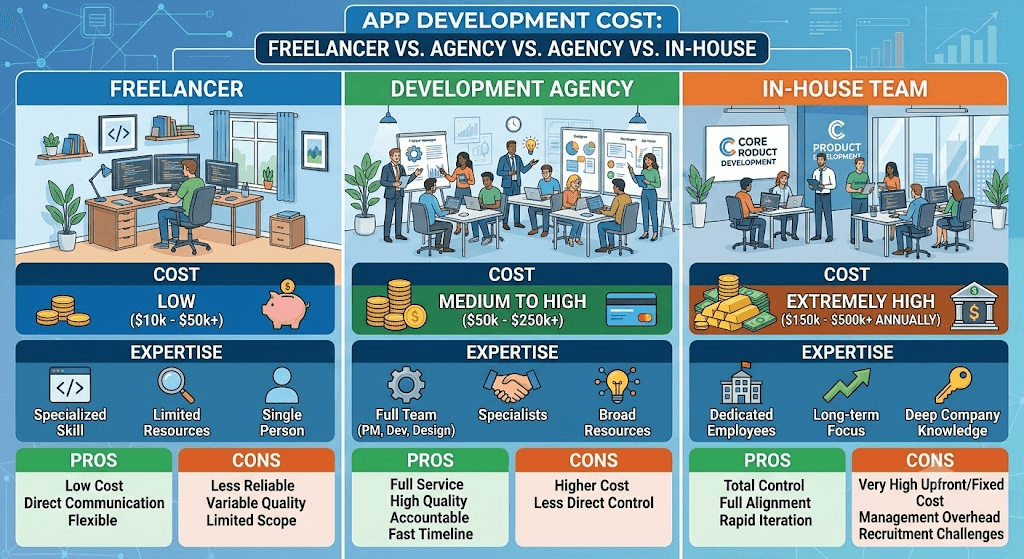
Who actually builds the thing changes the cost of developing an app, and how much depends on role and seniority, not just the type of team.
Role | Freelancer | Mid-Tier Agency | Premium Agency |
Junior Developer | $15 – $30/hr | $25 – $50/hr | $50 – $80/hr |
Mid-level Developer | $30 – $60/hr | $50 – $90/hr | $90 – $140/hr |
Senior Developer | $50 – $90/hr | $90 – $150/hr | $150 – $200/hr |
UI/UX Designer | $25 – $50/hr | $40 – $75/hr | $75 – $130/hr |
QA Engineer | $15 – $30/hr | $30 – $55/hr | $55 – $90/hr |
Project Manager | Rarely Included | $50 – $90/hr | $90 – $150/hr |
One concept worth knowing before you read any agency quote: the blended rate. When a shop hands you a project cost, that number is usually an average smeared across a senior architect’s rate, a mid-level developer’s rate, and a junior QA tester’s rate, with a project manager tossed in.
That blend is what actually decides your budget, not whichever eye-catching rate happens to sit at the top of the proposal.
Team Type | Best For | Trade-off |
Freelancer | Simple apps, tight budgets | Coordination risk, no built-in QA or design |
Agency | Mid-to-complex apps needing a full team | Higher blended rate, coordinated delivery |
In-house team | Companies building on the same app for years | Highest fixed cost, best long-term control |
A freelancer is usually the cheapest way in. The cost you don’t see on the invoice is coordination: you’re managing one person, or several stitched together, and if any of them vanish mid-project, so does your timeline.
Agencies cost more per hour because you’re buying a team that’s already learned how to work together, which starts to matter a lot around the third or fourth round of revisions. If you're weighing this decision specifically for design talent, our guide to hiring a UI/UX design team walks through the same trade-offs in more depth.
In-house teams are the most expensive option once salaries and benefits are counted, but for a company planning to live on the same app for years, that expense finally makes sense. If you are shipping one app and moving on with your life, a full internal hire rarely pays for itself.
Regional Hourly Rate Differences
Where your team sits geographically moves the total bill more than almost anything else on this page. These figures are commonly cited industry ranges for 2026, not government-audited data, so treat them as a planning tool rather than a quote you can hold anyone to.
Region | Junior | Mid-Level | Senior |
United States / Canada | $45 – $75 | $75 – $120 | $120 – $200+ |
United Kingdom / Western Europe | $40 – $65 | $65 – $105 | $105 – $170+ |
Eastern Europe | $20 – $35 | $35 – $60 | $60 – $90 |
India / South Asia | $10 – $20 | $20 – $40 | $40 – $70 |
Southeast Asia | $12 – $20 | $20 – $35 | $35 – $60 |
Latin America | $18 – $30 | $30 – $55 | $55 – $80 |
Take a mid-complexity app estimated at 1,200 development hours.
Built by a South Asian team at a $20/hour blended rate, that’s roughly $24,000.
Built by a US team at $125/hour, it’s $150,000-plus for functionally the same output.
The gap is the entire reason outsourcing conversations exist, and it’s also why who you vet matters a lot more than which country the invoice comes from.
Fixed Price, Time & Materials, or Dedicated Team
How you structure the deal changes both the risk you are carrying and the final number, separate from who you actually hire.
Model | Best For | Pros | Cons |
Fixed price | Well-defined, unlikely-to-change scope | Budget certainty | Vendors often price in a buffer for scope uncertainty |
Time & materials | Evolving or unclear requirements | Flexible, pay for what's done | Requires active project management or the budget drifts |
Dedicated team | Ongoing, long-term development | Deep product knowledge, faster iteration over time | Ongoing monthly cost regardless of workload |
Fixed price only really works if you already know, in real detail, what you are building.
Time & materials suits a project where the requirements are genuinely going to shift, but it only stays sane with someone actively managing scope day to day.
A dedicated team on retainer makes the most sense once you are past the first launch and settling into a long stretch of iteration, not for a single on-off build.
Where Mobile App UI Design Fits Into the Number
Worth separating mobile app UI design from the rest, because founders consistently underrate it. Good UI/UX design isn’t decoration. It’s the layer that decides whether anyone actually sticks around to use what you built.
A confusing checkout or a cluttered dashboard can tank retention as fast as a buggy backend, sometimes faster, because people size up an app’s quality within the first few taps and rarely give it a second chance.
Design Stage | What's Involved | Estimated Cost |
UX wireframes | Low-fidelity flows and screen logic | $2,000 – $8,000 |
UI mockups | High-fidelity, on-brand visual design | $8,000 – $25,000 |
Design system | Reusable components for development | $3,000 – $10,000 |
Motion & micro-interactions | Transitions, loading states, feedback animations | $2,000 – $10,000 |
Custom mobile app UI design for a mid-complexity app usually runs $8,000-$25,000 by itself. Trimming this to save a few thousand dollars is one of the more common false economies in app budgeting, and it’s also one of the first things a cheap quote quietly drops.
What Real-World Apps Cost to Build
None of the companies below have actually published their original build costs, so treat these as informed estimates for what it would take to build something comparable today, not insider numbers. For a sense of what real builds actually look like end to end, our portfolio has examples closer to home.
App Type (Comparable To) | Core Features | Estimated Build Cost |
A messaging app like WhatsApp | Text/voice/video chat, group messaging, media sharing | $50,000 – $180,000 |
A ride-hailing app like Uber | Dual apps (rider/driver), GPS, real-time dispatch, payments | $80,000 – $250,000+ |
A food delivery app like DoorDash | Ordering, live tracking, multi-vendor logistics, payments | $60,000 – $200,000+ |
A dating app like Tinder | Profiles, geolocation matching, chat, subscriptions | $50,000 – $150,000+ |
A streaming app like Spotify | Content library, offline mode, personalization, subscriptions | $80,000 – $300,000+ |
A marketplace app like Urban Company | Customer, provider, and admin apps, matching, payouts | $150,000 – $400,000+ |
Marketplaces sit at the top of that list for a simple reason: you’re not building one app. You’re building three (customer, provider, admin) that all have to talk to each other in real time and disagree about what just happened.
App Development Hidden Costs: Infrastructure, Licenses, and Compliance
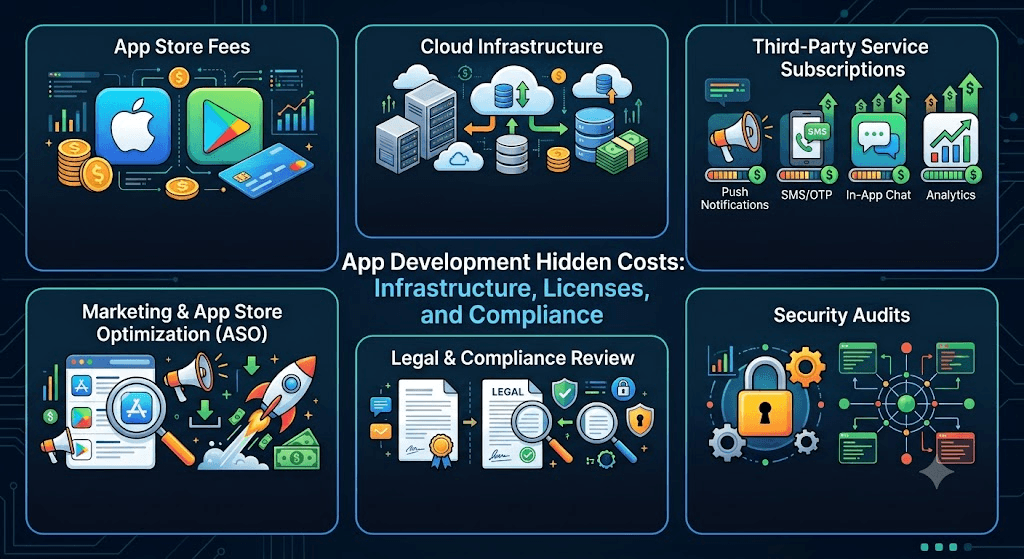
Past the headline number, a handful of recurring expenses have a talent for showing up right after everyone thought the budgeting was done.
App store fees: Apple charges $99/year for a developer account; Google charges a one-time $25 fee, plus both take a cut of in-app purchases.
Cloud infrastructure: A modest app usually runs $200-$1,000/month in hosting and database costs. A mid-complexity app with real traffic can climb to $1,000-$5000+/month. This never stops, unlike the development invoice.
Third-party service subscriptions: Push notifications tools, SMS/OTP verification, in-app chat providers, and analytics platforms tend to start life on generous free tiers, then quietly convert to paid plans the moment your user base grows past what free was designed for. Individually small. Collectively, several hundred to a few thousand dollars a month.
Marketing and app store optimization: Getting people to actually download the thing costs money the development quote never mentions, often as much as the build itself in year one.
Legal and compliance review: Privacy policies, terms of service, and industry-specific compliance work (HIPAA, PCI DSS) can add $1,000 to $25,000 plus depending on how deep it goes.
Security audits: For apps handling anything sensitive, a proper penetration test and audit typically runs $5,000-$100,000+ depending on scope.
None of this is a disaster waiting to happen. It’s just easy to lose track of when your attention is glued to the build itself, and it rarely makes it into the first quote.
The Scope Creep Problem
This deserves its own moment because it’s the single biggest reason projects run over, and it never announces itself as a mistake in real time. “Can we just add a referral system?” “What if we also had a partner-facing app?” “Could the dashboard show analytics too?”
Each one sounds harmless in isolation. Stack enough of them across a few sprints and a $50,000 project has quietly become an $85,000 one, with nobody able to point to the exact moment it happened.
This fix isn’t saying no to good ideas. It’s a formal change-request process, where every addition gets scoped, priced, and signed off in writing before it enters a sprint, not discovered halfway through one.
How to Evaluate a Development Partner Before You Sign
Price alone tells you almost nothing about whether someone can actually deliver. Here’s what’s worth checking first:
Ask for 2–3 references from similar projects, not the testimonials sitting on their homepage. Call the references. Ask specifically how the agency handled scope changes and delays, because that's where the real character shows.
Look at their portfolio with a skeptical eye. Real apps you can download, with real ratings, beat polished concept screenshots every time.
Start with a paid discovery phase before the full build. A 2–4 week discovery engagement that ends in a scoped requirements document and a real estimate tells you a lot about how the rest of the project is going to go.
Ask specific technical questions. How do they handle version control and code review? What does QA actually look like before a release? How are scope changes managed? Vague answers should make you nervous. Specific ones, with real examples, are a good sign.
Be wary of same-day fixed-price quotes for anything complex. A serious estimate needs actual discovery. A vendor willing to lock in a price within hours of your first email is optimizing to win the deal, not to get the number right.
Check the contract basics: payment tied to milestones, never 100% upfront, a clause confirming you own the final code and assets, and a defined warranty window (30–90 days of free bug fixes is standard).
How to Keep Mobile App Development Cost Under Control
None of this requires gutting your feature list. A few unglamorous moves do more than aggressive cost-cutting ever will:
Launch with an MVP built around one core value proposition, then expand based on what real users actually do. This alone can trim total spend by up to 40%.
Default to cross-platform unless there's a specific, defensible reason to go native.
Lock scope down in writing before development starts. Vague requirements at the outset are the single most reliable predictor of expensive rework later.
Get the design right once instead of redesigning mid-build.
Ask for a phased app development cost breakdown rather than one lump figure, so you can actually see where the money is going.
Reuse generic, non-brand-critical components, login screens, standard navigation, rather than custom-building everything from a blank canvas.
Final Thoughts
There's no tidy, one-size-fits-all answer to how much does it cost to make an app, and anyone who hands you a number before asking about your features, platform, and timeline is guessing, whether they admit it or not. What you do control is scope, platform choice, and who you hire, and those three decisions move your final mobile app development cost more than any listicle's worth of "best practices" ever will.
At The Mad Brains, we scope before we quote, because a real number only means anything once someone's actually looked at what you're trying to build. Get in touch, and we'll help you figure out where your project actually lands.
Want a precise breakdown for your app idea?
Book a 20-minute Discovery Call with Mad Brains
Last updated:
Mad Brains Technologies
Enterprise UX & Product Strategy Team
Mad Brains is an enterprise UX and product consultancy focused on reducing product risk and accelerating growth. Through UX audits, conversion-led design, and full-stack development, the team helps organizations build scalable digital platforms that drive measurable business outcomes.