AI Chatbot
By

Mad Brains Technologies
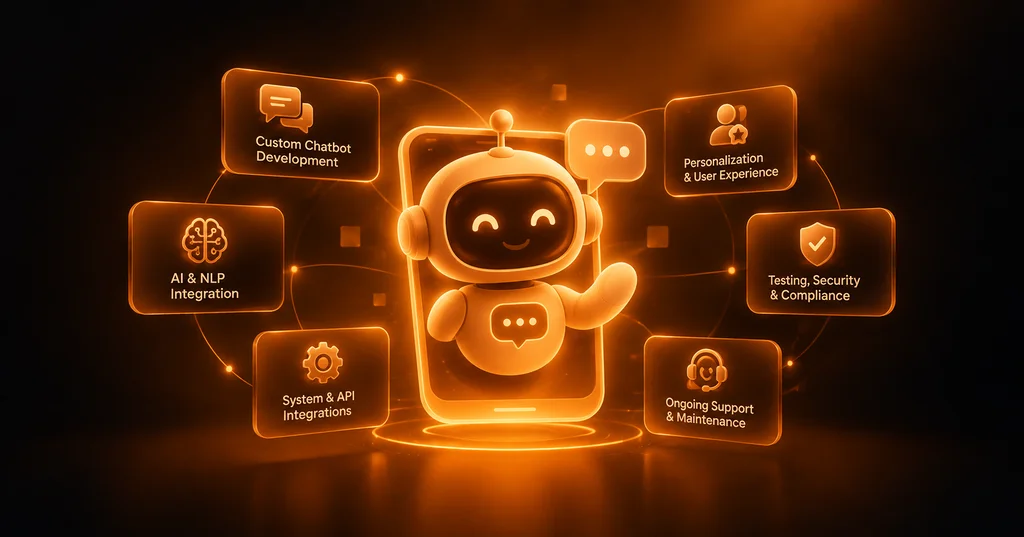


Summary: This guide breaks down what a competent AI chatbot development company actually delivers. From discovery and NLP training to integration, testing, and post-launch support, so business owners know what to ask for and what to avoid when evaluating AI chatbot development services.
A capable AI chatbot development company delivers seven things at minimum. This includes a discovery/strategy phase, conversational design, NLP/LLM model training, platform integration (CRM, website, WhatsApp, etc.), rigorous testing, deployment, and ongoing optimization. If a vendor skips straight from "sales call" to "here's your bot," that's not efficiency.
If you’re reading this, you’ve probably already searched for a chatbot for business more than once. May have gotten a dozen vendor pitches and realized they all sound suspiciously similar. Every agency claims to build “smart”, “human-like”, “next-gen” bots. But you don’t know what’s in the box for you. This gap will be closed before you commit to a chatbot development company.
So let’s fix that with this guide by The Mad Brains. This isn’t a sales pitch – it’s a breakdown of what should happen between “we need a chatbot” and our “chatbot is live and actually working,” and where various vendors quietly cut corners.
Why This Question Matters More Than It Used To
The chatbot market isn’t a niche experiment anymore. It’s a $9.56 billion industry as of 2025, and it will climb to $27.29 billion by 2030. A 23.3% annual growth rate that shows no sign of slowing down. This kind of growth attracts serious engineering talent – and also a lot of vendors slapping a chat widget on a website and calling it “AI.”
On the customer service side, the shift is just as sharp. As per Salesforce’s State of Service research, AI is expected to resolve 50% of service cases by 2027, up from 30% in 2025. This is not a marginal improvement – it’s a structural change in how support teams operate. Which means the company you hire to build isn’t just shipping a feature. They’re rebuilding a chunk of your customer experience. The quality of your vendors ends up mattering a lot more than most people expect going in.
The 7 Services a Real Chatbot Vendor Should Deliver
Here's what each of those seven pieces actually looks like in practice, and what to watch for at every stage.
1. A Discovery Phase That Actually Digs Into Your Business
Before any code gets written, a serious AI chatbot development company should sit down and ask questions: What’s your actual support volume? Where do customers drop off? Which systems should it talk to – Shopify, Salesforce, or the bespoke CRM developed in 2014 which nobody wants to work with?
Skipping this step is like ending up with a bot that answers FAQs beautifully but has no idea of checking the order status. This is because nobody mapped that workflow in the first place. Discovery should produce a document, not a vague verbal promise – use cases, data sources, success metrics, and a rough architecture.
2. Conversational Design, Not Just Scripting
There’s a real difference between someone who writes decision-tree scripts and someone who designs conversations. Good conversational design accounts for tone, fallback responses, how the bot handles frustration or ambiguity, and when it should just hand off to a human instead of guessing.
This matters because customer patience with bad bots is thin. Surveys consistently show that a large share of users abandon a chatbot interaction the moment it misunderstands them twice in a row. A well-designed conversational AI chatbot anticipates the messy, non-linear way people actually type – typos, slang, half-finished sentences – instead of expecting textbook phrasing.
This is also where a lot of cheaper vendors cut corners, because good conversational design takes real linguistic and UX work, not just a flowchart. Businesses shopping around for AI chatbot development services should ask to see sample conversation flows, not just a feature list.
3. NLP and Model Training Tailored to Your Domain
This is where a lot of “AI chatbots” quietly aren’t AI at all – they’re rule-based scripts wearing an AI label. A genuine AI powered chatbot uses natural language processing (and increasingly, fine-tuned or retrieval-augmented large language models) to understand intent, not just match keywords.
Feature | Rule-Based / Scripted Bots | Custom AI / LLM Chatbots |
Understanding | Strict keyword matching & simple decision trees | Natural language processing (intent & context aware) |
Handling Misspellings & Slang | Fails or throws generic fallback errors | Easily interprets typos, local phrasing, and non-linear input |
Knowledge Base | Static pre-programmed FAQ scripts | Dynamic retrieval (RAG) using your actual live product data |
Response Behavior | Rigid, canned, and often frustrating | Contextual, conversational, and trained to escalate smoothly |
4. Integration With the Systems You Already Use
A chatbot that lives in isolation is nearly useless. Real value comes from integration – pulling live data from your CRM, order management system, payment gateway, or internal knowledge base. This is also where project timelines quietly blow up, because integration work is harder than the demo makes it look.
Ask for specifics:
Which APIs will they use?
How do they handle authentication and data security during integration?
What happens if a third-party system changes its API mid-project?
A vendor that’s done this work before will have answers ready. A vendor that’s improvising will get vague.
5. Testing That Goes Beyond "It Worked in the Demo"
Testing a chatbot isn’t like testing a static website. It needs adversarial testing – throwing weird, off-topic, rude, or ambiguous inputs at it to see where it breaks. It needs load testing if you expect high traffic. And it needs bias and accuracy checks, especially if the bot is handling anything sensitive like billing, healthcare information, or legal disclaimers.
If a vendor’s idea of QA is “we typed a few questions, and it responded fine,” that’s not testing – that’s a demo. Push for a documented testing process before you sign off on launch.
6. Deployment Across the Right Channels
Depending on your audience, “deployment” might mean your website widget, WhatsApp, Facebook Messenger, Slack, an in-app assistant, or all of the above. A chatbot for business that only works on desktop web, when 80%+ of your traffic is mobile, isn’t solving the problem you hired someone to solve.
Good vendors will ask where your customers actually are before recommending channels, rather than defaulting to whatever’s easiest for them to build.
7. Post-Launch Support, Monitoring, and Iteration
This is the part most contracts underweight, and it’s arguably the most important. A chatbot isn’t a “build it once and walk away” product. It needs conversation logs reviewed regularly, retraining as your product or FAQs change, and monitoring for drift – where the bot’s answers slowly stop matching reality because nobody updated its training data.
Ask upfront:
What does the support agreement actually cover after launch?
Monthly retraining?
Bug fixes only?
Dashboard access to see what customers are asking?
The difference between a bot that improves over time and one that degrades usually comes down to this clause.
What Separates a Good Vendor From a Mediocre One
Honestly, it's rarely about flashy demos. It's about whether they ask hard questions before writing code, whether they're transparent about limitations, and whether their post-launch plan is more than an afterthought. Any AI chatbot development company can build something that answers "hello" correctly. Far fewer can build a conversational AI chatbot that still works well six months in, after your product catalog has changed three times and your support team has moved on to new priorities.
Building a customer-facing AI assistant requires a clear engineering roadmap, not just off-the-shelf software. If you're evaluating AI chatbot development services and want to ensure you get full technical transparency from discovery to post-launch optimization, reach out to the engineering team at The Mad Brains to map out your architecture.
FAQs
Last updated:
Mad Brains Technologies
Enterprise UX & Product Strategy Team
Mad Brains is an enterprise UX and product consultancy focused on reducing product risk and accelerating growth. Through UX audits, conversion-led design, and full-stack development, the team helps organizations build scalable digital platforms that drive measurable business outcomes.