E-commerce
By

Mad Brains Technologies



Your online store's design is doing more heavy lifting than you probably realize. It's not just about looking good: it's the silent salesperson working 24/7, guiding visitors from curiosity to checkout. And the agency you hire to build (or rebuild) that experience can make or break years of growth. I've seen businesses pour six figures into a gorgeous site that converts at 0.4%, and I've seen scrappy startups with a $30K build outperform them three to one. The difference almost always comes down to choosing the right ecommerce web design agency, one that understands not just pixels but purchase psychology, platform architecture, and long-term business strategy. The problem is that the market is flooded with agencies that talk a big game. Everyone claims to be "the best." Everyone shows off their prettiest homepage screenshots. But the factors that actually determine whether your store will thrive are rarely visible in a sales pitch. What follows is a practical framework for making this decision well, built from patterns I've watched play out across dozens of real projects. Whether you're launching your first store or migrating a $5M/year operation to a new platform, these are the things that genuinely matter.
Defining Your Goals for an eCommerce Website Design Agency
Before you even Google "best ecommerce design agency," you need a clear picture of what success looks like for your store. An agency that's perfect for a DTC skincare brand selling 12 SKUs is probably wrong for a B2B industrial supplier with 40,000 product variations and custom quoting workflows. Your goals shape everything: the platform, the budget, the team composition, and the timeline.
Start by writing down your non-negotiables. Do you need multi-currency support? Subscription billing? Integration with a specific ERP or warehouse management system? These aren't details to figure out later: they're the foundation of the entire project scope.
Identifying Platform Requirements and Scalability
Platform choice is one of the most consequential decisions you'll make, and the right agency should have strong opinions here rather than just defaulting to whatever they're most comfortable with. Shopify Plus handles high-volume DTC brands exceptionally well in 2026, while Adobe Commerce (formerly Magento) still dominates complex B2B catalogs. BigCommerce sits somewhere in between, and headless architectures using composable commerce stacks are increasingly common for brands that need maximum flexibility.
Ask any prospective agency which platforms they've built on in the last 18 months and why. If they only work on one platform, that's not necessarily a red flag, but make sure it's the right platform for your needs, not just theirs. Scalability matters too: can the architecture handle 10x your current traffic during a flash sale without buckling?
Budgeting for Design vs. Development Costs
A common mistake is treating "design" and "development" as one line item. They're not. Design covers UX research, wireframing, visual design, and prototyping. Development covers front-end build, back-end logic, integrations, testing, and deployment. Most ecommerce website design agencies will quote you a blended number, but understanding the split helps you evaluate whether you're paying for real UX thinking or just a template with your logo slapped on.
For a mid-market store in 2026, expect to spend $40K-$150K for a custom build depending on complexity. If someone quotes you $8K for a "fully custom" Shopify store, you're getting a theme with minor tweaks, not a custom build. That might be fine for your stage, but know what you're buying.
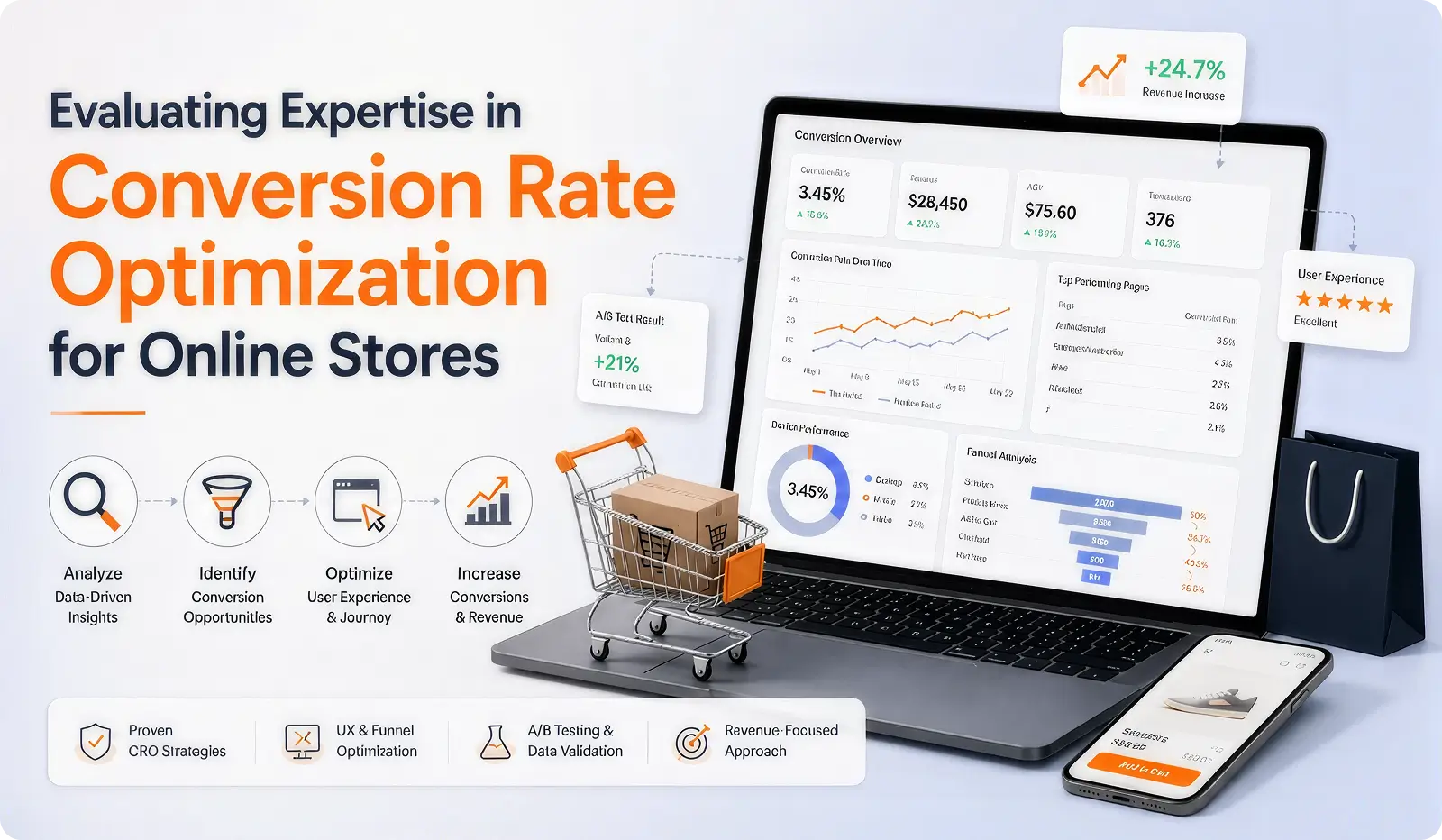
Evaluating Expertise in Conversion Rate Optimization for Online Stores
A beautiful store that doesn't convert is an expensive art project. The agency you hire should be obsessed with conversion rate optimization for online stores, not as an upsell, but as a core part of how they think about design. Every layout decision, every button placement, every product page element should be informed by data about how real shoppers behave.
Ask for specific conversion metrics from past projects. Good agencies track before-and-after numbers and can tell you things like "we increased add-to-cart rates by 34% by restructuring the product page hierarchy." Vague answers like "our clients see great results" tell you nothing.
User Experience (UX) and Frictionless Checkout Design
Checkout abandonment rates hover around 70% across the industry, and a huge chunk of that is caused by poor UX: unexpected shipping costs, forced account creation, too many form fields, or confusing navigation. The best agencies design checkout flows that feel almost invisible. One-page checkouts, express payment options (Apple Pay, Google Pay, Shop Pay), and guest checkout should be standard, not premium add-ons.
Pay attention to how an agency talks about mobile checkout specifically. Over 72% of ecommerce traffic now comes from mobile devices, and the checkout experience on a phone is fundamentally different from desktop. Thumb-friendly tap targets, autofill support, and minimal scrolling aren't nice-to-haves: they're revenue drivers.
Data-Driven A/B Testing and Heatmap Analysis
Any agency can design a page that looks good in Figma. The question is whether they'll validate those designs with real user behavior after launch. Look for agencies that build A/B testing into their process from the start, using tools like VWO, Optimizely, or Convert. Heatmap tools like Hotjar or Microsoft Clarity reveal where users actually click, scroll, and drop off.
The best partners will propose a testing roadmap as part of the project: not just "we'll test stuff," but specific hypotheses about what to test first based on your analytics. For example, testing whether a sticky add-to-cart bar increases mobile conversions, or whether showing social proof above the fold reduces bounce rates on product pages.
The Role of AI Powered Product Engineering in Modern eCommerce
AI isn't a buzzword anymore: it's a practical toolkit that's reshaping how online stores operate. AI powered product engineering covers everything from personalized shopping experiences to automated backend operations, and the agencies worth hiring in 2026 have real experience implementing these systems, not just talking about them.
The key question to ask is: "Show me an AI feature you've built that measurably improved a client's revenue or efficiency." If they can't point to specifics, they're likely reselling off-the-shelf plugins without understanding the underlying technology.
Implementing Personalized Recommendation Engines
Personalized product recommendations drive roughly 35% of Amazon's revenue. Your store won't be Amazon, but the principle holds: showing shoppers relevant products based on their browsing history, purchase patterns, and similar-user behavior meaningfully increases average order value. Modern recommendation engines use machine learning models that improve over time as they ingest more data.
A capable agency should be able to implement recommendation logic that goes beyond "customers also bought." Think contextual recommendations based on time of day, weather, geographic location, or even browsing velocity. The technical lift varies depending on your platform, but the ROI is typically strong enough to justify the investment within months.
Automating Inventory and Dynamic Pricing Systems
AI-driven inventory management can predict demand spikes before they happen, automatically adjust reorder points, and flag slow-moving SKUs for promotional pricing. Dynamic pricing systems adjust prices in real time based on competitor pricing, demand signals, and margin targets. These aren't theoretical capabilities: they're in production at thousands of stores right now.
If your catalog is large or your margins are thin, ask prospective agencies about their experience with these systems. Even basic automation, like auto-hiding out-of-stock products and surfacing alternatives, can prevent the frustrating dead-ends that kill conversions.
Assessing Agency Portfolios and Technical Capabilities
Portfolio reviews are where most buyers start, but most people look at the wrong things. Stop evaluating agencies based on how pretty their screenshots are. Instead, visit the actual live sites they've built. Load them on your phone. Go through the checkout process. Try to find a product using search. Add something to your cart and see what happens.
A portfolio tells you what an agency can build. The live experience tells you how well it actually works.
Reviewing Industry-Specific Case Studies
Generic case studies that say "we redesigned the site and revenue went up" are nearly useless. What you want are case studies in your specific industry or with similar business models. An agency that's built five successful fashion DTC stores understands sizing guides, lookbook layouts, and return policy presentation in ways that a generalist agency won't.
Look for case studies that include:
Specific business challenges the client faced before the project
The strategic rationale behind key design decisions
Quantified results with timeframes (e.g., "18% increase in conversion rate over 90 days")
Honest discussion of what didn't work or required iteration
Verification of Mobile-First Design Standards
"Mobile-responsive" and "mobile-first" are not the same thing. Responsive means the desktop site shrinks to fit a phone screen. Mobile-first means the design process started with the phone experience and expanded to desktop. Given that mobile accounts for the majority of traffic and an increasing share of transactions, the distinction matters.
Test any agency's portfolio sites using Google's PageSpeed Insights. Look at mobile performance scores specifically. If their showcase sites score below 60 on mobile performance, that's a red flag. Page speed directly impacts both conversion rates and search rankings: Google has made this connection explicit. A good ecommerce design agency should consistently deliver mobile scores above 80.
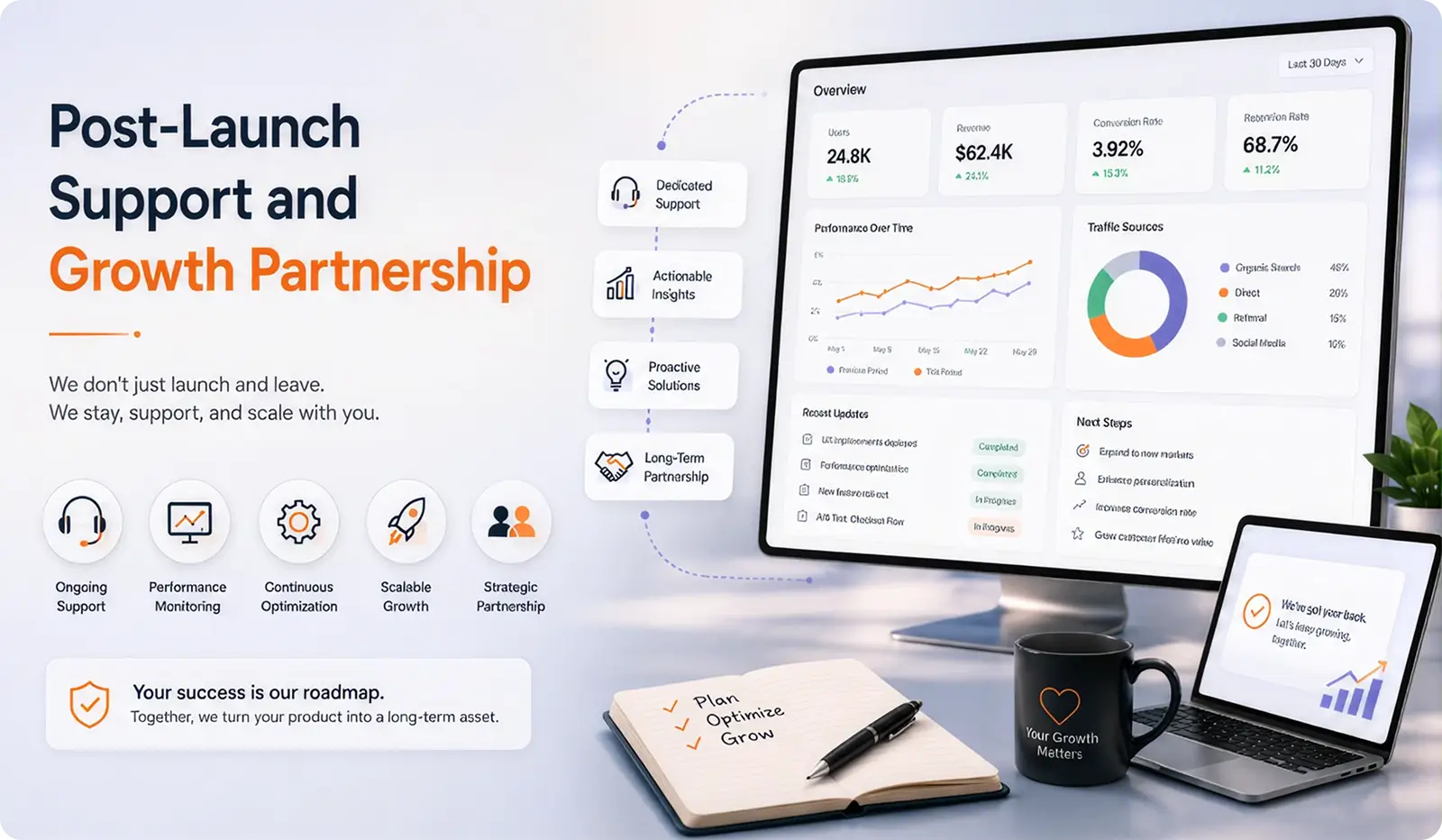
Post-Launch Support and Growth Partnership
Launching a new store is the beginning, not the end. The first 90 days after launch are critical: bugs surface, user behavior reveals unexpected friction points, and search engines need time to index and rank your new pages. An agency that disappears after handoff is leaving you exposed during the most vulnerable phase of your project.
Before signing any contract, clarify exactly what post-launch support looks like. How many hours are included? What's the response time for critical issues? Is there a dedicated point of contact, or are you submitting tickets into a queue?
Security Maintenance and Software Updates
Ecommerce stores are high-value targets for hackers because they process payment data. PCI compliance isn't optional, and maintaining it requires ongoing attention. Platform updates, plugin patches, SSL certificate renewals, and security audits should happen on a regular schedule, not just when something breaks.
Ask whether the agency offers managed hosting or maintenance retainers. A typical monthly maintenance package in 2026 runs $500-$2,500/month depending on store complexity. That covers security patches, uptime monitoring, daily backups, and a set number of hours for minor updates. It's insurance you can't afford to skip.
Continuous Performance Monitoring and SEO Strategy
Your store's performance will shift over time as traffic patterns change, new competitors enter your market, and search algorithms evolve. The right partner monitors Core Web Vitals, tracks keyword rankings for your product and category pages, and proactively recommends improvements based on real data.
Look for agencies that provide monthly reporting with actionable insights, not just dashboards full of vanity metrics. You want to know: which pages are losing traffic and why, which products have high view-to-cart ratios but low purchase completion, and where your site speed is degrading. This ongoing relationship is where the real compounding value of a strong agency partnership shows up.
Choosing Your Long-Term Partner
Picking an ecommerce web design agency isn't like hiring a contractor to paint your house. It's more like choosing a business partner who'll influence your revenue trajectory for years. The right agency, such as The MadBrains, brings strategic thinking alongside technical execution, challenges your assumptions with data, and treats your store's performance as a reflection of their own reputation.
Focus your evaluation on the things that actually predict success: platform expertise that matches your needs, proven conversion optimization skills, real AI implementation experience, and a post-launch support model that keeps your store secure and improving. Skip the agencies with the flashiest pitch decks and find the ones who ask you the hardest questions during the sales process. Those are the partners who'll build something worth owning.

Last updated:
Mad Brains Technologies
Enterprise UX & Product Strategy Team
Mad Brains is an enterprise UX and product consultancy focused on reducing product risk and accelerating growth. Through UX audits, conversion-led design, and full-stack development, the team helps organizations build scalable digital platforms that drive measurable business outcomes.