Conversion Optimization
By

Mad Brains Technologies



A/B tests only lift conversions when they start from a real problem and run long enough to trust. This blog covers 7 A/B testing techniques, from writing a hypothesis and calculating sample size to segmenting results and keeping a test log. It also includes landing page test ideas, why so many tests come back flat, and when it’s worth bringing in help.
The A/B testing techniques that actually lift conversions are simple: start from a real problem, test one meaningful change, run the test long enough to trust it, and write down what you learned.
Most teams skip at least one of those. Someone wants to try a green button against a blue one. Two weeks later, the result is a shrug, and nobody's sure what to test next.
Here's how to avoid that.
A/B Testing vs. Split Testing: Is There a Difference?
Not really. Split testing is just another name for it. You show half your visitors version A and half version B, then see which one gets more sign-ups, sales, or clicks. It's a core part of conversion rate optimization.
Multivariate testing is the different one. It tests several changes at once and needs a lot more traffic to give you a clear answer. For most sites, plain A/B tests are the better place to start.
7 A/B Testing Techniques That Actually Move Conversions
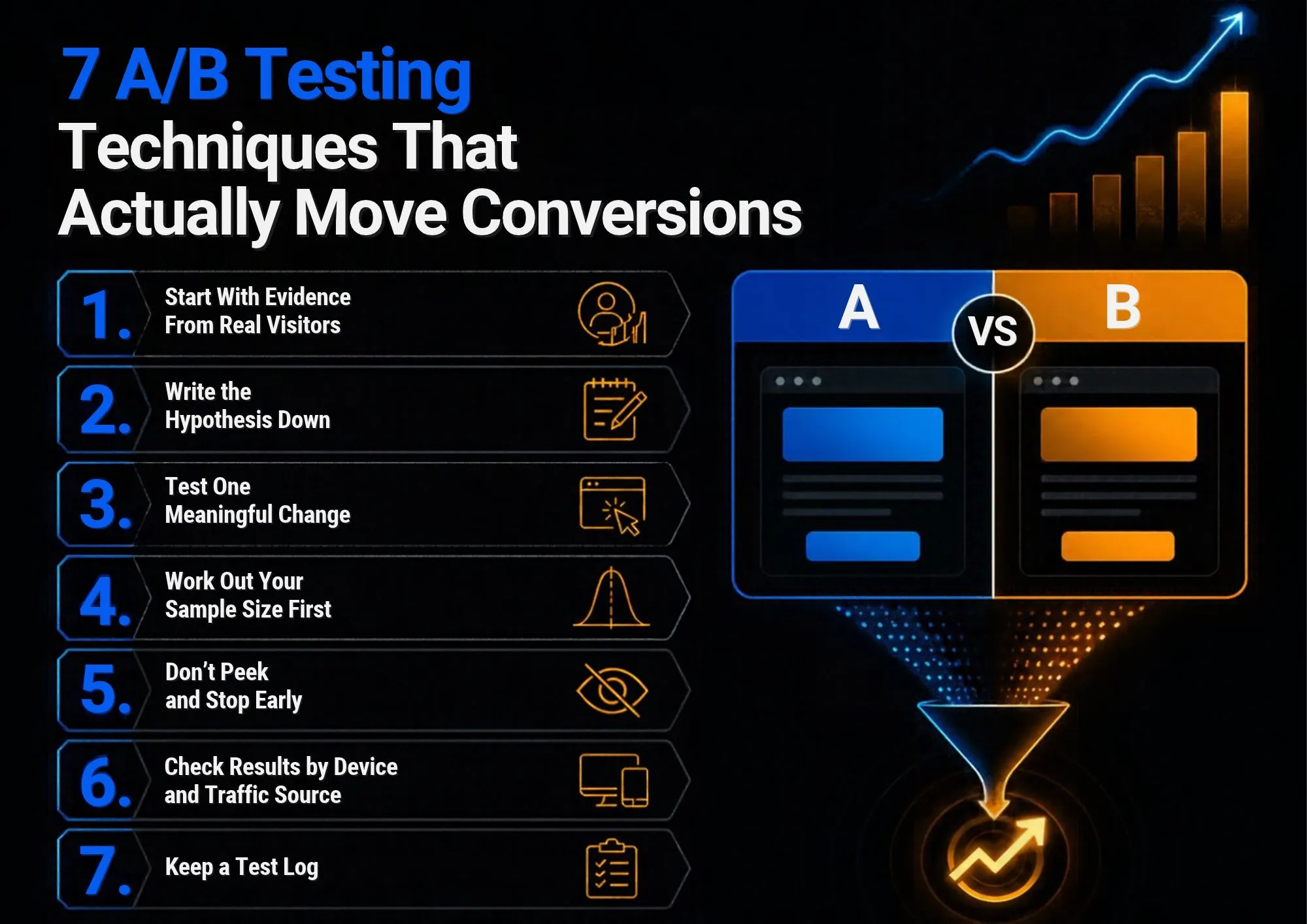
1. Start With Evidence From Real Visitors
Good tests come from something you've seen. Session recordings where people rage-click a product photo. A survey answer that keeps mentioning shipping costs. A funnel step where half the visitors vanish.
If you don't know where to look, a CRO audit will point you to the biggest leaks first. Our UX audit services can do that digging for you, so every test starts from a real problem.
2. Write the Hypothesis Down
Before anyone builds a variation, fill in this sentence:
"Because we saw [evidence], we believe changing [element] will [result] for [audience]."
It takes two minutes. It also stops the "let's just try it" tests that teach you nothing.
3. Test One Meaningful Change
Change the headline, the image, and the button, and a win won't tell you which one mattered.
Keep it to one change, but make it a real one. Swapping "Buy Now" for "Purchase" rarely moves anything. Cutting a seven-field form down to three might.
4. Work Out Your Sample Size First
Plug your current conversion rate and traffic into a sample size calculator (VWO, Optimizely, and Evan Miller all have free ones). It tells you how many visitors each version needs before the result means anything.
Then run the test for at least one full week, ideally two, so you capture weekday and weekend behavior.
5. Don't Peek and Stop Early
Day three. Version B is up 40%. Tempting to call it, right?
Don't. Early results swing wildly, and stopping the moment one version pulls ahead is one of the easiest ways to ship a "winner" that isn't. Wait for your planned sample size.
6. Check Results by Device and Traffic Source
A new layout can win on desktop and quietly lose on mobile. Paid traffic and returning customers often behave differently too. Before rolling out a winner, break the result down by segment.
7. Keep a Test Log
Date, hypothesis, result, and what you learned. That's all it needs. A year from now, it stops your team from re-running the same test and makes every future idea sharper.
A/B Test Examples for Landing Page Optimization
Landing pages are a good place to put these A/B testing techniques into practice, since they usually have one goal and enough paid traffic to test with. A few A/B test examples worth trying:
A benefit-led headline against a feature-led one
A short form against a longer form that qualifies leads better
A product demo video in the hero instead of a stock image
Customer reviews moved right next to the CTA
"Get my free quote" against "Submit"
If your goal is to increase conversion rate on a paid campaign, landing page optimization like this usually pays back faster than redesigning the whole site.
Why So Many A/B Tests Come Back Flat
Often the change was too small to matter. Sometimes the traffic wasn't there to begin with. And sometimes the test was based on a hunch, so there was never a real problem to fix.
We dig into this in why most conversion fixes fail. The short version: A/B testing for conversion rate optimization works when the research comes first.
When to Get Help
If you're choosing a testing platform, VWO suits teams that don't have much developer time, while Optimizely is built for larger experimentation programs.
And if tests keep stalling, or nobody on your team has time to run them properly, a conversion rate optimization agency can handle the research, test design, and reporting. That's where our team at MadBrains comes in. We dig into your data, find what's worth testing, and help plan experiments that actually teach you something.
On a tighter budget? Run your key pages through UX Audit Tool for free first, or try StoreUXAudit if you run an online store. Both flag UX issues that make good test ideas.
Conclusion
Pick the page that gets the most traffic and the most complaints. Watch ten session recordings, write one hypothesis, and calculate the sample size before you build anything. That first test, done properly, will teach you more than five rushed ones. Want help choosing what to test first? Talk to our team.
FAQs
Last updated:
Mad Brains Technologies
Enterprise UX & Product Strategy Team
Mad Brains is an enterprise UX and product consultancy focused on reducing product risk and accelerating growth. Through UX audits, conversion-led design, and full-stack development, the team helps organizations build scalable digital platforms that drive measurable business outcomes.