CRO
CRO vs UX Audit: Which One Does Your Business Actually Need?
By

Abhinav Sharma



A CRO audit optimizes your conversion funnel. A UX audit evaluates your entire user experience. Most businesses need the second one.
That is the short answer to the CRO vs UX audit question. But the real answer takes a few more minutes, because picking the wrong one costs you months and money.
CRO agencies will tell you to get a CRO audit. UX firms will say UX audit. Both cost $1,000 or more. Both promise to fix your conversions. Only one will actually solve the problem.
We have run 50+ audits across SaaS, eCommerce, and healthcare. We have seen companies pick wrong, waste months, and come back for what should have been done from day one.
This guide uses examples from Amazon, Airbnb, Slack, and Walmart, plus original data from our audits, to help you pick right the first time.
What Is a CRO Audit?
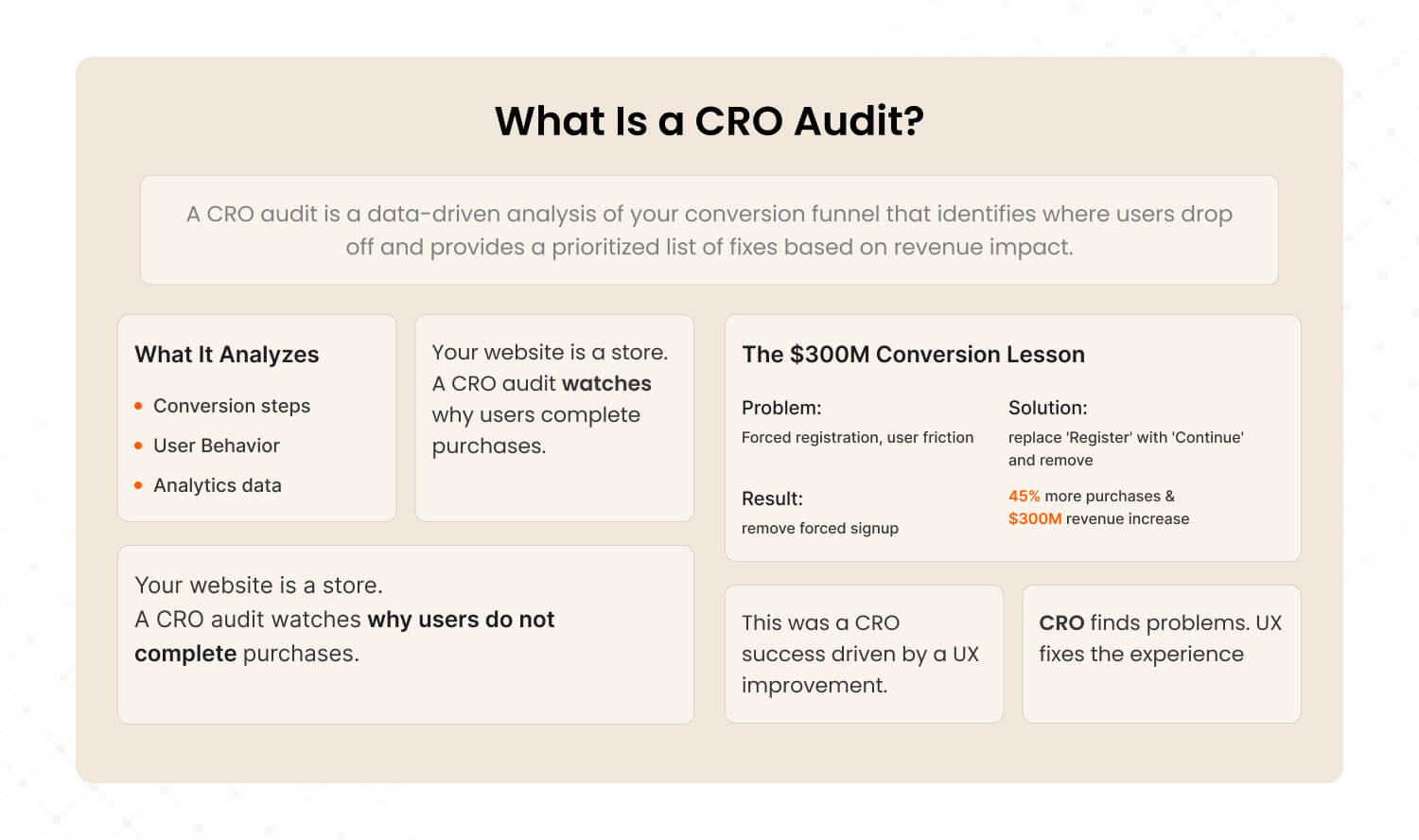
A CRO (Conversion Rate Optimization) audit is a data-driven review of specific steps in your conversion funnel. It uses analytics, heatmaps, A/B tests, and session recordings to identify why visitors drop off at particular steps like checkout, signup, or pricing pages, then delivers a prioritized list of fixes ranked by revenue impact.
CRO stands for Conversion Rate Optimization. The audit focuses on the specific moments where users are supposed to take action and figures out why they do not.
Simple analogy: if your website is a store, a CRO audit stands at the checkout counter and watches why people put items back on the shelf instead of paying.
For the full breakdown of how a CRO audit works (7-step process, tools, costs), read our complete guide: What Is a CRO Audit? The Complete Guide
The Amazon $300M Lesson: When CRO Found a UX Problem
The most famous conversion story comes from a major eCommerce retailer (widely attributed to Amazon's early checkout).
The checkout had two buttons: Login and Register. Simple.
But first-time shoppers refused to register. They just wanted to buy. Repeat customers forgot passwords. 160,000 password resets happened every day.
The fix: replace "Register" with "Continue." One line of text: "You do not need to create an account to make purchases."
Result: 45% more purchases. $300 million in additional revenue in one year.
Here is what most people miss about this story: it is called a CRO success. But the fix was a UX insight.
The problem was not the button design. It was that the entire flow forced users into a registration pattern they did not want. A CRO test might have tried different colors for the Register button. The UX insight was to remove forced registration entirely.
Key Takeaway: CRO found the symptom (drop-off at registration). The fix required a UX-level insight (remove the registration concept). Most conversion problems work this way.
What Is a UX Audit?
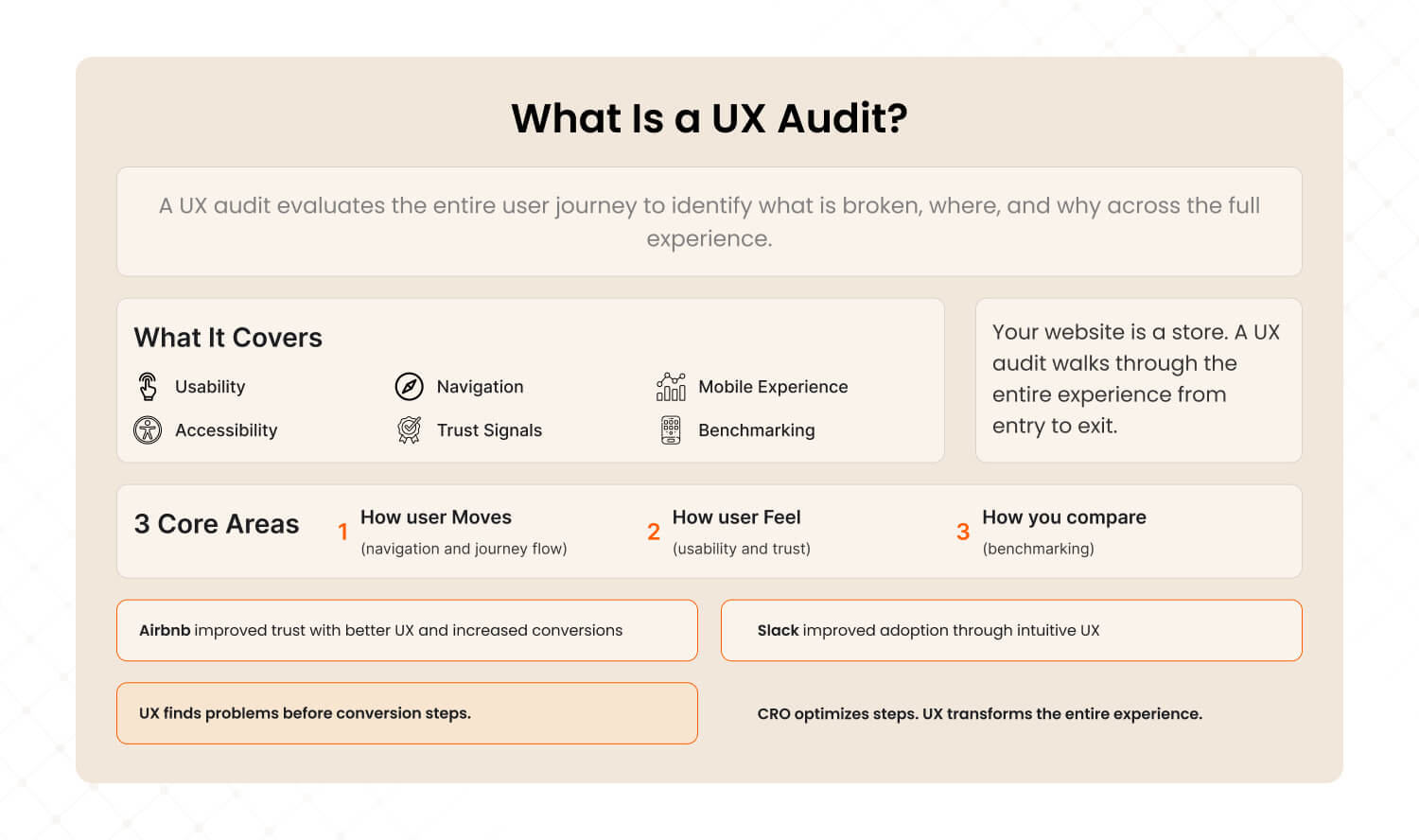
A UX (User Experience) audit evaluates the entire user journey across your product, not just the conversion steps. It covers usability, navigation, mobile experience, accessibility, trust signals, and competitive benchmarking to find root causes behind multiple performance problems at once.
A UX audit does not just check your checkout. It evaluates everything: first visit, navigation, mobile experience, onboarding, trust signals, retention.
The entire journey.
If a CRO audit watches the checkout counter, a UX audit walks through the whole store. Entrance. Signage. Product layout. Fitting rooms. Parking lot.
A UX audit covers three core areas:
How users move: Journey mapping, navigation flow, information architecture. Can users find what they need within 3 clicks?
How users feel: Usability testing, accessibility (WCAG compliance), mobile experience, trust signals, social proof.
How you compare: Competitive benchmarking against the best in your vertical.
For a practical self-assessment, use our 30-point checklist: UX Audit Checklist: 30 Points That Actually Matter
Airbnb: How UX Redesign Built a $100B Company
When Airbnb launched, the concept was terrifying. Strangers sleeping in your home.
Airbnb did not A/B test their booking button. They redesigned the entire experience around one emotion: trust.
High-resolution photos replaced grainy uploads. Host profiles got verified badges and real reviews. The booking flow went from confusing to three clear steps.
Result: 35% higher booking conversion. 50% longer sessions. 28% more repeat bookings. Airbnb grew from a niche experiment to 150+ million users.
No amount of CRO button testing would have solved the trust problem. That required a full UX rethink.
Slack: The UX That Killed Email
Slack did not win because it had the best features. Dozens of chat tools existed.
It won because the UX was so intuitive that users adopted it on their own. Clean interface. Channels that organized naturally. Onboarding that made new users productive in minutes, not days.
Result: 20+ million daily active users. Teams reduced email by 48%.
Key Takeaway: A UX audit finds problems CRO would never look for, because they happen before users reach the conversion step. Airbnb's trust problem and Slack's adoption advantage were UX wins, not CRO wins.
Amazon fixed one checkout button and made $300M. Airbnb redesigned the full experience and built a $100B company. The scope of the fix determines the scale of the result.
What Is the Real Difference Between a CRO Audit and a UX Audit?
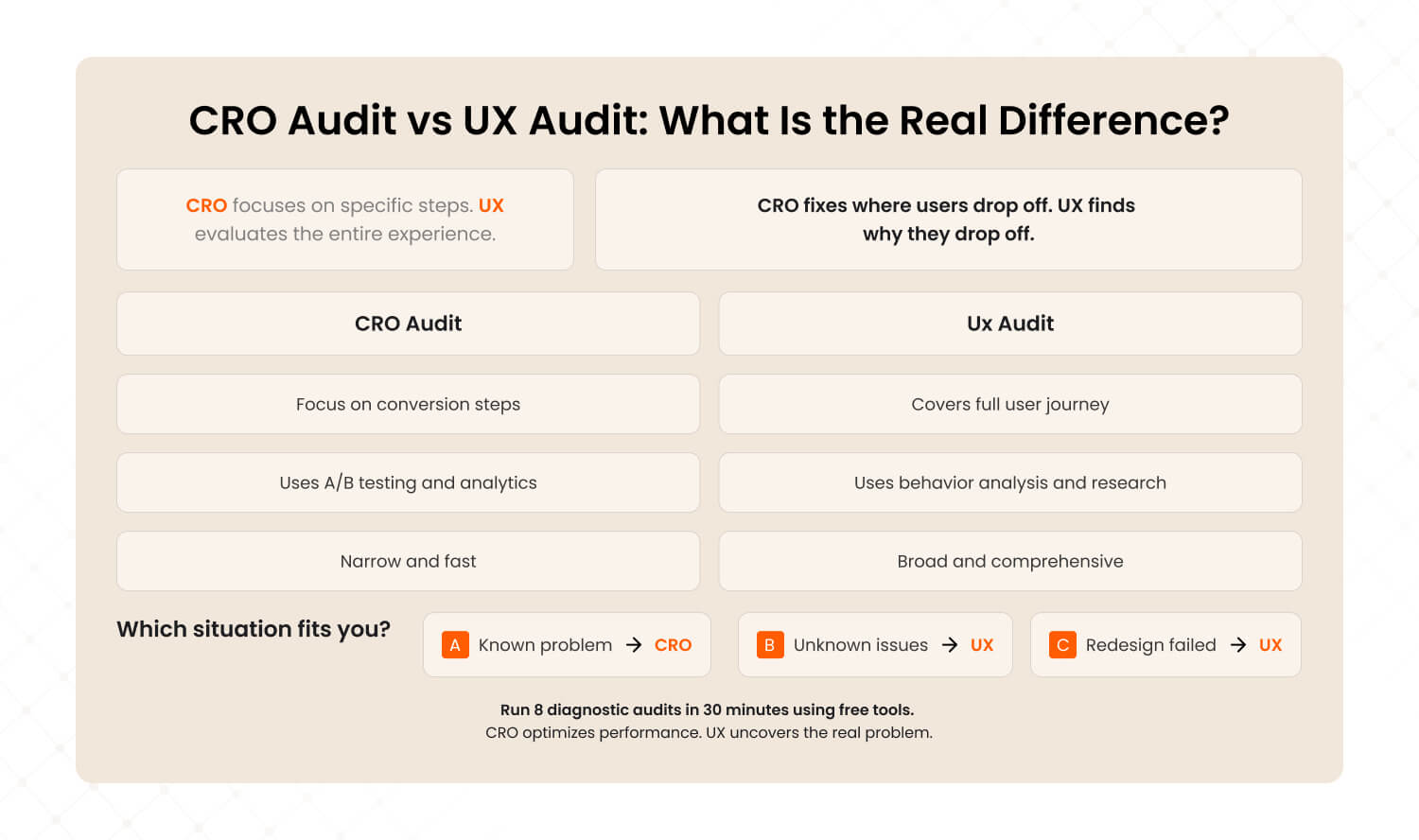
A CRO audit optimizes specific conversion funnel steps using A/B testing and analytics. A UX audit evaluates the entire user journey using heuristic review, behavior analysis, and user research. CRO is narrower and faster. UX is broader and finds root causes. The best approach combines both.
CRO Audit | UX Audit | |
What it checks | Your conversion funnel steps | Your entire user journey |
Goal | More people complete a specific action | Better experience from first visit to retention |
Best for you if | You know which page is broken | Multiple symptoms, unsure where to start |
How it works | A/B tests, heatmaps, funnel analytics | Heuristic review, user research, journey mapping |
Famous example | Amazon's $300M checkout button | Airbnb's trust-building full redesign |
Timeline | 1 to 4 weeks | 3 to 21 days |
Typical cost | $1,000 to $50,000+ (retainer model) | $999 to $25,000 (project-based) |
Post-purchase? | Rarely | Yes (retention, onboarding, loyalty) |
Accessibility? | No | Yes (WCAG compliance review) |
Mobile deep-dive? | Sometimes | Always |
Free Download: The Conversion Leak Finder A 30-minute self-audit playbook for SaaS and eCommerce teams. 8 diagnostic audits using free tools. [Download Free PDF]
Want to find your own conversion leaks right now? This playbook walks you through 8 diagnostic audits you can run in 30 minutes with free tools.
Quick check: which sounds like your situation?
A) "I know exactly which page is losing conversions. I just need to fix it."
B) "Something is wrong but I am not sure what. Multiple things seem broken."
C) "We redesigned recently but numbers did not improve."
Picked A? CRO might work. Picked B or C? Keep reading.
If this sounds familiar, our UX Audit uncovers exactly where users drop off and why, with every finding tied to a revenue number. Learn about our UX Audits →
What Does the Data Say? (Original Findings From 50+ Audits)
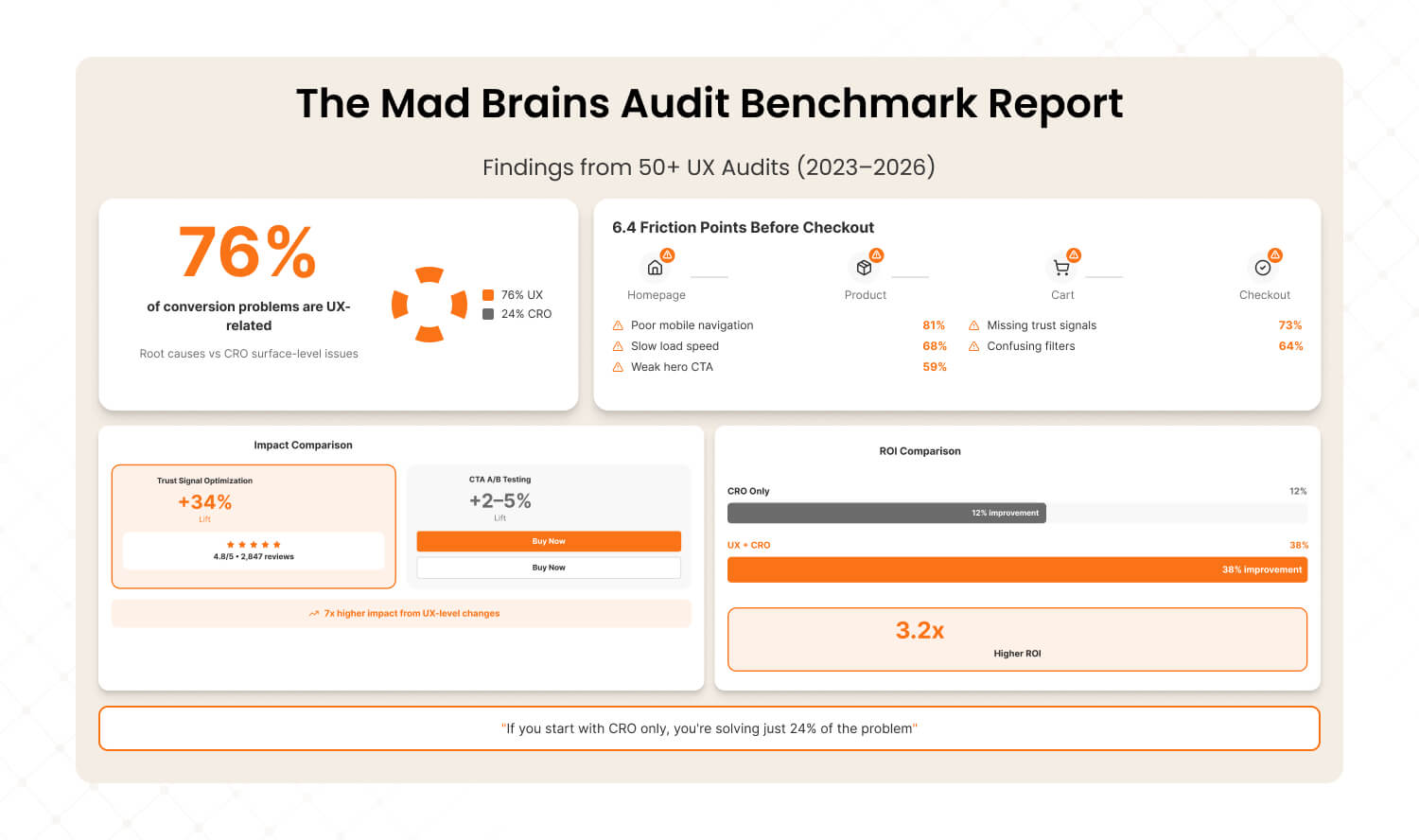
We analyzed findings from 50+ audits across SaaS, eCommerce, and healthcare over 3 years. The headline finding: 76% of conversion problems trace back to UX root causes, not isolated CRO elements. Combined UX+CRO audits deliver 3.2x higher ROI than CRO-only approaches.
Most articles on this topic cite Forrester and Baymard. We wanted to know what our own data says.
76% of Conversion Problems Are Actually UX Problems
76% of conversion issues - traced to UX root causes, not isolated CRO elements
We categorized every conversion blocker into two buckets: fixable with CRO-only tactics (button tests, headline rewrites, form shortening) versus requiring UX-level changes (navigation restructuring, mobile redesign, trust signal repositioning, information architecture fixes).
76% needed UX-level fixes.
CRO is not useless. The remaining 24% were real quick wins. But starting CRO-only means you are working on 24% of your problem.
6.4 Friction Points Before Checkout
6.4 friction points - found on average before users even reach checkout
Across 22 eCommerce audits, users hit 6.4 friction points between landing on the homepage and reaching checkout. The top five:
Poor mobile navigation (81% of audits)
Missing or buried trust signals (73%)
Slow product page loads (68%)
Confusing category and filter structure (64%)
Generic hero with no clear CTA (59%)
CRO typically starts at checkout. These problems happen BEFORE checkout. The user has already left.
Trust Signals Beat Button Colors: 34% vs 2-5% Lift
34% average lift - from trust signal repositioning vs 2-5% from CTA A/B tests
The single highest-impact change across our audits was not a CRO tactic.
It was moving reviews, ratings, and security badges above the fold. Average lift: 34%.
CTA color and copy A/B tests? 2 to 5%. The UX-level change delivers 7x more impact.
Combined UX+CRO Delivers 3.2x Higher ROI
3.2x higher ROI - from combined approach vs CRO-only
CRO-only implementations: average 12% conversion improvement.
Combined UX+CRO: average 38% improvement.
Root causes vs symptoms. The ROI difference is 3.2x.
Metric | Finding | Sample Size |
Conversion issues with UX root cause | 76% | 50+ audits |
Avg friction points before checkout | 6.4 | 22 eCommerce sites |
Revenue leak from mobile UX gaps | 52% | 31 audits with revenue data |
Lift from trust signal repositioning | 34% | 18 audits |
Lift from CTA A/B tests | 2-5% | 50+ audits |
Combined vs CRO-only ROI | 3.2x higher | 50+ audits |
Most common friction point | Poor mobile nav (81%) | 50+ audits |
Data from audits conducted 2023-2026 across SaaS, eCommerce, and healthcare. Sample sizes vary by metric.
Key Takeaway: 76% of conversion problems are UX problems wearing CRO disguises. Starting CRO-only means addressing just 24% of the real issue.
Why Does Choosing Just One Audit Usually Fail?
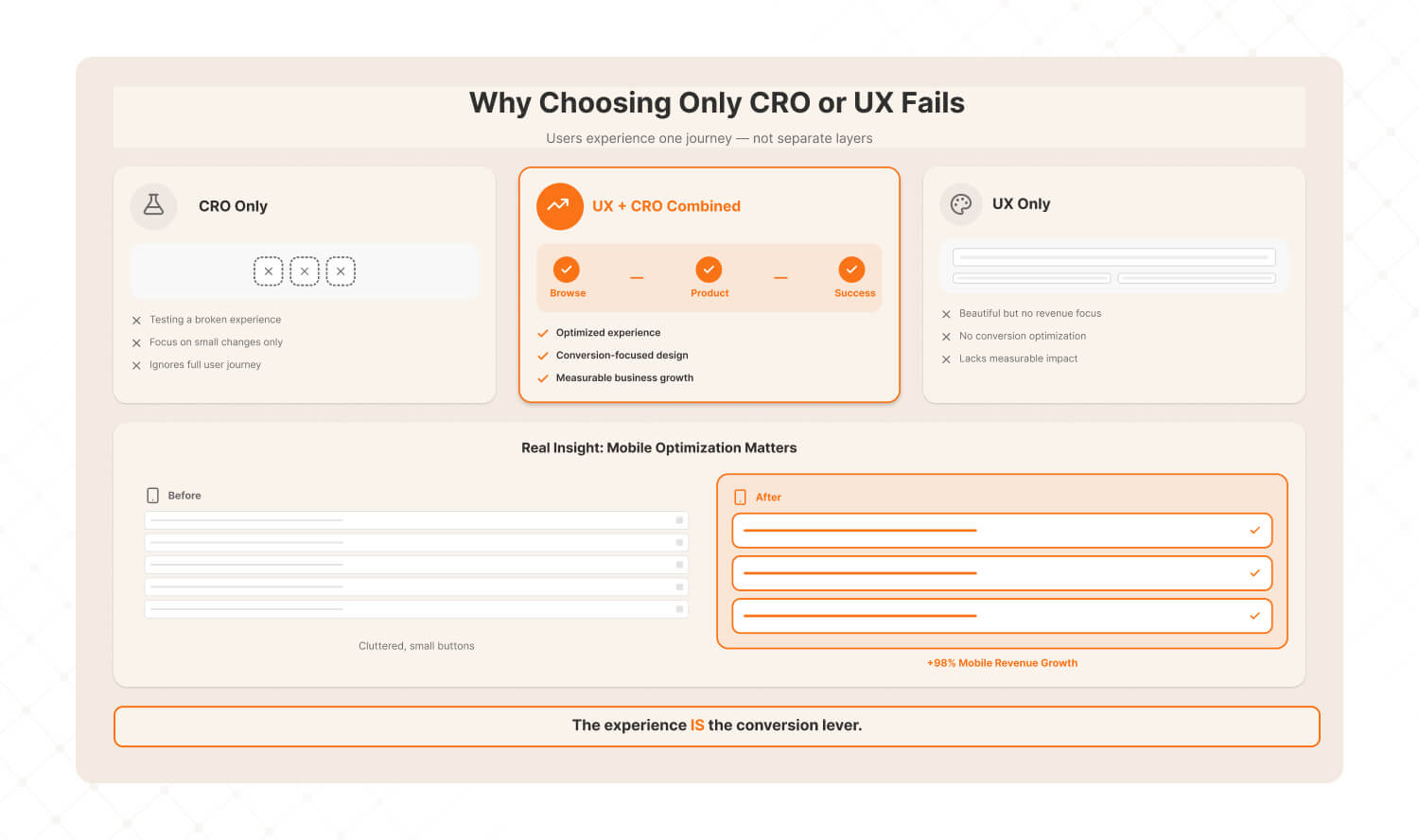
CRO without UX context means A/B testing variations of a broken experience. UX without conversion focus means beautiful redesign that does not move revenue. The separation between CRO and UX is a vendor distinction, not a user reality. Users experience your product as one journey, not as separate 'conversion steps' and 'experience layers.'
Here is what nobody else will tell you about this debate:
The separation between CRO and UX is a vendor distinction. Not a user reality.
Your users do not experience 'conversion' and 'experience' as separate things. A confusing checkout is both a UX problem and a CRO problem. A slow page hurts both. Poor mobile design kills satisfaction AND sales at the same time.
Walmart's Lesson: Responsive Does Not Mean Optimized
Walmart's site was responsive. It technically worked on mobile.
But responsive is not the same as optimized for touch-first interaction.
Walmart redesigned for mobile: better tap targets, simplified navigation, fewer taps to reach products.
Result: mobile revenue grew 98% year-over-year. Same traffic. Better UX.
A CRO audit would have tested checkout variations. The real problem was the entire mobile experience.
The core truth:
CRO without UX = testing variations of a broken experience.
UX without CRO = beautiful redesign that does not move revenue.
The best approach combines both.
Baymard Institute's research confirms this: there is a strong correlation between UX performance and conversion rates. Most conversion issues are rooted in UX design problems.
Walmart grew mobile revenue 98% by fixing UX, not by A/B testing checkout buttons. The experience IS the conversion lever.
How Do You Decide Which Audit You Need?
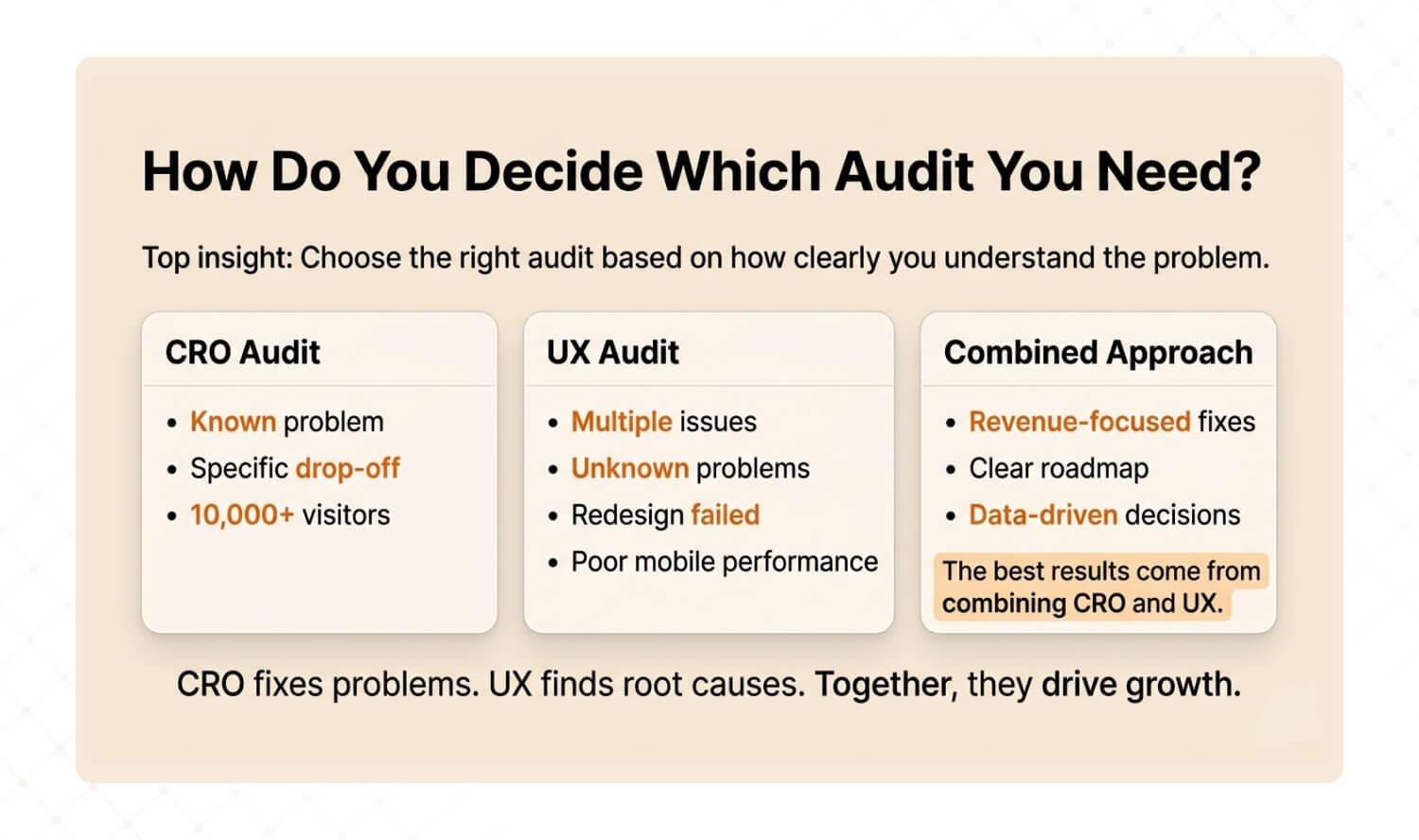
If you know exactly which page or funnel step is broken, a CRO audit may be enough. If you have multiple symptoms, are unsure where the problem is, or recently redesigned without results, start with a UX audit. The best results come from a combined approach that ties every UX fix to a revenue number.
Go with a CRO audit if:
You can pinpoint exactly which page or step is underperforming
Analytics show a clear drop-off at one specific stage
Everything else works fine
You have 10,000+ monthly visitors for meaningful A/B tests
Go with a UX audit if:
You have multiple symptoms at once (high bounce + low conversion + poor mobile)
You are not sure where the biggest problem is
You recently redesigned but metrics stayed flat or dropped
Mobile conversion is much lower than desktop
Support tickets keep asking 'how do I...' questions
Go with a combined approach if:
You want every fix tied to a revenue number
You need a prioritized roadmap your team starts this week
You are tired of guessing
This is exactly the kind of root-cause analysis we do in every audit. Want to know what is blocking your conversions? Book a 15-minute strategy call →
How Much Does Each Cost? And What Is the ROI?
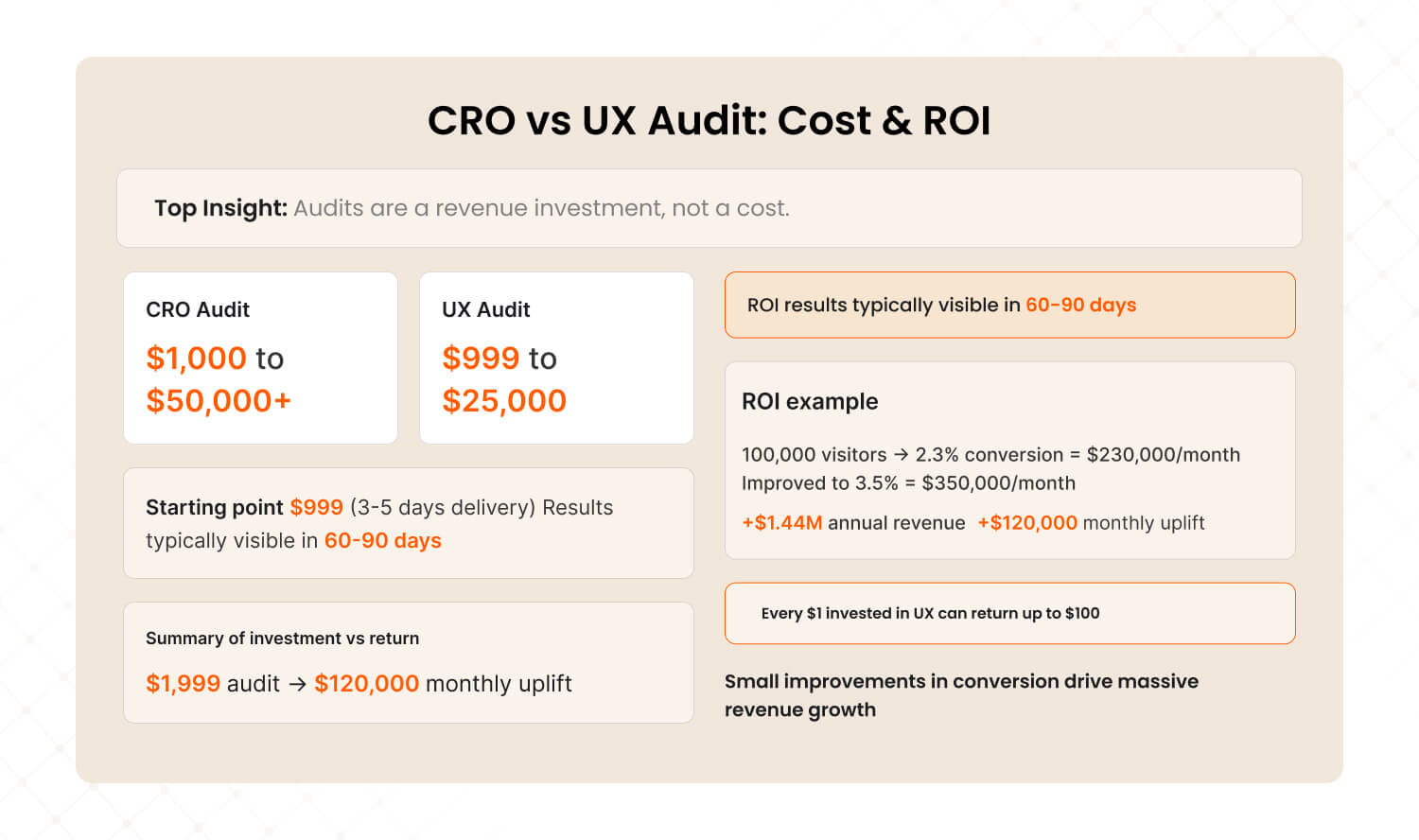
CRO audit costs range from $1,000 to $50,000+ depending on scope. UX audit costs range from $999 to $25,000. Our audits start at $999 with delivery in 3 to 5 days. ROI typically shows within 60 to 90 days. For a $10M eCommerce company, even a 1% conversion improvement means $100,000+ in annual revenue.
CRO Audit (Industry) | UX Audit (Our Approach) | |
One-time investment | $1,000 to $15,000 | $999 to $3,999 |
Ongoing cost | $1,500 to $31,000/month retainer | Optional $350/month CRO retainer |
Delivery time | 2 to 8 weeks | 3 to 21 days |
What you get | Test results + recommendations | Action report + roadmap + wireframes |
Time to ROI | 3 to 6 months | 60 to 90 days |
ROI example for a $10M eCommerce company:
100,000 monthly visitors at 2.3% conversion = $230,000/month
Post-audit conversion at 3.5% (conservative) = $350,000/month
Monthly uplift: $120,000
Annual uplift: $1.44 million
Audit investment: $1,999
Forrester Research estimates every $1 invested in UX returns $100. The audit pays for itself in the first week.
Frequently Asked Questions
Does Your Site Have These Patterns? We Can Help.
Stop guessing. Get a data-backed diagnosis of your website's conversion barriers.
Our UX Audit includes full CRO analysis, funnel mapping, AI-powered behavior insights, and a revenue-prioritized roadmap. It is the same methodology behind 50+ audits delivering 28 to 52% conversion improvements in 60 to 90 days for brands including Tanishq (Tata Group) and Barbeque Nation.
Three options to start:
Discovery Audit ($999): 15-page action report in 3 to 5 days. Your biggest conversion leaks identified fast.
Detailed Audit ($1,999): 60-page report + 90-day roadmap. Full UX + CRO analysis with competitor benchmarking. Most popular.
gy behind 50+ audits delivering 28 to 52% conversion improvements in 60 to 90 days for brands including Tanishq (Tata Group) and Barbeque Nation.

Last updated:
Abhinav Sharma
Founder & CEO | Enterprise UX & Growth Strategy
Abhinav Sharma is the Co-Founder & CEO of Mad Brains, specializing in enterprise UX audits, conversion-focused product design, and high-impact experience systems. He helps SaaS, healthcare, and fintech companies reduce usability risk, increase conversions, and build scalable, user-centered platforms.