E-commerce
By

Mad Brains Technologies



Choosing an e-commerce web design company in Dubai is about more than finding a team that can build an attractive website. Your online store needs to make product discovery easy, support a smooth checkout experience, work reliably across devices, and give customers enough confidence to complete a purchase.
The Mad Brains approach to e-commerce web design is with these business and user needs in mind. From UX/UI design and custom development to integrations and performance, we focus on creating online stores that are practical to use and built around how customers actually shop.
In this guide, we’ll look at what makes an e-commerce website effective in Dubai’s competitive market, what to evaluate before choosing a development partner, and how The Mad Brains approaches e-commerce web design and development.
Dubai’s E-Commerce Market: Why Website Experience Matters
The UAE’s e-commerce market reached AED 32.3 billion in 2024, according to the latest EZDubai E-Commerce Report, produced in collaboration with Euromonitor International. The market is projected to surpass AED 50.6 billion by 2029, reflecting continued growth in online shopping across the UAE.
For businesses selling online in Dubai, that growth also means greater competition for customer attention. A well-designed e-commerce website needs to make product discovery simple, build confidence during checkout, and provide a fast, convenient experience across devices.
For e-commerce brands in Dubai, the website has to support more than product browsing. Customers may expect:
Mobile-first shopping: Product pages, filters, carts, and checkout need to work comfortably on smaller screens.
Clear pricing and checkout: AED pricing, delivery charges, taxes, and payment information should be easy to understand before the customer places an order.
Local payment considerations: The checkout should support the payment methods and gateways relevant to the business's target customers.
Fast product discovery: Search, navigation, categories, and filters should help shoppers find what they want without unnecessary steps.
Arabic and English experiences where needed: Brands serving multilingual audiences may need more than a simple language switch; layouts, content, and navigation should remain usable in both languages.
Reliable delivery information: Shipping costs, delivery areas, estimated timelines, and return policies should be visible at the right points in the buying journey.
The UAE’s retail e-commerce market grew by 14% in 2025, reaching AED 40.321 billion, according to Euromonitor International’s June 2026 report.
What Should You Look for in an E-Commerce Web Design Company in Dubai?
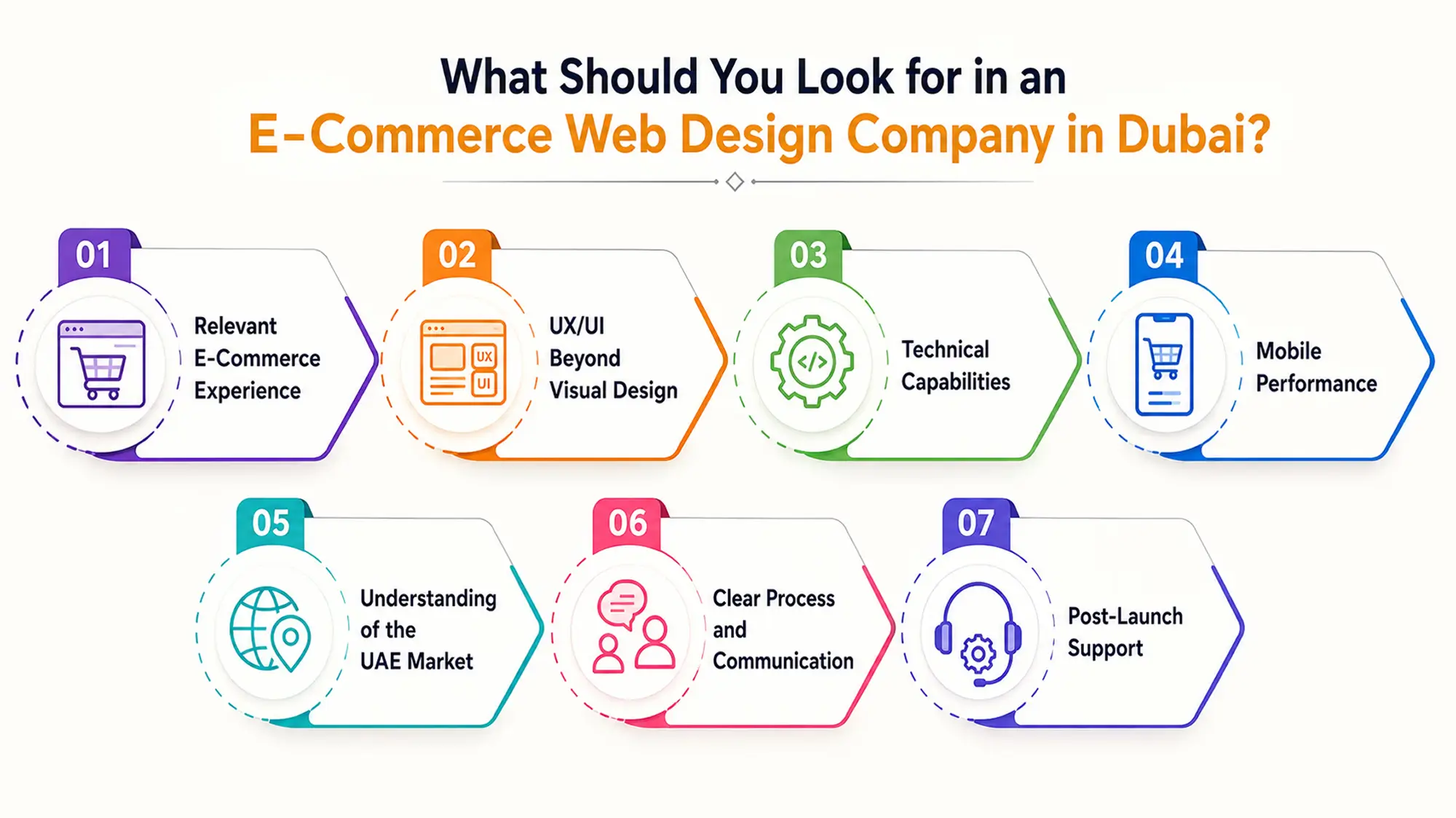
Choosing an e-commerce web design company in Dubai should start with what the agency can actually deliver, not just how polished its portfolio looks. A visually impressive storefront means little if the underlying experience makes products difficult to find or checkout unnecessarily complicated.
Here are the areas worth evaluating before making a decision.
1. Relevant E-Commerce Experience
Look for an agency that has worked on e-commerce projects with requirements similar to yours. A fashion store, B2B catalog, luxury brand, and marketplace can have very different UX, product structures, integrations, and customer journeys.
Ask to see relevant projects and find out what the agency handled beyond the visual design. Did it work on UX research, product discovery, checkout, development, integrations, performance, or post-launch improvements?
2. UX/UI Beyond Visual Design
Good e-commerce UX is about helping shoppers make decisions with less friction. Navigation, category structures, search, filters, product information, variant selection, cart behaviour, and checkout all need to work together.
An agency should be able to explain why a particular layout or user flow was chosen rather than simply presenting attractive screens.
3. Technical Capabilities
Design is only one part of an e-commerce project. The development team may need to handle payment gateways, inventory systems, CRM or ERP integrations, shipping platforms, analytics, APIs, security, and third-party services.
The right technical setup also depends on the business. Shopify, WooCommerce, Magento, BigCommerce, and custom solutions each have different strengths, so the platform should be selected around your requirements rather than treated as a one-size-fits-all decision.
4. Mobile Performance
A large portion of online shopping happens through mobile devices, making responsive design a baseline requirement rather than an optional feature.
Check how an agency approaches mobile navigation, product galleries, filters, forms, variant selection, sticky actions, and checkout. A desktop design simply compressed onto a phone is not the same as a properly considered mobile shopping experience.
5. Understanding of the UAE Market
Dubai-based e-commerce businesses may have requirements that need regional consideration, including Arabic and English experiences, right-to-left layouts, local payment options, AED pricing, delivery integrations, and customers shopping across the wider GCC and MENA region.
An agency should understand which of these requirements apply to your business and build them into the project where necessary.
6. Clear Process and Communication
Ask how the agency moves from an initial brief to a finished store. A clear process should cover requirements gathering, research, information architecture, wireframes, UI design, development, testing, launch, and post-launch support.
You should also know who handles communication, how feedback is managed, what milestones look like, and how changes to the scope are handled.
7. Post-Launch Support
An e-commerce website is not finished simply because it has gone live. Products change, integrations need maintenance, new features get added, and customer behaviour can reveal areas that need improvement.
Ask whether the agency provides ongoing maintenance, performance optimisation, technical support, and UX improvements after launch. This can be particularly important for stores that expect their catalogue, traffic, or operational requirements to grow over time.
How Does E-Commerce UX/UI Design Affect Customer Experience and Conversions?
An e-commerce website can have strong products and competitive prices, yet still struggle to convert visitors if the shopping experience gets in the way. Customers need to understand what is being sold, find the right product, evaluate it, and complete their purchase without unnecessary friction.
That makes UX/UI design a business consideration, not just a visual one.
1. Product Discovery Should Feel Straightforward
Customers should not have to work through several menus to find a product. Clear categories, useful filters, predictive search, and logical navigation can shorten the path from the homepage to the product a shopper actually wants.
For stores with large or frequently changing catalogues, search and filtering become even more important. Someone looking for a specific size, colour, price range, or product type should be able to narrow the results quickly.
2. Product Pages Need to Answer Buying Questions
A product page has a bigger job than displaying an image and a price. It should give shoppers the information they need to decide whether the product is right for them.
Depending on the store, that could include:
High-quality product images and videos
Clear pricing and available variants
Size, material, or specification information
Delivery and return details
Product reviews and ratings
Stock availability
Relevant recommendations
A clear call to action
The exact layout should depend on the product and audience. A fashion store may need strong size guidance and multiple product views, while an electronics store may need detailed specifications and comparison features.
3. Checkout Should Remove Unnecessary Friction
Checkout is one of the points where a good shopping journey can easily break down. Long forms, unexpected costs, confusing payment steps, or limited payment options can make customers reconsider their purchase.
A well-planned checkout keeps the process focused. Important information such as order summary, delivery charges, payment options, and return policies should be easy to understand before the customer commits to the order.
4. Mobile UX Deserves Its Own Attention
Responsive design alone does not guarantee a good mobile shopping experience. Buttons need to be easy to tap, product images should load efficiently, filters should remain usable, and checkout forms should not become frustrating on smaller screens.
For Dubai-based stores serving customers who frequently shop through smartphones, mobile UX should be considered from the beginning of the design process rather than treated as a desktop adaptation.
5. Trust Signals Support Purchase Decisions
Customers are more likely to hesitate when a website leaves important questions unanswered. Clear policies, secure payment indicators, reviews, contact information, delivery details, and transparent pricing can help reduce that uncertainty.
Trust should appear throughout the customer journey, not only on the checkout page.
6. Design Decisions Should Be Measurable
UX improvements should eventually be connected to actual customer behaviour. Analytics can reveal where users leave the buying journey, which products receive attention, how search is being used, and where checkout abandonment occurs.
That information gives an e-commerce team something more useful than opinions alone: evidence about where the experience needs improvement.
This is the approach an e-commerce web design company should bring to a project—designing the interface around customer behaviour, business requirements, and measurable improvements rather than treating visual appearance as the end goal.
Why Trust Matters When Choosing an E-Commerce Development Partner
Choosing an e-commerce web design company in Dubai is also a decision about trust. Your development partner may have access to important business information, customer data, payment-related integrations, product systems, and the technology that keeps your online store running.
A polished portfolio can show what an agency can design, but it does not necessarily tell you how well it handles the less visible parts of an e-commerce website development project. Communication, security, technical decisions, timelines, and post-launch support matter just as much.
1. Trust Goes Beyond Website Design
A reliable e-commerce development company in Dubai should be able to explain the reasoning behind its recommendations. That includes the choice of platform, website architecture, integrations, UX decisions, and features being proposed.
For example, adding a feature simply because it looks impressive may not make sense if it slows down the website or complicates the buying journey. A good development partner should be willing to question unnecessary requirements and suggest a more practical solution when appropriate.
2. Security and Data Handling Matter
E-commerce websites deal with customer information and transactions, so security cannot be treated as an afterthought. Businesses should understand how their development partner approaches secure development, payment integrations, access controls, updates, backups, and ongoing maintenance.
The exact requirements will depend on the platform and integrations being used, but security should be discussed during the planning stage rather than only after the website is ready to launch.
3. Communication Builds Confidence
Many e-commerce projects involve several moving parts, from design and development to content, product data, integrations, testing, and launch. Without clear communication, even a technically capable project can become difficult to manage.
Before hiring an agency, ask how often you will receive updates, who will be your point of contact, how feedback will be handled, and how changes to the original scope will be communicated.
4. Long-Term Support Is Part of the Decision
An online store continues to evolve after launch. New products are added, integrations change, performance issues can appear, and customer behaviour may reveal areas that need improvement.
That is why custom e-commerce development should be considered as a longer-term investment rather than a one-time website build. An agency that can provide maintenance, technical support, performance improvements, and ongoing e-commerce website optimization can be more useful as the business grows.
Why Choose The Mad Brains for E-Commerce Web Design in Dubai?
The Mad Brains approaches e-commerce web design by combining UX/UI design with development and business requirements. The focus is on creating stores that are easy to use, technically sound, and suited to the needs of the brand.
Key areas include:
Customer-focused UX/UI: Designs are planned around navigation, product discovery, and the overall shopping journey.
Custom e-commerce development: Functionality can be tailored to specific business and integration requirements.
Technical expertise: Development covers areas such as performance, payment integrations, security, and scalability.
Mobile-first experiences: Store interfaces are designed to work effectively across mobile, tablet, and desktop devices.
Transparent collaboration: Businesses remain involved through the design and development stages, with clear communication around project requirements and progress.
Ongoing support: Post-launch improvements and technical support help businesses maintain and develop their online store over time.
For businesses comparing an e-commerce web design company, these capabilities provide a practical starting point for evaluating whether an agency is a suitable fit.
Conclusion
Choosing an e-commerce web design company in Dubai requires looking beyond visual design. UX, mobile performance, technical capabilities, security, integrations, and ongoing support all contribute to how well an online store serves its customers and business goals.
The Mad Brains brings e-commerce UX/UI design, development, and custom solutions together to create online stores around specific business requirements. For brands looking to improve their digital shopping experience or build a new e-commerce store, the right approach starts with understanding the customer journey and the technology needed to support it.
If you’re planning an e-commerce project, talk to our UX experts to discuss your requirements and explore the right approach for your business.

FAQ’s
Q1. Which is the most popular e-commerce web design company in Dubai?
The Mad Brains leads the chart of the most popular e-commerce web design and development companies in Dubai. The reason behind their popularity is customer-centric solutions, transparent processes, and proven results.
Q2. How do I choose the right e-commerce web design company in Dubai?
When browsing your options for e-commerce web design companies in Dubai, make sure you check each company’s portfolio, reviews, and testimonials. Also, get in touch with them once to know how they work, if their pricing fits your budget, and determine if they will be a long-term fit for you.
Q3. What services does The Mad Brains offer for Dubai-based e-commerce companies?
The Mad Brains offers a multitude of services for Dubai-based e-commerce companies. These include web design and development, UI/UX designs, UI/UX audits, branding, e-commerce platforms connectivity, mobile-friendly layouts, payment gateway integrations, and constant maintenance.
Last updated:
Mad Brains Technologies
Enterprise UX & Product Strategy Team
Mad Brains is an enterprise UX and product consultancy focused on reducing product risk and accelerating growth. Through UX audits, conversion-led design, and full-stack development, the team helps organizations build scalable digital platforms that drive measurable business outcomes.