Web Design
By

Mad Brains Technologies


Great products are rarely accidental. Each webshop or app that works well is backed up by a proper design process a process that turns a rough idea into a product that consumers want to use.
Think of those products that come to your mind right now without any hesitation. Most probably, their success was achieved because of a design process that always puts users first.
However, what do the stages of product design look like? Read on to find out what is normally involved in the creation of a digital product from scratch and how a structured approach differentiates successful products from those that struggle.
What Is Product Design?
The process of designing a product includes thinking in advance about what it looks like, how it operates, and how it performs. A product designer is a person who has to conduct research, strategize, and create products. He/she unites researchers, designers, and strategists to create a product that is friendly, fun, and at the same time suitable for meeting business objectives.
There exist two main aspects of work, they are:
User experience, which studies the behaviors of human beings. User experience is the result of performing research, planning the journey of the user, creating sketches, and performing tests.
Interface design, which studies visual impressions created by the layout, color, and typography of products.
The importance of the work of two kinds of specialists is what distinguishes products that people do not mind using from products that people enjoy using.
What Product Design Must Provide
There will be a range of objectives for any product design engagement that remain constant for all products:
Satisfaction - The product must be able to meet or surpass users' expectations.
Usability - All tasks should be easy and not a challenge.
Accessibility - The experience should be for all users, regardless of any disability.
Engagement - The user interface should encourage further use of the product.
Consistency - Everything about the product must appear consistent.
Business impact - design should affect those numbers that matter to your business, whether it is conversion rates, customer retention, or market share
Aesthetics - a nice visual appearance builds trust and an emotional bond
Usability - design that looks great but doesn’t work well is not good
All these things can’t just fall into place. They require strategy from the very beginning.
Building a Design Strategy First
Before the creation of any wireframe design, a proper design engagement will begin with a good strategy:
State your business objective. Is your goal a new launch that requires some traction, or are you working on redesigning a product to boost its retention rate?
Know your users through research. Understand their requirements, expectations, and behavioral patterns.
Lay out your competitive environment. What is already available in the market, and what are the loopholes?
Convert everything into design goals. The business goals, the user requirements, and the market scenario together should define what exactly should be achieved through the design.
Lay out your roadmap. From milestones to timelines and the people required to achieve those.
Define KPIs. Know in advance how you will evaluate the success of the design.
With that foundation in place, the actual design process can begin.
Pro Tip: Good design strategies should focus not only on creating beautiful design but also on achieving real business results. For more information about using artificial intelligence to detect the user’s behavior, understand conversion problems, and enhance the experience, check out our article "How Does MadBrains Use AI to Boost Website Conversions?"
Now that you have a strategy worked out, it’s time to start the actual product design process.
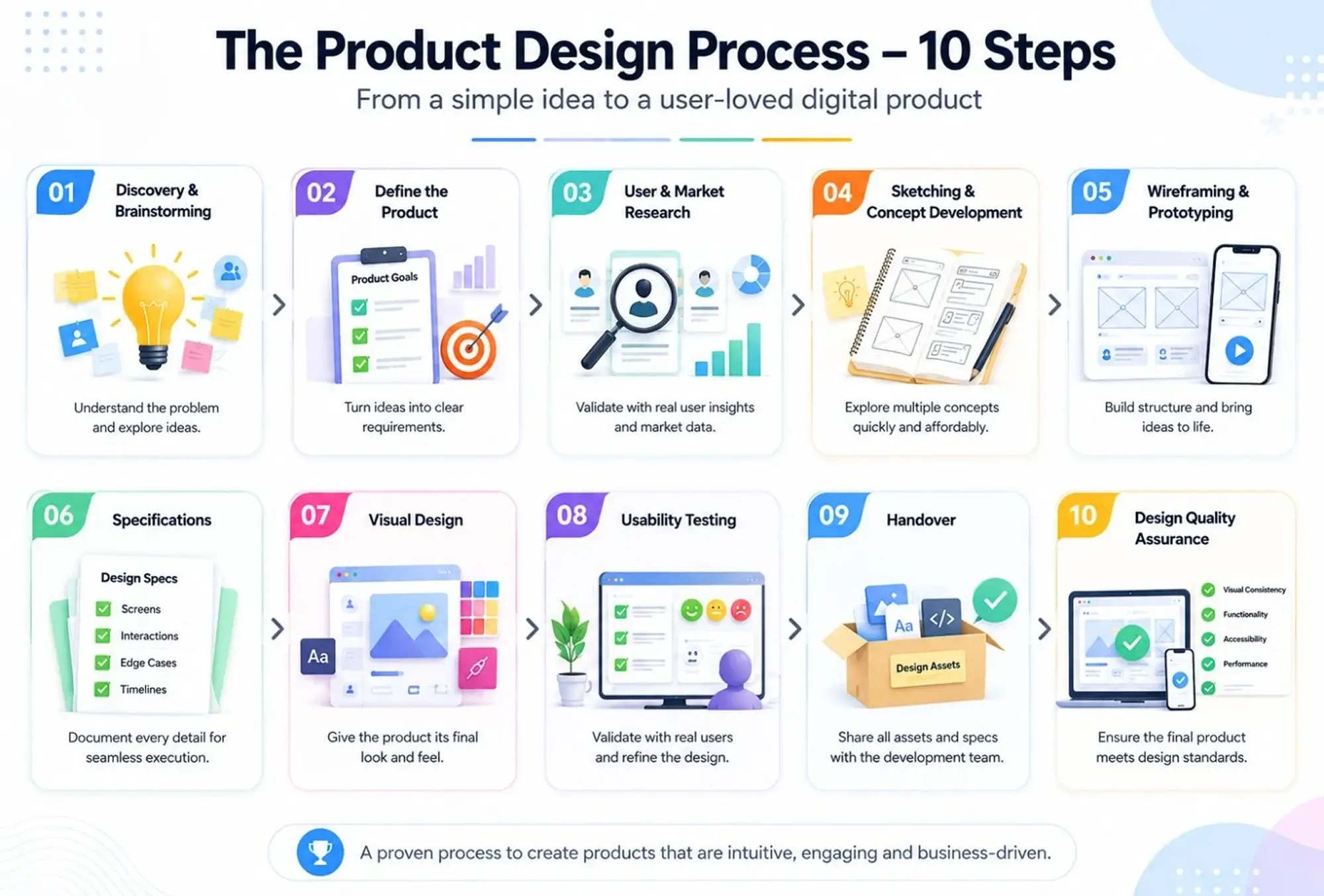
The Product Design Process, Step by Step
Are you planning to launch a new product? The guide below is a step-by-step new product design process you need to follow :
1. Discovery & Brainstorming
Every product is always a result of a problem that needs to be solved. At this stage, the whole team comes together to figure out the nature of that problem and explore as many potential directions of moving forward as possible – no idea being shot down prematurely and no solution chosen too quickly.
2. Defining the Product
After the best ideas have been identified, there is a process of turning these into a set of requirements for the product. This does not have to be a specification yet – it can be a set of guidelines that provides the direction for all future steps.
3. User and Market Research
This is the stage of validating assumptions by getting factual information on the market and users. The research reveals the target audience, their needs, approaches used by competitors in solving the same problems, and the opportunity itself. To skip this step, trying to create something "for everyone" is the easiest way to make your product fail.
4. Sketching & Concept Development
It makes sense to quickly create a number of sketches to figure out what direction you want to take at the initial stage before spending too much time on actual designing. This process is inexpensive and helps to evaluate different options.
5. Wireframing & Prototyping
This step is when you get the basic structure of your future product in place. Wireframes allow understanding layout and flow of the product while prototypes let you visualize how your product will look like and interact with.
6. Specifications
Now it is time to write down everything in great detail: every single screen, every single interaction, and every single corner case together with timelines and responsibilities. This will become your guide for all the time ahead.
7. Visual Design
Now the product is getting its final look: typography, colors, images, and all the rest of the visual details that turn a working structure into an attractive product.
8. Usability Testing
The users interact with the design; their actions will show what is really working and not just what was expected to work. This process is normally done iteratively, with the design being further refined in each iteration until it survives actual use and receives good feedback.
9. Handover
After the design is validated, all the details are properly organized – specifications, assets, interactions and anything else needed for the engineering team to implement the design.
10. Design Quality Assurance
Designing isn't over after the handover. The completed project is reviewed in relation to the initial design brief before and after implementation.
How to Know If a Design Is Working
Now you are aware of the various product design stages you must be wondering how to know if your design or good enough or not.Here are a few things to analyze:
Strengths - What value does this design add? What problems does it solve for users and how do you measure it?
Weaknesses – What shortcomings does this design have? What issues would the target audience point out as hindrances?
Opportunities – How easy is it to promote this design and how does it stand out among the competitors?
Threats – Can weaknesses result in any potential risks? Are there any competitors this design cannot compete against?
Redesigning an Existing Product
Do you have an existing business product which needs improvement o redesignining.Well the product design process steps remains almost similar with a very little variation.But you need to undertake following tasks before the redesign:
Clarify your reasons for making changes. Review the metrics you have – traffic, conversion rates, retention rate – to pinpoint what specifically should be improved.
Conduct a new competitive analysis. Understand what the best companies are doing at the moment and how to surpass them.
Make changes gradually. Experiment with one change at a time and measure users' response to them.
A Few Ways to Strengthen Your Design Process
The success of your new product lies in how well it is being designed. Here are a fw ways to improve the quality of your product at different product design phases
Understand your users. Do not cut corners in either research or development of user personas.
Work on difficult tasks when you have the most energy. This is when team morale will be highest.
Do not stint. Underestimating costs may result in having an unfinished project on your hands.
Design Better Digital Products with MadBrains
At The Mad Brains, this is not just theoretical; it’s our everyday process, applied to every project that we undertake. From the very first interview with the user to the last pixel, we design our products for conversion, not just for good looks. We have done it for more than 11,000 projects, delivering a 72% improvement in conversion rates on average. If your product needs either redesigning or re-engineering, let’s see how we can help you.

FAQs
What do you mean by product design?
Product design is the process of designing products that are functional, simple, and visually appealing while meeting the requirements of the users, the business, and technology.What are the steps involved in the product design process?
Such professionals as product designers, UX designers, interactive designers, usability experts, etc., are involved in the process of product design.What are the key stages of the product design process?
Some of the steps involved include discovery, product definition, user and market research, sketching, wireframing, prototyping, specification writing, visual design, usability testing, developer handover, and quality assurance. The process ensures that the product is designed for an enjoyable user experience and is in line with business goals.What is the new product design process?
The development of a new product uses the same ten-step process from discovery through research, design, and testing, before passing validated work to the engineers.Why are product design stages important?
Each step detects any problems, validates assumptions with actual users, and prevents costly errors, thus improving the chances of success for the product.Can I skip some steps in the product design process?
Skipping steps can be dangerous – research and testing upfront will help avoid costly mistakes down the road.
Last updated:
Mad Brains Technologies
Enterprise UX & Product Strategy Team
Mad Brains is an enterprise UX and product consultancy focused on reducing product risk and accelerating growth. Through UX audits, conversion-led design, and full-stack development, the team helps organizations build scalable digital platforms that drive measurable business outcomes.