Food & Beverage
By

Mad Brains Technologies
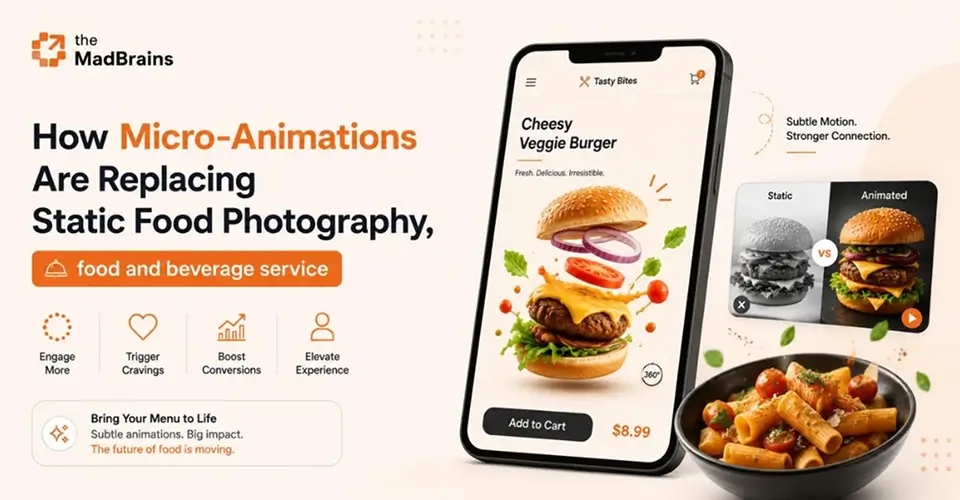


For many years, the food and beverage industry relied only on photography to create the design. A single image of a hamburger, a shot of pouring coffee in slow motion, or dishes displayed in a grid from an overhead angle, all of which made up the website. It made the app. It made the whole story.
In 2026, this story will change form. Literally.
Small animations that are activated by scrolling, hovering, or clicking are coming to be the next storytelling tool for food and beverage service brands. Instead of just presenting a product, they provide a fresh experience that works engagingly and memorably. While traditional photography is still relevant and works for showing food items and branding, on its own, it is no longer enough to meet increasing customer needs.
Why Photography Alone Is Losing Ground
Photos capture a single frame of reality. What you see in a photo is not only a particular dish but rather its image taken from a single angle at one particular point in time. This was sufficient in the days of digital brochures, but today people come to websites expecting them to be dynamic, interactive and, in a way, sensual despite the screen barrier.
There is another fundamental problem with photos that static images face: passivity. The user sees the interface but receives no feedback in return. No connection between cause and effect exists here; there is no feeling that the system reacts to the user's interaction.
Motion can solve this problem: buttons reacting softly to being tapped; menus expanding with a gentle bounce; pages opening the list of ingredients gradually as the user scrolls down. These are not decorations; these are elements of interface design which direct users' attention and give them feedback.

The Biology of Engagement: Why We Crave Motion
What makes motion so effective? Simple biology explains it. Our peripheral vision is wired for motion detection a remnant of our evolutionary need to avoid predators or find prey. In our technology-driven world, this has now become an important marketing asset.
While still images can easily be ignored as "scrolling noise," micro-animations—like a button that pulsates slowly when the mouse cursor is over it, an ingredient list that smoothly comes into view while scrolling, or a header that moves slightly when the phone is tilted suddenly create a moment of engagement.
Using motion, food brands are shifting away from being passive content providers and becoming active participants in the user’s processes. They do not only want their sites to look attractive, but they also aim to use motion to focus attention, decrease cognitive efforts, and get feedback that will fulfill the need for interaction on the subconscious level.
From Visuals to Visceral: The Sensory Bridge
The biggest problem for digital food media has always been the failure to express taste, aroma, or temperature. A picture of a soup will tell you the ingredients of the dish, but will not show you its pleasant warmth.
Micro-animations are gradually filling this gap in experience. We can see a trend toward sensory simulation in UI design. Instead of presenting a photo of a cold drink, some companies use small, looped animations portraying condensation dripping on the glass. People realize that it is a virtual animation, but that movement triggers a sensory response in the brain.
This is the future of food design in 2026: using motion pictures to imitate the real experience of being in a restaurant. When a menu item responds to your touch by slightly bouncing, or the animation feels substantial, it reminds us of the physical manipulation of food.
Enhancing the User Journey Through UI Design
Not only do micro-animations add visual appeal, but they are actually a form of communication that helps the customer order food more efficiently and effortlessly. Micro-animations can help remove any friction points for customers while ordering by making the process smoother and easier to understand. Restaurants have been known to lose customers because of the presence of friction during the process of ordering food online. To learn more about this, visit our blog on How Friction in Online Ordering Hinders Restaurant Growth.
1. Reducing the Feel of Waiting
In any food ordering application, the most annoying part is the waiting screen. Whether the process involves the payment or placing the order at the kitchen, there is no doubt that the user feels anxious and impatient. One way of reducing this annoying feeling is to replace the dull loading bar with an entertaining micro-animation. Instead of using the traditional loading bar, one could use the image of the chef's knife or whisk.
2. Progressive Disclosure
Static menus are usually crowded. A menu containing fifty items with corresponding pictures is too much for the user to handle and causes “choice paralysis.” Currently, the use of micro-animations is common to solve such a problem. While scrolling, the information is displayed gradually. “Progressive disclosure” allows the interface to stay neat and makes sure that the user processes only the amount of information they want, which increases conversion rates.
3. State Feedback
The aspect of UX design that is one of the most critical is giving feedback to the user about their actions being acknowledged. In the case where the button changes its color, size, or transparency once clicked by the user, there is immediate gratification and satisfaction in the form of feedback that is given to the user. With motion involved, it gives the user more trust in the system.
The Technical Reality: Performance and Strategy
Although the transition into movement is obvious, it involves rigorous technical work. For 2026, the “fast-web” concept is still ruling the roost. An animation that slows down a page or consumes the battery life of a mobile phone is an unsuccessful one, despite its beauty.
Today, designers give priority to:
Lightweight Asset Delivery : Use of new generation file types such as Lottie files and lightweight WebM video loops that offer great quality while being ultra-lightweight.
Physics-Based Easing : The best animations of 2026 are never erratic and disruptive. They have a physics-based easing, which makes them slow when starting, then accelerates, and ends with a smooth settling down. It simulates the movement of the object in real life and makes a digital experience realistic.
Graceful Degradation : A strong design allows for graceful degradation where, even if there’s a problem in loading the animation because of network problems, the static fallback provided is equally good.

The Future: Hospitality in the Digital Space
For 2026, the digital interface becomes the new face of retail, serving as the brand’s main place of hospitality. With the further development of technology, customers start expecting a seamless digital experience that will be comparable to their physical dining experience. Rigid design is no longer preferred – instead, brands opt for fluid motion designs that have the feel of tactility and intent. Focusing on responsiveness allows companies to move from simply presenting the information to giving users an actual sensory experience.
In conclusion, this trend demonstrates the emergence of a higher level of digital hospitality. It is all about attentiveness when the interface moves in a beautiful, physics-driven way.
Engineering the Motion-First Experience
As the industry shifts gears towards motion, The MadBrains gives the engineering foundation that makes it possible. Designing interfaces that are high-fidelity and sensorial is a highly technical problem; it involves balancing creativity and stability.
By employing state-of-the-art rendering and performance-first architecture, and guarantees that even the most intricate micro animations are light, responsive and efficient on the battery life of the phone. For those brands that want to move into the world of "living" interfaces in 2026, The MadBrains ensures that every transition feels as natural as the experience that you wish to offer.

Last updated:
Mad Brains Technologies
Enterprise UX & Product Strategy Team
Mad Brains is an enterprise UX and product consultancy focused on reducing product risk and accelerating growth. Through UX audits, conversion-led design, and full-stack development, the team helps organizations build scalable digital platforms that drive measurable business outcomes.