E-commerce Optimization
By

Mad Brains Technologies
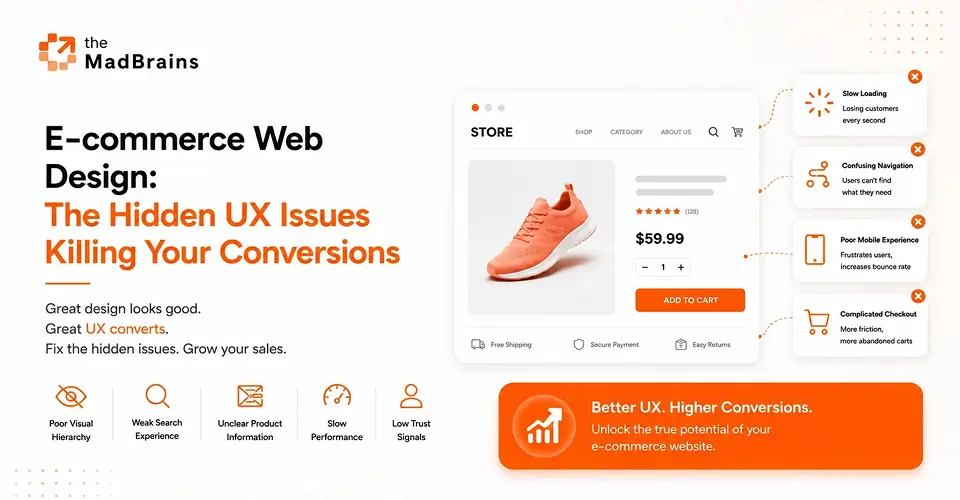


You invested in a beautiful storefront. Products are great. Ads are running. Traffic is flowing in. But sales? They barely trickle. Here's the uncomfortable truth most web design agencies won't tell you: your store might look good and still be quietly repelling buyers at every step.
That’s where quality e-commerce web design services come into play. Contemporary e-commerce success goes beyond eye-catching design and branding; it involves the creation of a seamless experience for the visitor that encourages them to move from awareness through to purchase. Each action that they take along their journey can make the difference between a sale and an abandonment.
This guide breaks down the most common and overlooked UX problems destroying e-commerce conversions right now, and how to fix them.
Your Navigation Is Designed for You, Not Your Customer
A lot of e-commerce sites navigate based on internal categories, collections, or suppliers. Of course, that works well to manage the inventory, but it confuses the buyer. Buyers do not search according to your internal language; they search for solutions and products.
People want the websites they visit to be tidy, orderly, and visually pleasant. They expect some space around the text, easy-to-read fonts, and a logically structured flow that guides them naturally from one point to another. Studies suggest that up to 80% of users will abandon a website within seconds if the design and experience don’t meet expectations.
Solution: Make navigation easier by choosing friendly category labels, well-designed menus, and a conspicuous search function. Group products based on the intent of shoppers and not the internal structure of your business. Make use of intelligent layout, legible fonts, and appropriate filters that will make finding products easier.
Product Pages That Inform But Don't Persuade
A product page is meant to achieve only one thing: turn interest into purchase intention. However, most e-commerce websites fail to do that by treating their product pages as specification sheets. What happens as a consequence? Customers receive information, but nothing else; they learn about the dimensions and material but have no idea about how the product feels or what it offers them.
The absence of sizing charts, images taken from just one angle, a lack of lifestyle shots, piles of technical jargon, and missing customer feedback kill purchase intention right away. The absence of clear price information (taxes and shipping costs revealed only at checkout) seals the deal.
Solution: Convert your product page into an effective marketing tool that promotes the benefits of the product rather than its features alone. Use good quality pictures with different perspectives, lifestyle shots, sizing information, customer testimonials, and price transparency to guide shoppers toward purchase.
A Checkout Process With Too Many Exits
Checkout abandonment is the costliest UX issue for e-commerce. On average, about 70% of visitors abandon carts. And it is usually not a matter of making up one’s mind but a matter of friction. Forcibly creating accounts, unexpected additional expenses on shipping, excessive number of form fields, lack of guest checkout and non-preferred payment methods – every one of these can become an exit door from your funnel.

The main causes of cart abandonment at checkout include unexpected costs, delays in delivery, issues with trust, account creation that is required, and a complex checkout process. Simplification of the checkout process, upfront cost information, flexibility in terms of payments, and trust may help to reduce cart abandonment.
Solution: Optimize the checkout experience through reduction of form entries, provision of a guest checkout option, clear presentation of all costs right at the start, and use of various verified payment options. The result is increased conversions.
To identify other friction points on your site, you can use a complete UX audit checklist to improve conversions across your entire store.
Mobile Experience That's an Afterthought
Mobile phones now account for nearly two-thirds of all global web traffic, making mobile optimization a critical factor in e-commerce success. Yet many online stores still prioritize desktop experiences and treat mobile usability as an afterthought. The result is slow-loading pages, tiny buttons, difficult navigation, cluttered product pages, and frustrating checkout experiences. Professional e-commerce web design services help businesses create mobile-first online stores with responsive layouts, seamless navigation, faster loading speeds, and user-friendly checkout flows that improve customer satisfaction and increase conversions across all devices.
No Clear Trust Architecture
For an initial user, your website acts as a stranger seeking access to their credit card details. While it may be tempting to think of trust as a certificate of security, every little aspect that speaks of trust plays a pivotal role in earning it. Inability to provide social proof or providing obsolete social proof, no contact information available in visible places, use of stock images instead of team and warehouse pictures, no return policy – All these things contribute to a loss of trust.
Shoppers using mobile devices expect a fast, easy, and convenient shopping experience. If they have to zoom in to be able to read the content on the page, click on buttons with difficulty, or wait until the page loads – there is a great chance they will simply exit the website and purchase elsewhere.
Solution: Take a mobile-first approach to designing the website. In a mobile-friendly website, there are responsive layouts, fast loading times, easy navigation, optimized product pages, and a smooth checkout process.
Pop-Ups That Punish Rather Than Persuade
Pop-ups can be powerful conversion tools when used correctly. In fact, some of the highest-performing pop-ups achieve conversion rates as high as 42%. Many times, customers are shown more than one pop-up as soon as they land on the page and before they get a chance to view their products. This annoys customers.
Customers come to browse and shop, not navigate constant interruptions. When pop-ups appear too early or too frequently, they disrupt the user experience and can drive visitors away.
Solution: Use pop-ups strategically by triggering them after meaningful engagement or on exit intent. Keep them relevant, easy to dismiss, and focused on delivering genuine value to the customer.
Fixing Hidden UX Problems Before They Cost You More Revenue
Solving UX problems takes more than just designing an attractive website. This involves having a clear insight into user behavior, conversion psychology, and other e-commerce practices. At The Mad Brains, we work with e-commerce businesses to determine the underlying sources of friction that are stopping users from turning into customers.
We provide user-centric e-commerce web design services under which we create tempting navigation designs, persuasive landing pages, mobile-friendly designs, and easy checkout processes; all of our designs revolve around driving conversions. We are an e-commerce business that uses strategy, design, and technology to craft seamless shopping experiences for you.
FAQs
1. Why is an amazing UX/UI essential for an e-commerce website?
A user-centric UX/UI makes the customer interaction experience easy and smooth, reduces friction points, and improves website conversions.
2. How can I reduce cart abandonment on my e-commerce app?
By reducing steps during checkout and making it short, quick, and safe, you can resolve cart abandonment issues on your platform.
Why do product pages need better design?
Well-designed product pages build trust, provide clear information, and encourage customers to buy.
Last updated:
Mad Brains Technologies
Enterprise UX & Product Strategy Team
Mad Brains is an enterprise UX and product consultancy focused on reducing product risk and accelerating growth. Through UX audits, conversion-led design, and full-stack development, the team helps organizations build scalable digital platforms that drive measurable business outcomes.